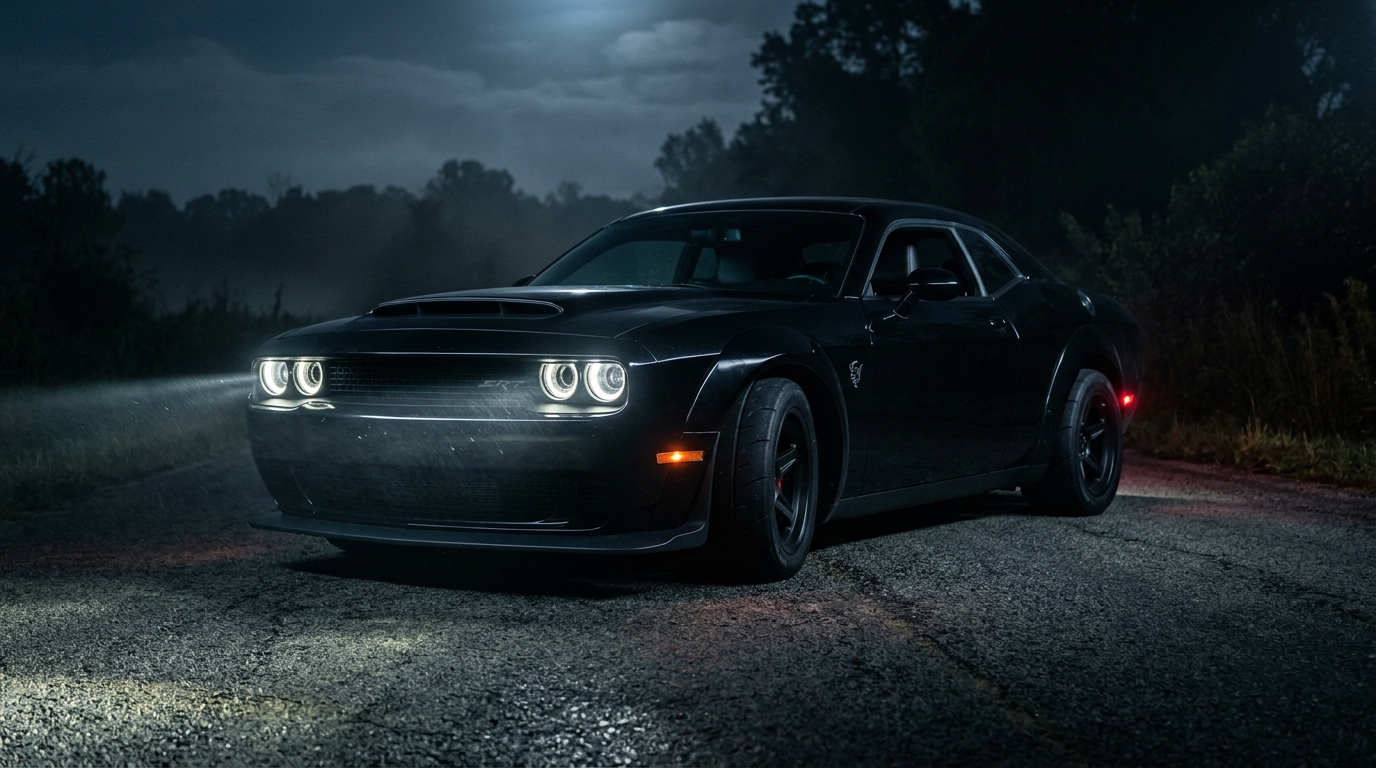
It is 1 a.m. at a dead-quiet drag strip, the floodlights are humming, and the only thing louder than the crowd is a supercharged 6.2-liter V8 idling like it resents being restrained. The 2018 Dodge Challenger SRT Demon was built for exactly this kind of night: one straight, one tree, and no mercy for the tires.
A Car Built Around the Strip
Dodge teased the Demon for months, famously dropping a 2017 New York Auto Show reveal that confirmed it as the world’s first factory-built production car with a legal quarter-mile time under ten seconds. The sealed claim: 9.65 seconds at 140 mph on 91-octane-compatible mapping with race fuel, certified by the NHRA as too fast to run without a roll cage. Dodge built just 3,300 units for the 2018 model year (3,000 for the US and 300 for Canada), each a nod to the lunatic drag-racing ethos of the Challenger’s muscle-car roots.
The headline number is 840 horsepower and 770 lb-ft of torque, but only when the car is fed 100-plus octane race fuel through the included Demon Crate (more on that below). On 91-octane pump gas, output drops to 808 horsepower and 717 lb-ft, which is still more than a Hellcat Redeye makes today. The 6.2-liter supercharged Hemi has a larger 2.7-liter supercharger than the Hellcat’s, spinning at up to 14.6 psi of boost, plus a unique 2.7-liter blower snout, upgraded fuel pumps, and a high-flow intake system that pulls cool air through the hood’s offset Air-Grabber scoop.
Driving the Demon After Dark
At night, the Demon’s character changes. The street seems to shrink around you, and every light you pass becomes a reminder of how few places exist where this car makes sense. The standard Challenger headlights throw an honest pool of light ahead, perfectly adequate for road use, but this is not a car you tour with at 80 mph for hours; it is a car you load onto a trailer, drive to a strip, and unleash.
Idle it in a parking lot and the sound is staggering. The supercharger whine is layered over a deep, rolling V8 burble that rattles windows from a hundred feet away. Dodge chose not to give the Demon a muted exhaust note, and at night, with fewer ambient sounds to compete, the effect is theatrical. Cold air also helps the engine, and the Demon’s Air Catcher headlight intake draws chilled night air straight into the induction path, a small but real benefit when you are chasing tenths on a cool evening.
The Demon features a Torque Reserve system, which holds the engine at high rpm against the transmission’s brake and stored boost, then uses an “Elapsed Time” launch strategy in combination with Line Lock and a TransBrake. In plain terms: you stage the car, flip into the drag-mode menu, and the Demon cocks itself like a spring. It will launch on its own sticky Nitto NT05R drag radials (315/40R18 up front on the factory 18×11 wheels) while the front end rises in a dramatic wheelie, a legitimate record at 2.92 inches of lift measured by Guinness.
The Crate, the Gear, and the Details
Every Demon shipped with the Demon Crate, a sturdy plastic-and-aluminum box packed with go-fast bits: a high-flow air filter, a set of lightweight front runner wheels with skinny tires, a tool kit, a Power Chiller kit, a custom-made carbon-fiber-pattern storage bag, and the keys to unlocking the full 840 horsepower. It is the sort of presentation that makes a Dodge Challenger SRT Demon feel less like a purchase and more like an event.
Under the skin, the 8-speed TorqueFlite automatic gets a stronger gearset and a transbrake function built specifically for drag launches. Dodge also deleted the passenger seat and rear seat as no-cost options on the build sheet to save weight, cutting about 54 pounds for the rear bench and 55 pounds for the passenger seat, and shaving the curb weight to roughly 4,280 pounds when you opt for both. The car lost its Hellcat side-view glass defrosters and fog lights to save mass, and gained a unique, wide-body fender flare package that stretches the width to 78.3 inches, including mirrors.
How It Rides
Beyond the strip, the Demon rides stiff but not savage. Bilstein adaptive dampers soften the edges, and the front brakes use six-piston Brembo calipers with 15.4-inch rotors, plenty to rein in the car on a cool-down lap. The steering is quick and decently weighted, and in the Street mode the car remains tame enough to commute in, though few owners will. The cabin is a mix of Hellcat comfort and no-nonsense minimalism: the optional deletes mean a bare interior that screams purpose, with a unique gauge cluster that shows drag-specific readouts like boost, G-force, and the ET timer.
The reality of nighttime ownership is hype and humility in equal parts. The Demon is a rolling celebration of American excess, but it is also a surprisingly polite daily car if you keep your right foot in check. Few cars are this loud, this fast, and this easy to live with, and that is precisely what makes it a legend. Dodge’s decision to make exactly 3,300 means collectors have already begun paying well above the $86,090 original sticker, with clean examples trading for six figures.
The Demon is a loud, glorious, one-year farewell to the era of unapologetic horsepower, and it still sets the standard for what a factory drag car should be. If you can find one, buy it, drive it, and take it to a strip on a cool night when the air is thick with possibility.