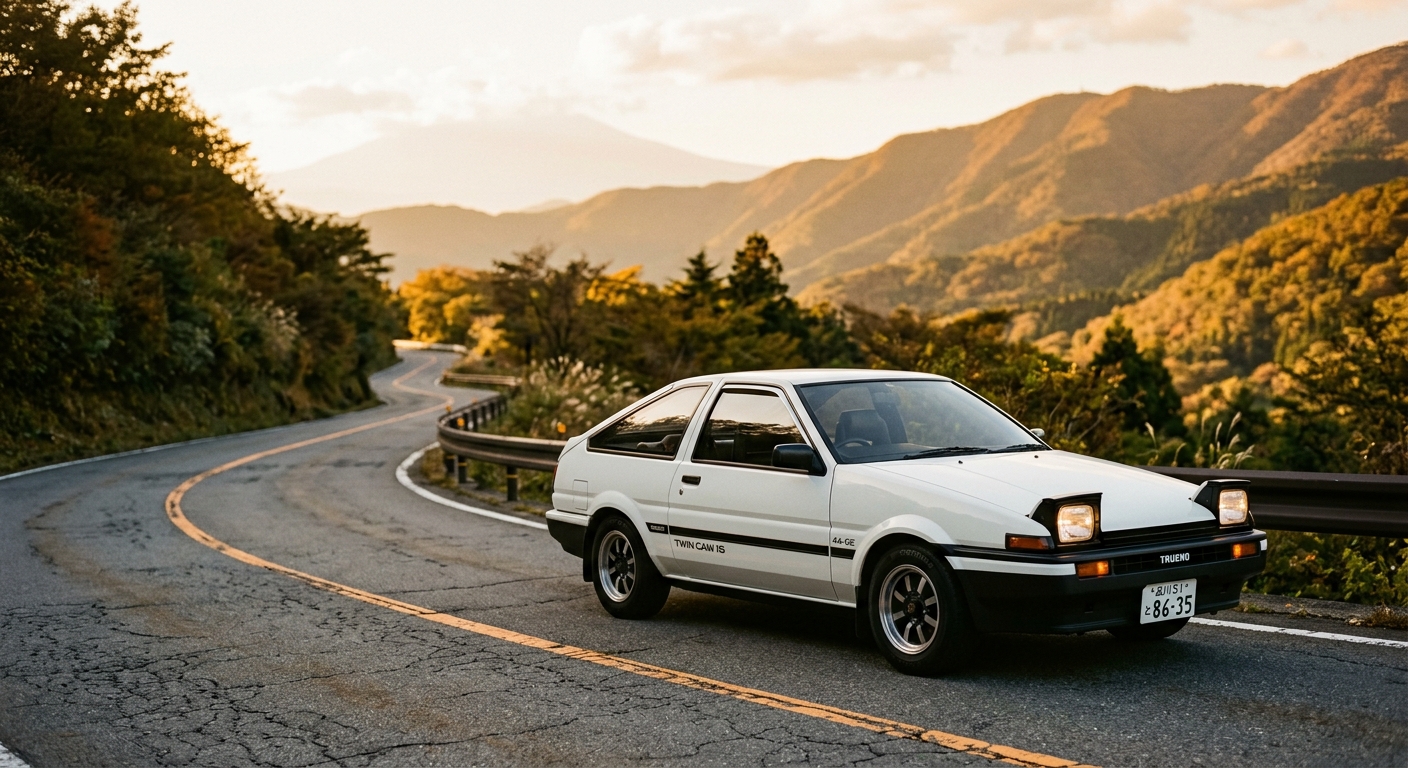
In the pantheon of automotive legends, few cars have achieved cult status quite like the Toyota Corolla AE86. What began as Toyota’s humble attempt to keep the Corolla sporty in an era of increasing front-wheel-drive economy cars would become the foundation of an entire motorsport discipline. The AE86 didn’t just spawn drift culture: it defined what a perfect driving machine could be when stripped of everything unnecessary.
The Last of the Lightweights
By 1983, Toyota faced a dilemma. The automotive world was rapidly shifting toward front-wheel drive for better fuel economy and interior space, but enthusiasts still craved the pure driving dynamics that only rear-wheel drive could deliver. Toyota’s solution was elegant in its simplicity: build one last rear-wheel-drive Corolla, make it as light as possible, and give it just enough power to be interesting.
The AE86 chassis, internally known as “Hachiroku” (Japanese for “eight-six”), became a masterclass in automotive minimalism. Weighing in at just 2,300 pounds, the car featured a perfectly balanced 53/47 front-to-rear weight distribution. The rear-mounted differential and well-tuned suspension geometry created a chassis that was forgiving at the limit yet responsive to driver input.
Heart of a Twin Cam
Under the hood sat Toyota’s 4A-GE twin-cam four-cylinder engine, a 1.6-liter powerplant that produced 112 horsepower in its initial form. While the numbers might seem modest by today’s standards, the engine’s character was anything but ordinary. The 4A-GE loved to rev, delivering its best performance above 5,000 rpm and singing all the way to its 7,500-rpm redline.
What made the AE86 special wasn’t raw power but the relationship between engine, chassis, and driver. The car demanded skill and rewarded precision. Understeer was virtually nonexistent, and the tail would step out progressively and predictably when pushed beyond the limits of adhesion. This characteristic would prove crucial to the car’s future reputation.
Birth of Drift Culture
In the mountains of Japan during the late 1980s, a driving technique called “drifting” was emerging among street racers navigating tight touge passes. The AE86’s balanced chassis, responsive steering, and predictable oversteer characteristics made it the perfect tool for this sliding discipline. Drivers like Keiichi Tsuchiya, later known as the “Drift King,” used AE86s to pioneer and perfect drift techniques that would eventually become a global phenomenon.
The car’s influence extended far beyond Japan’s mountain passes. When Initial D, the manga and anime series featuring an AE86-driving protagonist, captured global attention in the 1990s, the humble Corolla transformed from used car to cultural icon. Suddenly, enthusiasts worldwide were seeking out these lightweight Toyota coupes.
Driving the Legend
Behind the wheel, the AE86 feels remarkably modern despite its 1980s origins. The driving position is nearly perfect, with clear sightlines and intuitive control placement. The five-speed manual transmission shifts with mechanical precision, and the clutch engagement is progressive and predictable.
On twisty roads, the AE86 reveals its true character. The steering is communicative without being heavy, providing detailed feedback about front-tire grip levels. The suspension strikes an excellent balance between compliance and control, absorbing surface imperfections while maintaining precise body control during spirited driving.
Power delivery is smooth and linear, encouraging high-rev driving that maximizes the twin-cam engine’s potential. The car feels alive in a way that modern vehicles, with their layers of electronic assistance, rarely match. Every input matters, every correction registers, and the connection between driver and machine remains pure and unfiltered.
The AE86 proves that greatness isn’t always about numbers on a spec sheet but rather the intangible connection between human and machine. Toyota created something special here: a car that teaches you to drive better while rewarding every improvement in skill. Decades later, the Hachiroku remains the gold standard for pure, unassisted driving pleasure.