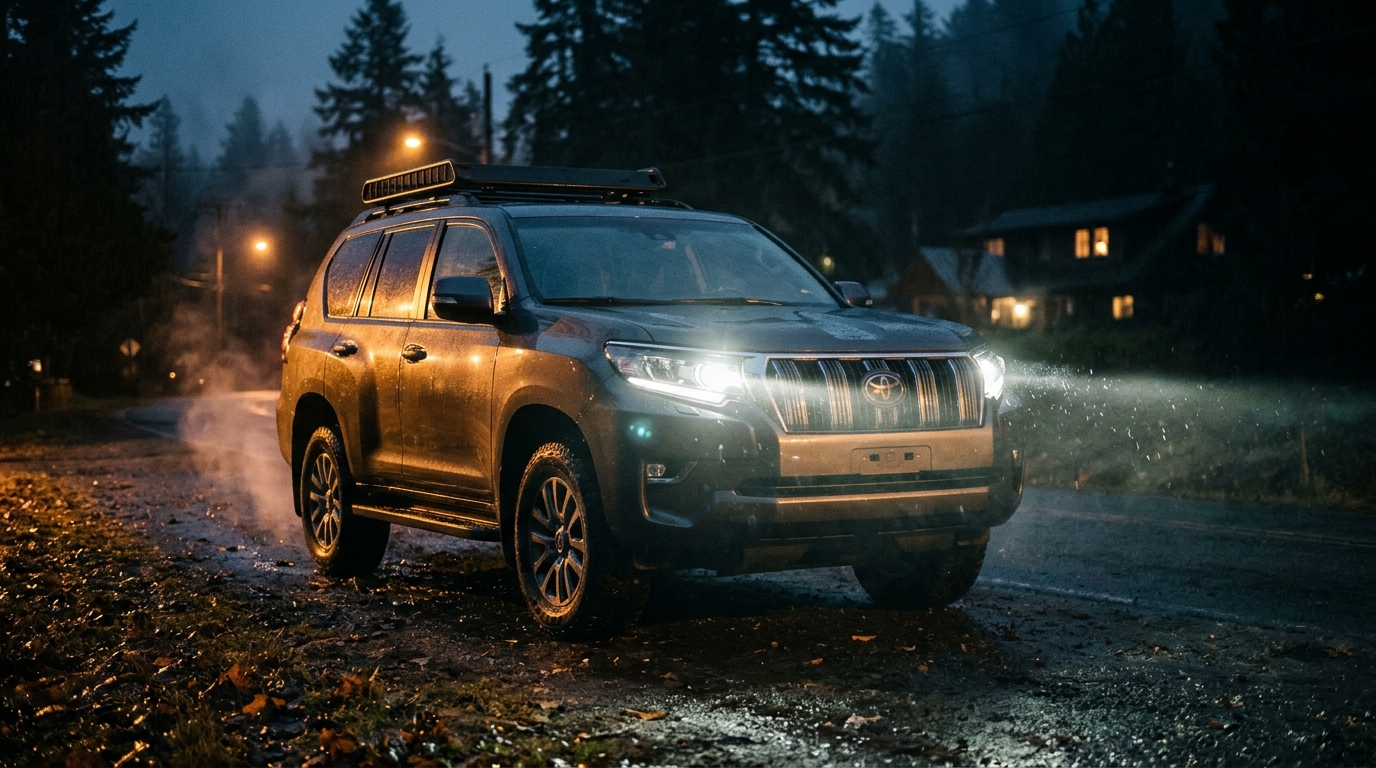
There is a particular kind of quiet that settles over a dirt road after midnight, broken only by tyres crunching gravel and a pair of headlights carving a tunnel through the black. The 2020 Toyota Land Cruiser Prado was built for exactly that moment, and it arrives in the dark like it has done this a thousand times before. We spent a long night with it to find out whether the J150’s reputation for unflappable competence holds up when the sun goes down.
A Legend Built for the Long Haul
The Prado name belongs to the lighter, more road-friendly branch of the Land Cruiser family tree. It traces back to the 70 Series Light Duty models of the 1980s, took the Prado badge in the 1990s, and the J150 generation debuted in late 2009. By 2020 it was a mature product, having received a significant facelift in 2017 and a handful of equipment updates since. It is sold as the Land Cruiser Prado in most export markets, while North America knows a closely related sibling as the Lexus GX. The Prado has never been about chasing trends. It has been about showing up, starting every time, and getting you home.
Headlights and the Night Shift
For the 2020 model year, Toyota’s 2017 refresh brought LED headlamps with a distinctive bar of daytime running lights, and on the higher trims these work alongside an automatic high-beam function. On a pitch-black highway the beam pattern is wide and even, with a clean cutoff that avoids dazzling oncoming traffic. The auto high-beam is smart enough that we left it on for most of the drive, though it occasionally hesitated when a car crested a distant rise. Away from street lighting, the Prado’s upright seating position and big glasshouse make it easy to read the road, and the high driving position lets you see well over the crest of a hill before you commit to it.
Inside, the cabin is lit in a calm amber that does not wreck your night vision. The instrument cluster is clear and legible, with a central multi-information display that shows the 4WD system status, fuel economy and tyre pressures. The infotainment screen has a dimming mode that keeps glare in check, a small thing that matters at 2 a.m.
The Sound of the Diesel in the Dark
Our test car carried the 2.8-litre four-cylinder turbo-diesel, the 1GD-FTV engine from Toyota’s GD family that replaced the older 3.0-litre unit in the Prado in 2015. It produces 130 kW and 450 Nm when paired with the six-speed automatic, and it is a refined, torquey motor that pulls hard from low revs. At night, with little traffic noise to mask it, you notice just how well it is isolated. There is a faint diesel thrum under load and a distant turbo whistle, but nothing intrusive. Cruising at 110 km/h the engine settles near 1,800 rpm and the cabin stays hushed enough for a normal conversation, which is a genuine blessing on a four-hour overnight run.
The 4.0-litre 1GR-FE V6 petrol is also available in many markets, and it delivers a smoother, more linear character with a pleasing growl at high revs. It is thirstier and less torquey down low, but if you want a naturally aspirated soundtrack for your midnight run, it is the one to pick.
Off the Tarmac After Dark
Turning off the highway onto a corrugated track is where the Prado earns its keep. The full-time four-wheel-drive system uses a Torsen limited-slip centre differential with a low-range transfer case, and higher grades add a rear locking differential. Toyota’s Multi-Terrain Select and Crawl Control let you dial in the right response for sand, mud or rock without any fuss. In the dark, where you cannot always judge the surface until you are on it, having the car manage wheel slip for you is a real confidence booster.
The suspension is a double-wishbone front and a four-link live axle rear, with Kinetic Dynamic Suspension System (KDSS) available on higher trims to improve both on-road body control and off-road axle articulation. The ride is composed over rough surfaces, soaking up washboard better than most body-on-frame rivals. It is not sporty, and body roll is noticeable in tight corners, but it feels planted and predictable, which is exactly what you want when visibility is limited.
Living With It
The seven-seat layout makes the Prado a genuine family hauler, and the third row is usable for kids or short trips. Fold it flat and you have a vast, practical load bay. Safety kit on 2020 models included Toyota Safety Sense features in many markets, with pre-collision warning, lane departure alert and adaptive cruise control, all of which are welcome during long night stints when fatigue creeps in. The Prado is not cheap, and rivals such as the Mitsubishi Pajero Sport and Ford Everest offer a lot of kit for less money, but few can match the long-term durability reputation that Toyota has earned over decades.
Editor’s verdict: The 2020 Land Cruiser Prado will not win a drag race or a styling contest, but at 2 a.m. on a lonely track it is the SUV you want under you. Quiet, composed and endlessly capable, it turns the darkness from a hazard into a non-event.