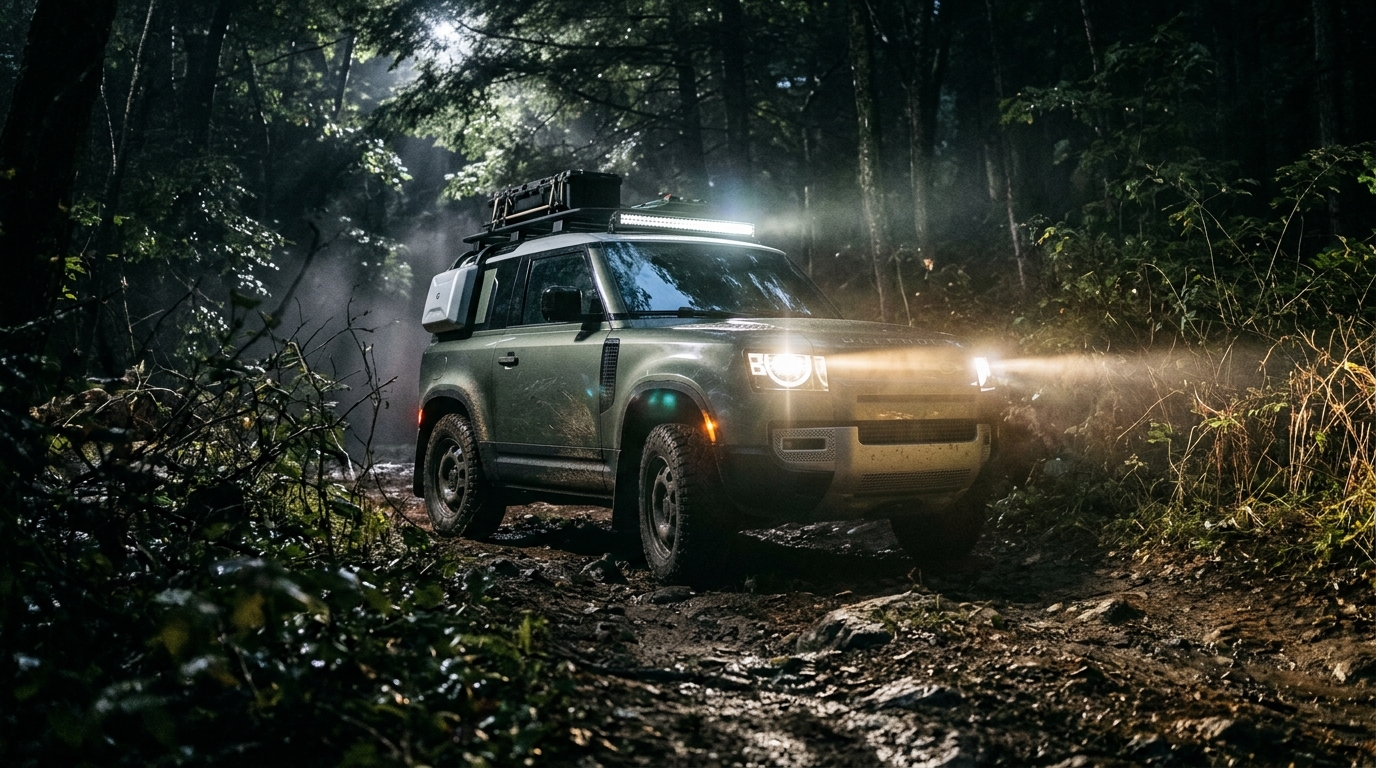
The trailhead is empty and the temperature has dropped to the point where the fog lights make visible cones in the air. In the dark, the Defender 90 looks like what it is: a short, upright block of aluminum and attitude, sitting on its haunches like it knows something you do not. We came out here after midnight to find out whether the reborn icon is as good in the pitch black as it is in the brochure.
A Legend Reborn, Shortened
The original Land Rover Series I debuted in 1948, and the Defender name arrived in 1990 to differentiate the utilitarian workhorse from the softer Discovery and Range Rover. Production ended in January 2016 after nearly seven decades. The new L663 Defender, revealed in 2019 and arriving in the United States for the 2020 model year, was a clean-sheet rethink: a unibody (Land Rover calls it the D7x architecture) built from aluminum, with fully independent suspension and a structure Land Rover claims is three times stiffer than a traditional body-on-frame design.
The 90 is the short-wheelbase three-door, and for 2021 it joined the lineup in the US, with a wheelbase of 101.9 inches and a stubby overall length of about 180 inches. It is the spiritual successor to the old Defender 90 that kids in the 1990s taped to their bedroom walls.
Lights Out: Visibility on the Trail
Night driving in a Defender begins with that upright greenhouse. The seating position is commanding, and the glass area is generous. The standard lighting on the 90 is LED, with a Matrix LED adaptive option on higher trims that keeps high beams on without dazzling oncoming traffic. On a black forest road, the beam pattern is wide and even, throwing light up and across the trail edges rather than just straight down the middle, which is exactly what you want when a deer decides to step out.
The party piece is Land Rover’s ClearSight Ground View, a camera-based system that projects a view of the ground ahead of the front bumper onto the central screen, effectively letting you see under the hood line. At night, with the underbody lit by the camera system, it makes tight rock steps and washouts far easier to read. The 3D Surround Camera and the Wade Sensing display, which shows water depth around the car when fording, round out a genuinely useful night-trail toolkit.
The Drive: Six Cylinders and a Quiet Rumble
Our test car carries the P400, a 3.0-liter turbocharged inline-six with a 48-volt mild-hybrid system. It produces 395 horsepower and 406 lb-ft of torque, routed through an eight-speed ZF automatic and a two-speed transfer case to all four wheels. The six is smooth in a way the old Td5 diesels never were, with a throaty, restrained burble at idle that carries beautifully across a silent night landscape. The mild-hybrid starter-generator smooths out stop-start behavior, and the electric supercharger-free setup relies on a single twin-scroll turbo, which keeps response linear.
Land Rover quotes 0-60 mph in about 6.1 seconds, which is startlingly quick for something this boxy, and the long-wheelbase 110 is only fractionally slower. Top speed is limited to around 119 mph. Those numbers matter less than the character: the throttle is progressive, the power builds without drama, and the steering is light but accurate. The short wheelbase makes the 90 feel nimble in tight switchbacks and a little more fidgety on the highway than its bigger sibling, where the shorter rear overhang can produce some pitching over expansion joints.
Off-Road After Dark
Standard air suspension on the P400 lets you raise the body to a maximum of 11.5 inches of ground clearance in off-road mode, and the approach, breakover, and departure angles are class-leading for a unibody vehicle: roughly 31.5, 26.7, and 37.7 degrees on the 90. The Terrain Response 2 system reads the surface and adjusts the powertrain, locking differential, and ESC calibration. On a damp, rutted night trail, the car feels remarkably planted. The electronically controlled center differential and available locking rear differential mean you rarely run out of traction before you run out of nerve.
Wading depth is rated at 35.4 inches, and the tall, rounded fenders and short overhangs make placing the Defender on a narrow trail intuitive even when your only references are two LED beams and a camera feed.
Living With It at 2 A.M.
Inside, the dashboard is an exposed magnesium crossmember dotted with Torx bolts, a deliberate nod to the original’s utilitarian honesty. The Pivi Pro infotainment system with its 10-inch touchscreen is fast and logical, and the optional front jump seat (a three-across front bench) is a quirky holdover from the original. Ambient lighting is subtle, and the digital instrument cluster dims cleanly so it does not wreck your night vision.
The honest downsides: the three-door body means rear-seat access is awkward and the cargo area is tight, at around 15.6 cubic feet behind the rear seats. Reliability reputation for early Land Rovers remains a shadow over the nameplate, and fuel economy hovers in the low twenties on the highway. But for a vehicle that costs less than a fully loaded Range Rover and out-trails nearly everything with a unibody, the 90 is a compelling, charismatic package.
The Defender 90 is proof that a modern icon can honor its roots without being trapped by them: quick on pavement, shockingly capable on the dark trail, and dripping with personality. If you can live with a tight cargo bay and the occasional reliability worry, it is the most charismatic way to spend a midnight in the woods.