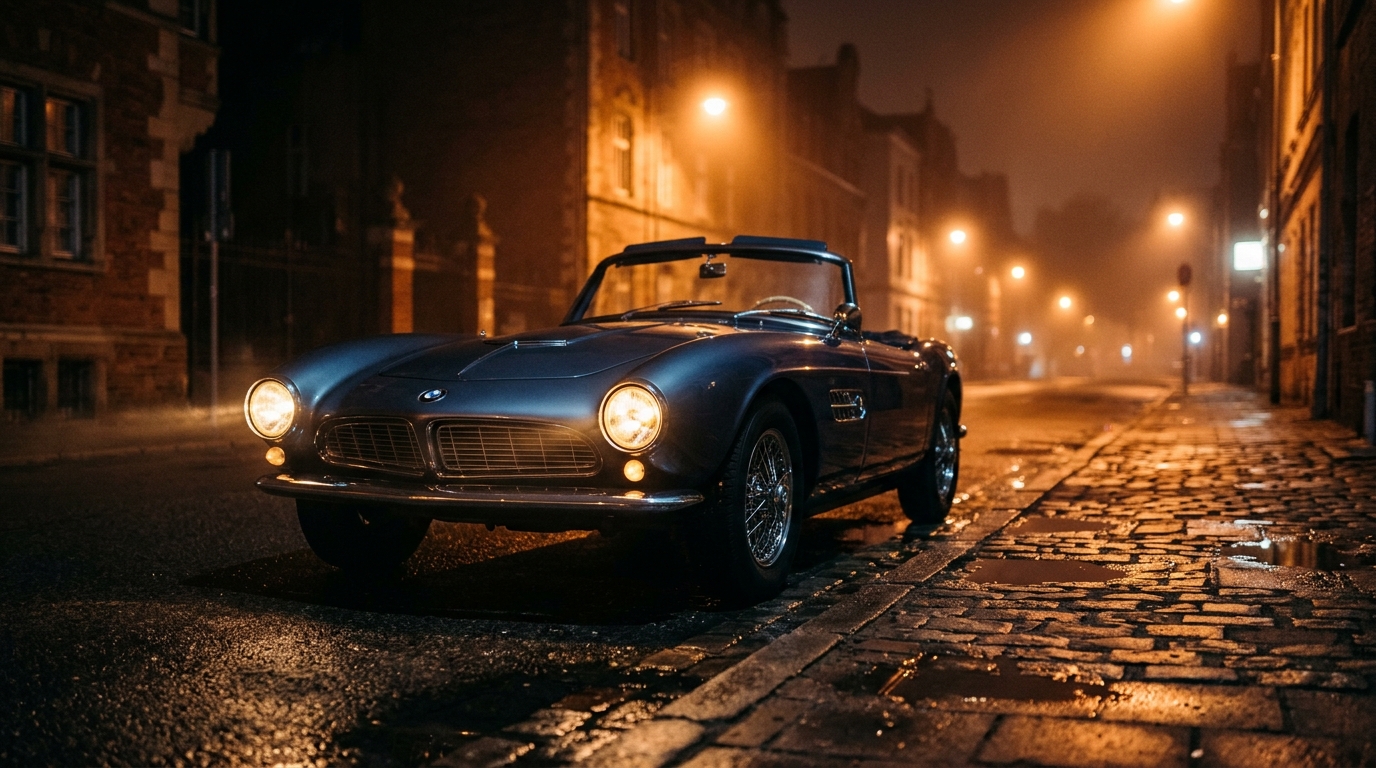
Imagine a deserted boulevard at midnight, wet from an earlier shower, with orange sodium lamps smearing their glow across a long, low bonnet. Then comes the sound: a soft, mechanical rumble from an all-aluminum V8 that seems to belong to another era entirely. That is the BMW 507, a car that has spent its whole life looking better after dark.
A Note on the Headline and the Facts
First, a correction to the legend. The BMW 507 never won Le Mans, and it was never really a racing car. It was a road-going luxury roadster, built from 1956 to 1959, and it was never sold new in 1966. Any 507 you see in a 1966 context is a used car, already seven or eight years old and, by then, a bit of a forgotten curiosity. BMW did race its lightweight 328 at Le Mans in the 1930s, and that is where the 507’s sporting reputation was borrowed from. The 507 is a night-time legend of a different kind: a car of premieres, film stars and late-evening glamour.
Birth of a Dream
The 507 was the brainchild of Max Hoffman, the New York importer who convinced BMW that America would pay handsomely for a V8 sports roadster. Count Albrecht von Goertz, a German industrial designer working in the United States, penned the body. It debuted at the 1955 Frankfurt Motor Show and entered production in late 1956. The shape was extraordinary: a long hood, a short tail, a delicate twin-kidney grille set low and wide, and flanks that curved with the confidence of a sculpture. Under the skin sat a steel tubular chassis with an aluminum body, a combination that kept weight down but made each car largely hand-built.
Under the Hood After Dark
The 3.2-liter all-aluminum V8 was derived from the engine in the BMW 502 sedan, retuned for the 507 with twin Zenith carburetors, higher compression and a hotter camshaft. It made around 150 PS (roughly 148 bhp) at 5,000 rpm and about 177 lb-ft of torque. Driven at night, this is where the car comes alive. The exhaust note is deep and smooth rather than raucous, a purposeful hum that bounces off tunnel walls and shop fronts. Roll on the throttle in second gear and the V8 pulls cleanly, with that distinctive mechanical whir from the valvetrain underneath.
Visibility and Atmosphere
Night driving in a 1950s car is an exercise in humility. The 507’s headlamps, sealed beams or period units depending on market, deliver a modest pool of yellowish light by modern standards, so you slow down and pay attention. The reward is the cockpit. The big wooden-rimmed steering wheel, the Veglia-style white-on-black gauges and the glow of the instruments create an intimate cabin. Visibility is generous with the top down, and the low seating position makes the world feel larger and the speeds feel higher than the numbers suggest.
How It Drives
A four-speed manual with a floor-mounted shifter handles the gears, and the 507 is geared for relaxed touring rather than pure sprinting. Two rear axle ratios were offered, with the taller option pushing top speed toward 220 km/h (about 137 mph) in the best cases. The steering is a worm-and-roller setup that feels lively but vague by modern standards, and the drum brakes, front discs were available later, ask for forward planning. This is a car to be driven smoothly, rolling through corners and letting the V8 do the work on the straights.
Hollywood and Ruin
The 507 attracted famous owners: Elvis Presley bought one while stationed in Germany, and the racing driver John Surtees owned another. But the car was a financial disaster for BMW. It cost roughly twice what Hoffman had hoped, around 26,500 Deutsche Marks in Germany, priced against the Mercedes 300 SL. Only 252 were built, and BMW lost money on every one. The 507, together with the expensive 502 sedans, nearly bankrupted the company and helped trigger the rescue that put the Quandt family in control. In a sense, BMW as we know it was born from the 507’s failure.
Living With One Today
A surviving 507 is among the most valuable BMWs in existence. Prices have climbed into the multi-million-dollar range, with the best cars reaching well over a million dollars and top examples much higher. Owning one means engaging with a specialist community and accepting that hand-built parts are scarce. Yet driving one at night, with the top down and the V8 warm, remains one of the great analog experiences of the classic world.
Editor’s verdict: The BMW 507 never won Le Mans and never made BMW a cent, but it remains one of the most beautiful roadsters ever built. Catch one rumbling under orange streetlights at midnight and you will understand why a failed product became a legend.