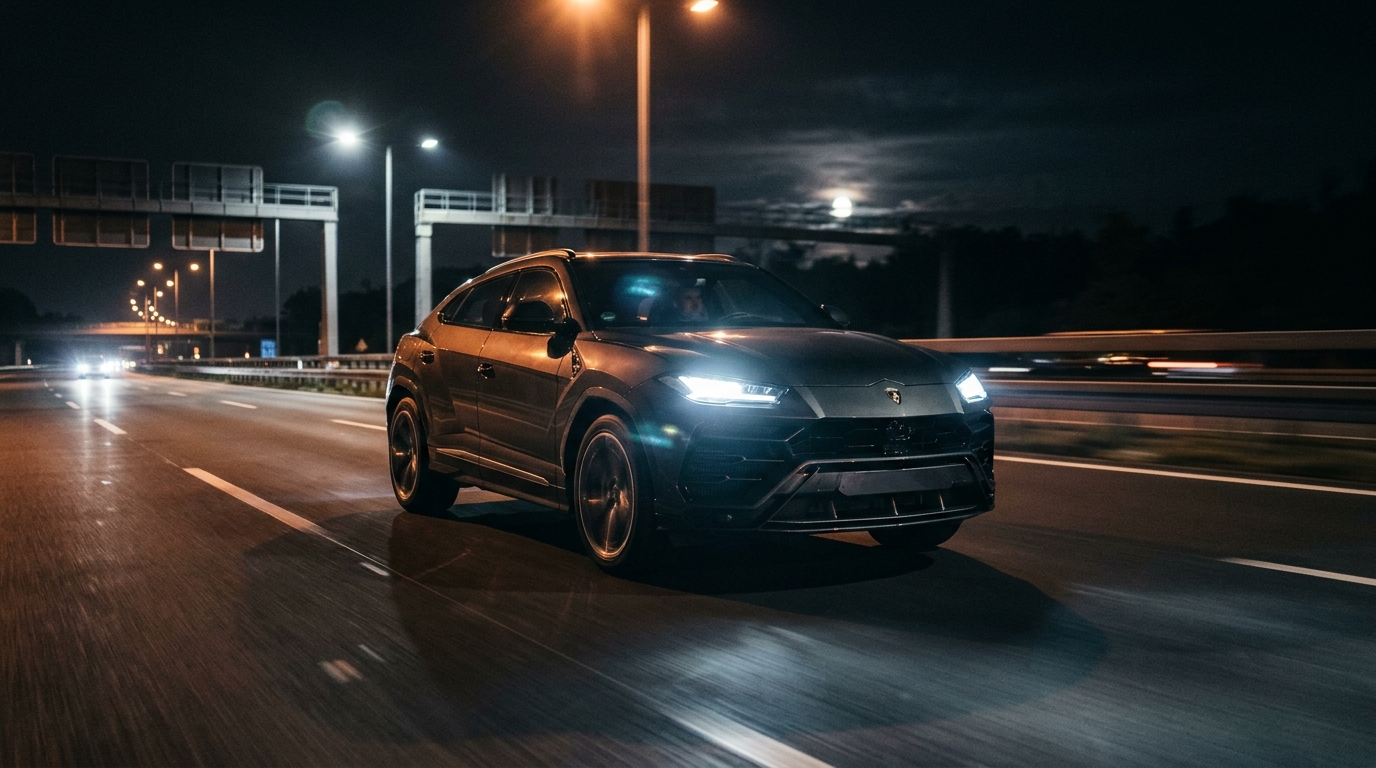
It is a few minutes past midnight, and the autobahn ahead is empty enough to feel like a private airstrip. The Urus’s Y-shaped LED headlights pull a hard white wedge out of the darkness, and the twin-turbo V8 settles into a low, simmering growl. This is the car that was supposed to be impossible: a Lamborghini with a rear hatch, five seats and a proper trunk.
A Raging Bull Goes Practical
The Urus is named after the aurochs, the extinct wild ox that is the ancestor of modern cattle and a fitting relative of the bull on Lamborghini’s badge. The name carries real history. Lamborghini first showed the Urus concept at the 2012 Beijing Motor Show, and the production car broke cover in December 2017 before reaching customers for the 2018 model year. It was not Sant’Agata’s first off-road idea either. The LM002 of the 1980s, the so-called Rambo Lambo, built the template for a Lamborghini that could ignore tarmac entirely.
The 2018 Urus is built on the Volkswagen Group MLB Evo platform, shared with the Porsche Cayenne, Bentley Bentayga and Audi Q8. That is hardly a secret, and it should not be a criticism. The shared bones gave Lamborghini a stiff, sophisticated foundation, and the company then fitted its own engine, tuning, aerodynamics and attitude on top. The business case was just as significant: the Urus roughly doubled Lamborghini’s annual sales within a couple of years, funding the rest of the lineup.
The Midnight Run
Night is where the Urus makes its best case. Cabin lighting is restrained, the digital gauge cluster glows in crisp reds and whites, and the fighter-jet flip-cover over the start button reminds you what you are driving. Thumb the button and the 4.0-liter twin-turbo V8 barks awake, then settles into a purposeful burble that echoes off tunnel walls and guardrails.
On an open, empty stretch of autobahn the Urus does what its numbers promise. Lamborghini claims 0-60 mph in 3.6 seconds and a top speed of 190 mph, making it the fastest production SUV when it launched. The power builds in a thick, relentless wave with almost no turbo lag, and at night the sensation is amplified because your peripheral vision strips away the details. Reflective road signs flick past in a blur, and the lane markings turn into a strobe.
The headlights deserve their own mention. The Urus uses a full LED setup whose daytime running light signature, a Y-shaped motif, is borrowed from the Aventador and Huracan family. At speed the beam pattern is wide and even, and the high-beam reach is excellent, which is exactly what you want when closing on a slower truck at 150 mph with nothing but darkness ahead. Matrix-style adaptive features helped here, keeping glare off other drivers while preserving range.
Handling After Dark
The Urus hides its mass remarkably well. Active anti-roll bars, rear-wheel steering and an adaptive air suspension combine to make a two-ton-plus SUV feel far smaller on a twisty road. Torque vectoring and the torque-splitting all-wheel-drive system send most of the power rearward, so the Urus feels tail-happy in a good way when you switch to Corsa mode. Night driving heightens the feedback: the steering is quick and weighted with real heft, and the carbon-ceramic brakes haul the car down with unnerving confidence from triple-digit speeds.
Mode selection matters. Strada is smooth and civilized, Sport sharpens everything, and Corsa unleashes the full character of the engine and chassis. The Terra, Sabbia and Neve modes cover off-road, sand and snow, a reminder that this is, at heart, a genuine SUV. Few owners will ever use them, but at 2 a.m. on a wet backroad, Neve mode is oddly reassuring.
Living With It
The Urus is a more livable Lamborghini than any before it. Rear seats fit adults, the trunk swallows real luggage, and the ride in Strada mode is genuinely comfortable on long motorway stints. The infotainment uses a dual-screen layout, and while it is not the best in the segment, it is serviceable. Fuel economy is exactly what you would expect from a 641-hp twin-turbo V8, so plan on frequent stops, ideally at a lit petrol station where you can admire the car in the glow of the canopy lights.
Editor’s verdict: The 2018 Urus proved a Lamborghini could have a back seat without losing its soul, and at midnight on an empty autobahn it feels every bit like a raging bull in a tailored coat. It is thirsty, expensive and unapologetically excessive, which is exactly the point. If you need one car that can do school runs by day and supercar sprints by night, nothing from that era did it better.