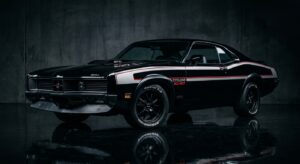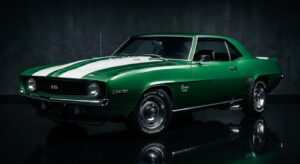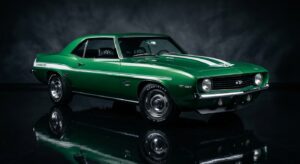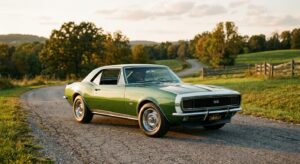
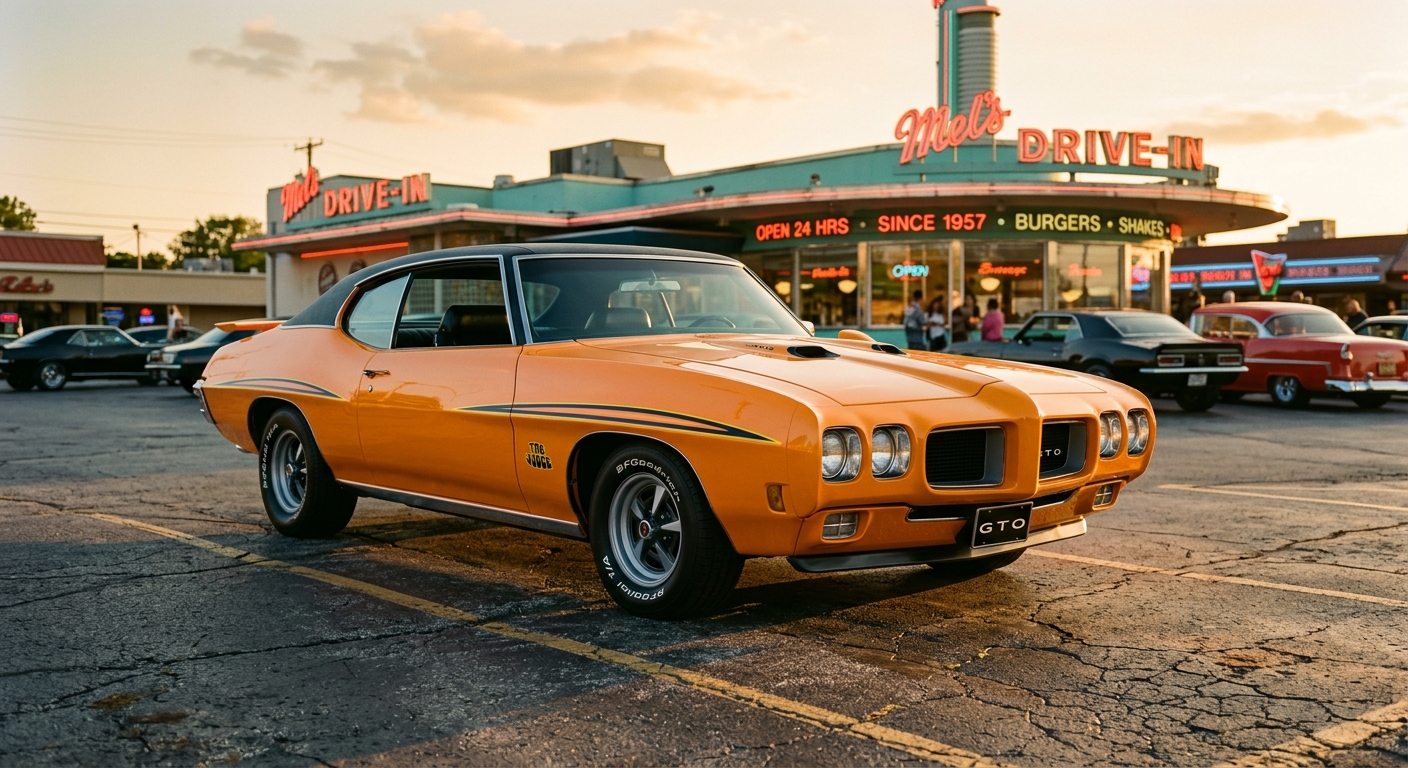
In 1970, when General Motors was still pretending to care about its 400-cubic-inch limit in intermediate cars, Pontiac created the most audacious loophole in automotive history. The GTO Judge wasn’t just a muscle car, it was performance theater, complete with psychedelic paint, cartoon decals, and enough horsepower to back up its outrageous personality. This was America’s answer to the question nobody asked: what if a muscle car could be even more ridiculous?
The Birth of Automotive Theater
Pontiac’s marketing department was clearly having too much fun in 1970. The Judge package, available on any GTO, transformed an already potent muscle car into something approaching automotive vaudeville. Named after the “Here come da judge” catchphrase from NBC’s Laugh-In, the Judge came standard in Orbit Orange paint with bold side stripes and cartoonish Judge decals that announced your arrival from three blocks away.
But beneath the circus act lived serious muscle. The base Judge came with Pontiac’s 366-horsepower 400-cubic-inch Ram Air III V8, a torquey beast that made the GTO one of the quickest cars on American roads. For those who demanded ultimate performance, the optional Ram Air IV package brought a more aggressive cam, better heads, and 370 horsepower that could shame many modern sports cars.
Driving the Beast
Behind the wheel, the Judge reveals its dual personality immediately. The steering is heavy and vague at parking lot speeds, the ride quality somewhere between firm and punishing. This isn’t a car built for comfort, it’s built for straight-line dominance and weekend drag strip glory.
Plant your right foot and the Judge transforms. The Ram Air IV engine delivers a volcanic eruption of torque that overwhelms the rear tires with authority. The soundtrack is pure American V8 symphony: a deep, rumbling idle that builds to a glorious roar under acceleration. The Muncie M22 “Rock Crusher” four-speed transmission requires deliberate, forceful shifts, but rewards proper technique with satisfying mechanical precision.
Acceleration is the Judge’s specialty. With 3.90:1 gears and the right driver, a Ram Air IV Judge could break into the 13-second quarter-mile range, making it genuinely quick even by today’s standards. The experience is visceral and immediate, all noise, vibration, and forward thrust that modern cars can’t replicate.
The End of an Era
The Judge’s timing was both perfect and tragic. Introduced for 1969, it hit its stride in 1970 just as the muscle car party was ending. Insurance companies were cracking down on high-performance cars, emissions regulations were tightening, and GM’s own corporate policies were shifting away from the horsepower wars.
Only 3,797 Judge packages were sold in 1970, making it rare even when new. Today, a clean Judge represents one of the most desirable muscle cars of the era, with Ram Air IV examples commanding serious collector money. The combination of outrageous styling, genuine performance, and historical significance has made the Judge a blue-chip classic.
The 1970 GTO Judge represents everything wonderful and absurd about the muscle car era. It’s loud, brash, unapologetically American, and faster than it has any right to be. Sure, it’s crude compared to modern performance cars, but that’s entirely the point. This is automotive rebellion in Orbit Orange paint, a glorious middle finger to sensible transportation that reminds us why cars can be so much more than mere appliances.