While Plymouth built Road Runners and Dodge crafted Challengers for the youth market, Oldsmobile took a different approach with their 4-4-2. This was muscle for the mature buyer, someone who wanted big block power wrapped in sophisticated styling and luxurious appointments. The 1971 model year marked a pivotal moment, representing both the peak of refinement and the beginning of the end for the original muscle car era.
The Last Hurrah
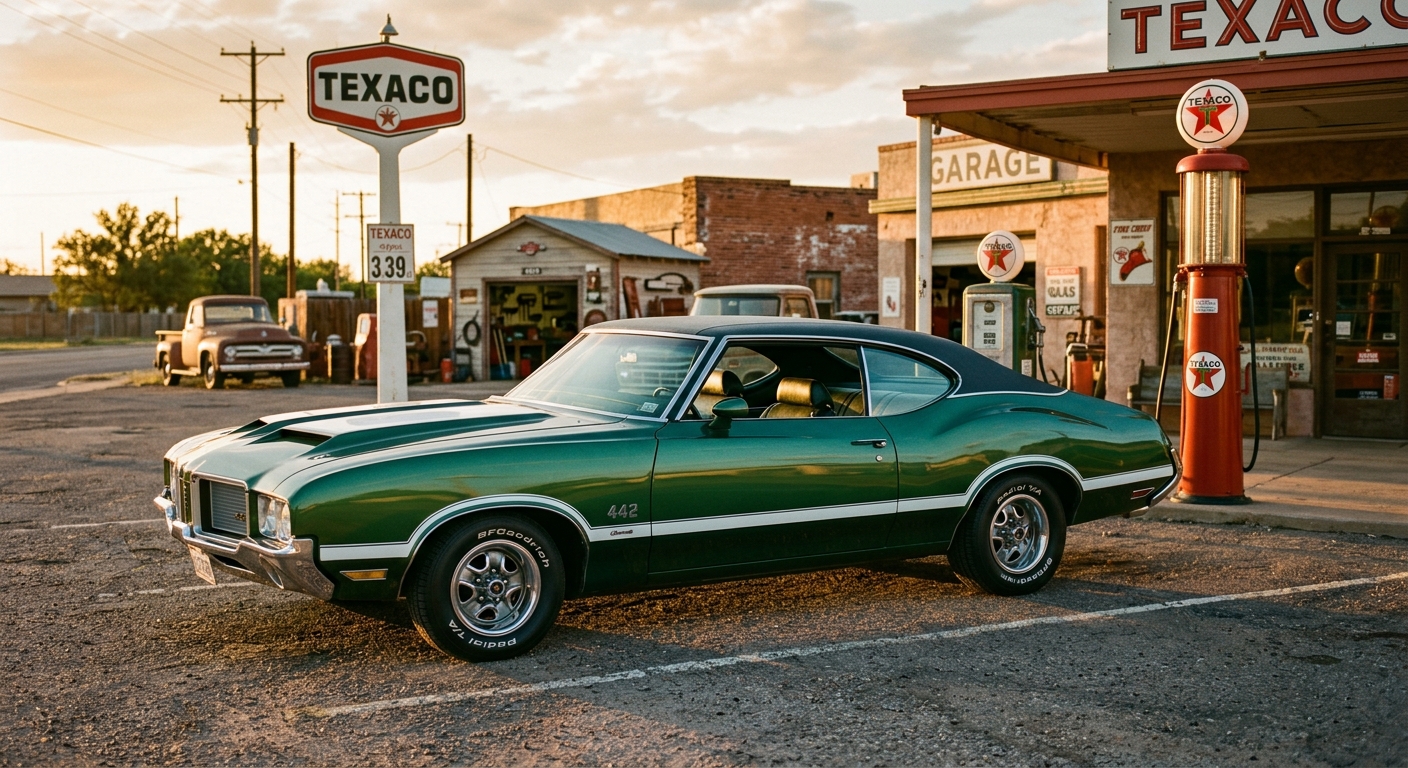
The 1971 Cutlass 4-4-2 arrived at a crossroads in automotive history. Federal emissions regulations were tightening, insurance companies were cracking down on high-performance cars, and the writing was on the wall for unlimited horsepower. Oldsmobile’s response was to create what might be the most civilized muscle car ever built, a machine that could humble a Chevelle SS on the street while providing the comfort of a luxury sedan.
Under the hood sat Oldsmobile’s legendary 455-cubic-inch V8, rated at a conservative 340 horsepower. Like most manufacturers of the era, Olds was sandbagging their power figures to appease insurance companies. In reality, this big-inch motor likely produced closer to 375-380 horsepower, with a mountain of torque that made highway passing effortless.
Sophisticated Power
What set the 4-4-2 apart from its corporate siblings wasn’t just the engine, but the entire approach to performance. The suspension used heavy-duty components tuned for both handling and ride quality. The steering was precise without being harsh, and the brakes were adequate for the car’s considerable mass. This wasn’t a stripped-down racer like an A-body, but a complete performance package that didn’t sacrifice daily drivability.
The interior reflected Oldsmobile’s upmarket positioning within GM’s hierarchy. Where a Chevelle SS might have basic bucket seats and minimal trim, the 4-4-2 offered rich upholstery, woodgrain accents, and a full complement of gauges. Air conditioning was common, as were power windows and other luxury amenities that were rare in the muscle car world.
On the Road
Behind the wheel, the 1971 4-4-2 feels substantial in a way that lighter muscle cars don’t. The big 455 delivers power in a smooth, linear fashion, building torque from idle and pulling strongly through the midrange. Unlike the frenetic, high-strung nature of small-block engines, the Olds big block generates thrust with an almost effortless quality.
The transmission options included a three-speed manual, four-speed manual, or Turbo Hydra-Matic automatic. Most buyers chose the automatic, which suited the car’s sophisticated character perfectly. The THM transmission shifted smoothly and featured a useful kickdown that made highway merging confident and quick.
Design Evolution
The 1971 model year brought subtle but significant styling changes to the Cutlass line. The front end was restyled with a more aggressive grille and revised headlight treatment, while the rear featured new taillights and cleaner lines. The result was a car that looked muscular without being overtly aggressive, maintaining the sophisticated image Oldsmobile cultivated.
The 4-4-2 package included distinctive hood scoops, special badging, and unique wheel covers or optional Rally wheels. These visual cues were understated compared to the wild graphics and spoilers found on some competitors, reflecting Olds’ preference for tasteful performance.
The 1971 Oldsmobile Cutlass 4-4-2 represents the final flowering of sophisticated American muscle, a car that could embarrass the competition at a stoplight while providing genuine luxury and refinement. Today, these gentlemanly bruisers are among the most undervalued classics from the muscle car era, offering big block thrills with upscale appeal at prices that still make sense.