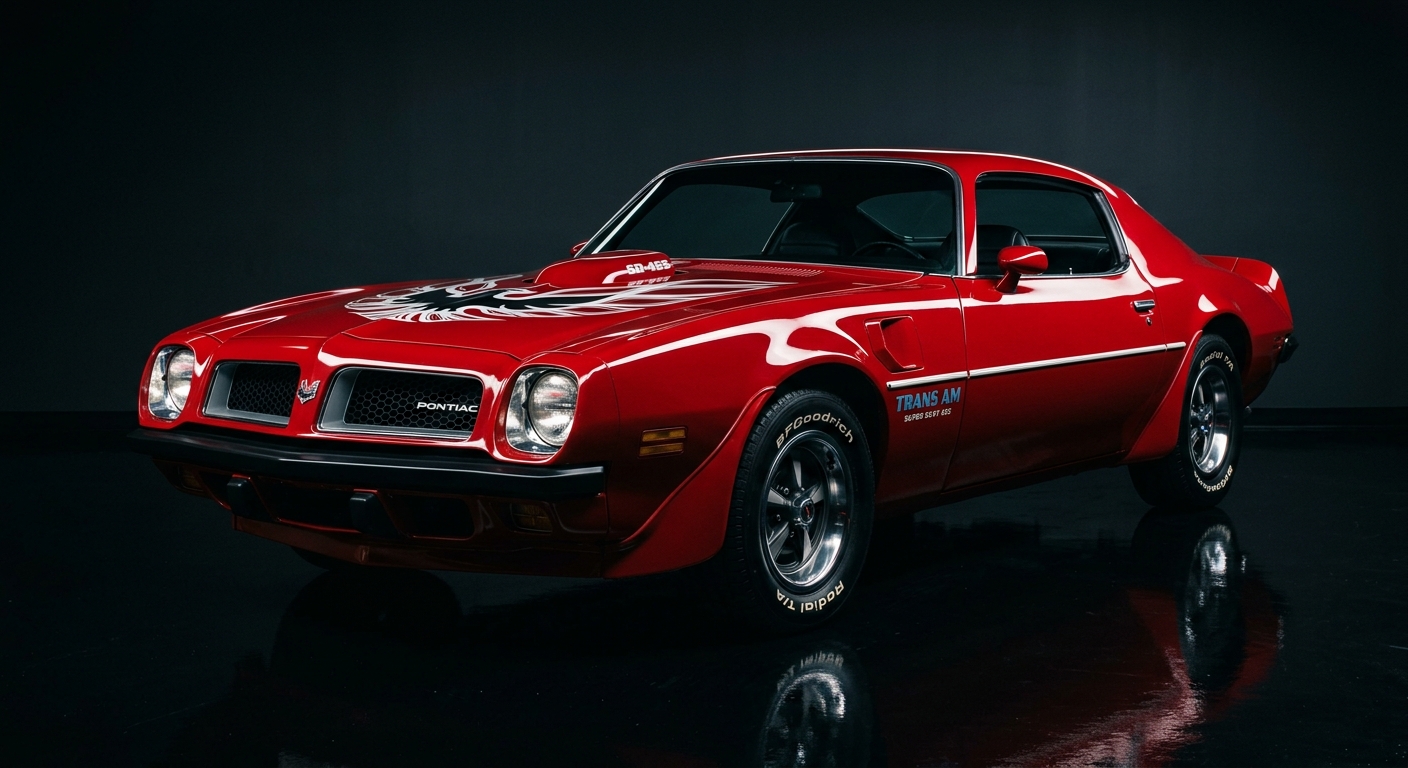
When Congress tightened emission standards and insurance companies declared war on horsepower, most manufacturers rolled over and accepted defeat. Pontiac, however, had one last ace up its sleeve. The 1974 Trans Am Super Duty 455 arrived as a defiant middle finger to the regulatory machine, packing legitimate muscle when everyone else was waving white flags.
The Last Stand of American Muscle
While other manufacturers were busy strangling their engines with primitive emissions equipment, Pontiac’s engineers pulled an all-nighter that would become automotive legend. The Super Duty 455 wasn’t just another big-block casualty of the malaise era. It was a purpose-built weapon designed to prove that American muscle wasn’t ready to roll over and die.
The numbers tell the story: 290 horsepower and 395 lb-ft of torque in an era when most “performance” cars were barely cracking 200 hp. But those were SAE net figures, measured with all accessories and emissions equipment attached. By the gross standards of the golden age, this thing was pushing closer to 370 horsepower. In 1974, that was borderline miraculous.
Engineering Rebellion
The Super Duty wasn’t just a regular 455 with a catchy name. Pontiac’s engineers completely redesigned the bottom end with forged pistons, shot-peened rods, and a forged steel crankshaft. The heads received larger valves and improved port work, while a hotter cam profile ensured this beast had the lungs to breathe.
Most importantly, the Super Duty was designed from the ground up to meet emissions requirements without sacrificing performance. While other manufacturers bolted on crude catalytic converters and watched their engines wheeze, Pontiac engineered compliance into the very DNA of their final big-block masterpiece.
Behind the Wheel of History
Firing up the Super Duty is like awakening a sleeping dragon. The idle has that unmistakable big-block lope, a rhythmic rumble that announces serious intent. The Turbo Hydra-matic 400 transmission clicks into drive with authority, and suddenly you’re piloting the last true muscle car of the original era.
The acceleration is brutal by any standard, but in 1974 it was absolutely shocking. Zero to 60 mph disappears in just 5.4 seconds, with the quarter-mile falling in the mid-13s. These were numbers that embarrassed supposed supercars of the day and left import sports cars choking on American dust.
More Than Just Straight-Line Speed
The Trans Am’s suspension setup, while primitive by modern standards, was sophisticated for its time. The rear anti-roll bar and carefully tuned springs gave the car genuine handling prowess to match its straight-line performance. The power steering was actually communicative, and the four-wheel disc brakes provided stopping power worthy of the acceleration.
Inside, the cockpit wrapped around the driver with purpose. The Formula steering wheel, Rally gauges, and genuine leather appointments created an environment that felt special without being ostentatious. This was a driver’s car, not a boulevard cruiser pretending to be fast.
Cultural Lightning Rod
The Trans Am had already achieved pop culture status thanks to “Smokey and the Bandit,” but the Super Duty models carried a different kind of mystique. These weren’t just cars; they were statements. Owning one meant you understood that something important was ending, and you refused to go quietly.
Only 943 Super Duty Trans Ams were built in 1974, making them instantly collectible. Pontiac knew they were creating something special, something that would mark the end of an era. Every Super Duty that rolled off the Norwood assembly line carried the weight of history on its shoulders.
The 1974 Trans Am Super Duty 455 stands as the definitive bookend to America’s golden age of muscle. It proved that even in the face of impossible regulations and cultural shifts, pure automotive passion could still triumph. This isn’t just a collectible classic; it’s a monument to the engineers who refused to surrender without one final, glorious fight.