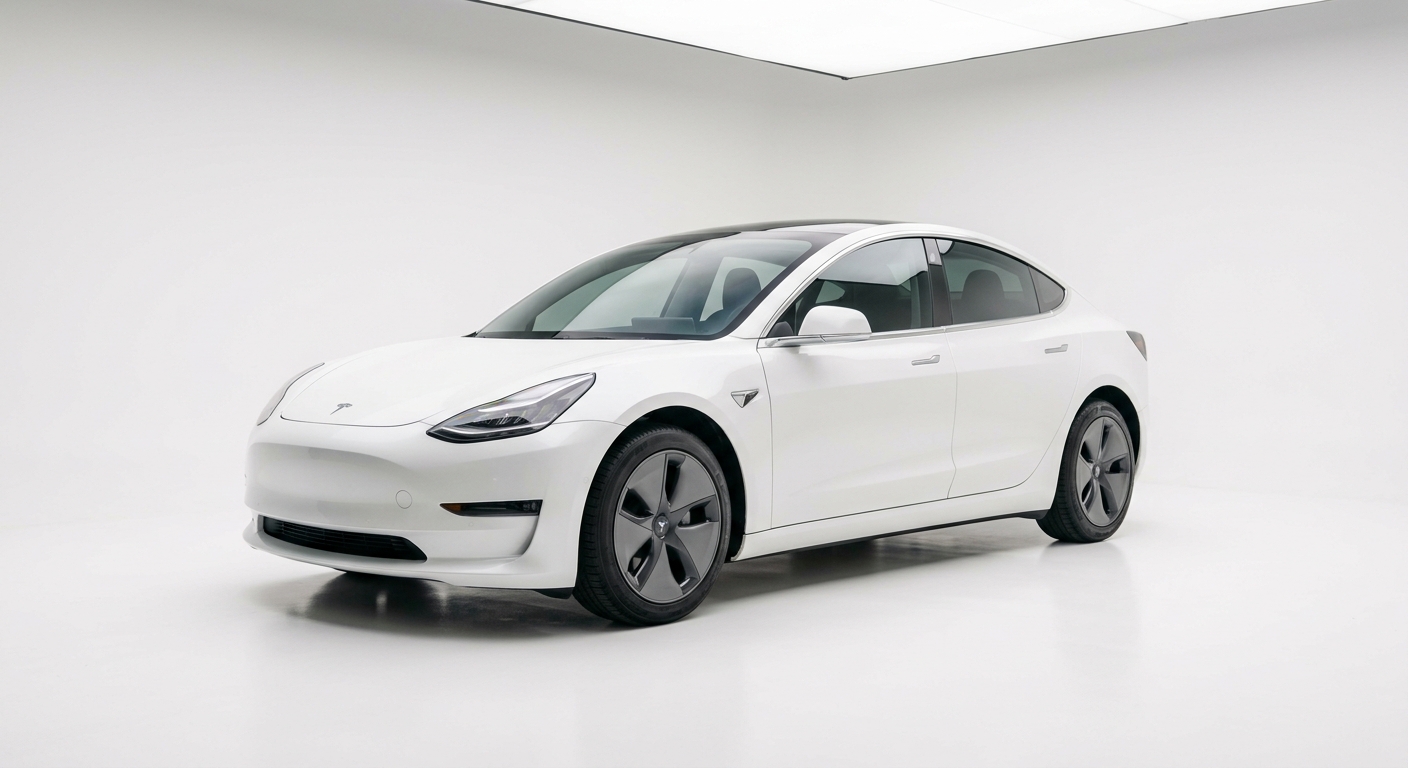
When the first production Tesla Model 3 rolled off the line in July 2017, it represented more than just another electric car launch. It was the moment electric vehicles transitioned from expensive curiosity to mainstream inevitability, with over 400,000 pre-orders proving that the world was ready for affordable electric mobility.
The Mission Critical Vehicle
Tesla had already proven electric cars could be desirable with the Roadster and Model S, but the Model 3 faced an entirely different challenge: making EVs accessible to the average buyer. Starting at $35,000 before incentives, the Model 3 needed to deliver on range, performance, and practicality while maintaining Tesla’s technological edge.
The result was a masterclass in efficient design. The Model 3’s minimalist interior, anchored by a single 15-inch touchscreen, initially polarized critics but proved intuitive in daily use. Everything from climate control to glove box operation runs through this interface, creating a smartphone-like user experience that felt revolutionary in 2017.
Performance That Changed Perceptions
Behind the wheel, the Model 3 Long Range delivers 310 miles of EPA-rated range and 0-60 mph in 5.1 seconds, figures that silenced skeptics who questioned whether an affordable EV could match gasoline cars for real-world usability. The instant torque delivery creates a driving experience that feels fundamentally different from internal combustion engines, with seamless acceleration that never requires waiting for gear changes or turbo lag.
The low center of gravity, thanks to the floor-mounted battery pack, gives the Model 3 handling characteristics that belie its 3,552-pound curb weight. The car rotates willingly through corners with minimal body roll, while the regenerative braking system can be adjusted to provide one-pedal driving in most situations.
Technology Integration
Beyond the drivetrain, the Model 3 introduced Autopilot as standard equipment, with eight cameras and twelve ultrasonic sensors enabling semi-autonomous highway driving. While full self-driving remained a future promise, the Model 3’s over-the-air update capability meant the car could literally improve while parked in your garage.
The Supercharger network, expanding rapidly in 2017, addressed the charging infrastructure concerns that had previously limited EV adoption. With over 1,000 Supercharger stations operational, long-distance travel became genuinely viable for the first time in an affordable electric car.
Production Hell and Triumph
The Model 3’s launch wasn’t without drama. Tesla’s “production hell” saw manufacturing delays and quality control issues as the company scaled from boutique manufacturer to mass producer. Early cars suffered from panel gap inconsistencies and interior rattles, but subsequent improvements addressed most concerns while maintaining the core appeal.
Seven years later, the Model 3 stands as the car that proved electric vehicles weren’t just the future, they were ready for the present. Its combination of technology, performance, and practicality created a template that every manufacturer now follows, making it arguably the most influential car of the 21st century. The revolution didn’t just arrive with the Model 3; it came with a full charge and 310 miles of range.