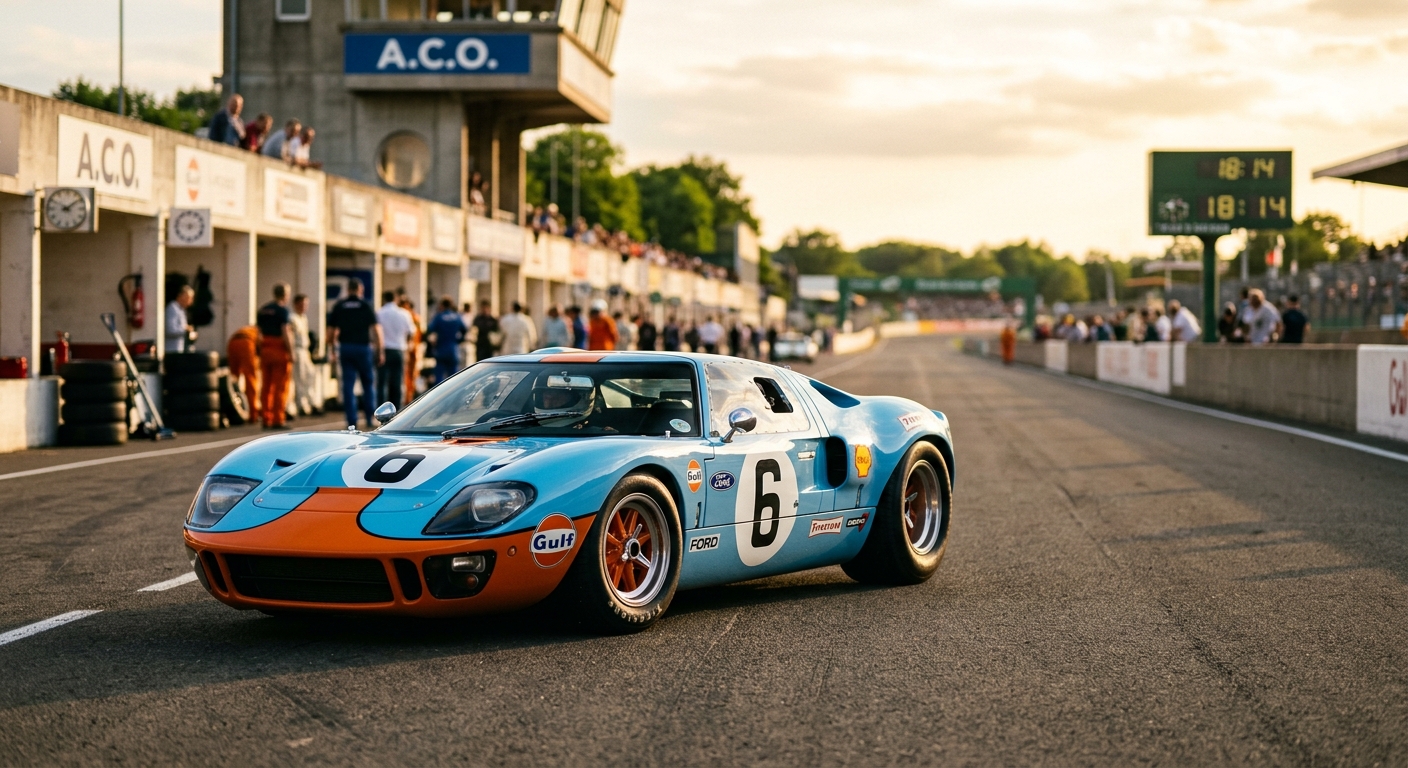
In the pantheon of automotive legends, few cars carry the emotional weight of David versus Goliath quite like the Ford GT40. Born from Henry Ford II’s wounded pride after Enzo Ferrari spurned his acquisition attempt, this mid-engine missile was America’s declaration of war on European racing supremacy. What emerged wasn’t just a race car, but a rolling testament to American determination and engineering prowess.
The Birth of a Giant Killer
The GT40 story begins in 1963, when Ford’s attempt to purchase Ferrari fell apart at the last moment. Enzo’s rejection wasn’t just business, it was personal, and Henry Ford II’s response was swift and uncompromising: build a car that would beat Ferrari at Le Mans. Ford Advanced Vehicles in England, working with American muscle and British chassis expertise, created something unprecedented in American automotive history.
The result was a car that looked like it was carved from a single block of purpose. At just 40 inches tall (hence the name), the GT40 hugged the ground with predatory intent. Its mid-mounted small-block V8 represented a radical departure from traditional American front-engine layouts, while the sophisticated chassis borrowed heavily from European racing knowledge.
Engineering Marvel
Under that impossibly low hood sat a 289 cubic inch Ford V8, initially producing around 350 horsepower. But the GT40 wasn’t about raw power alone, it was about total integration. The lightweight steel monocoque chassis, advanced aerodynamics, and sophisticated suspension created a package that could match European exotics for finesse while delivering distinctly American reliability.
The driving experience was nothing short of revelatory for its era. This wasn’t a converted street car with racing aspirations, it was a purpose-built racing machine that happened to be street legal. The steering was immediate and precise, the brakes were massive by 1960s standards, and the engine delivered power with a ferocity that few contemporary cars could match.
Le Mans Conquest
The GT40’s racing pedigree speaks for itself: four consecutive Le Mans victories from 1966 to 1969, including the famous 1-2-3 finish in 1966 that finally silenced Ferrari. These weren’t lucky victories, they were the result of methodical development and an uncompromising commitment to winning at the highest level of international motorsport.
What made the GT40 special wasn’t just its speed, it was its completeness. While many American performance cars of the era were fast in straight lines but crude in corners, the GT40 could dance through technical sections with European sophistication while still delivering knockout punch on the straights.
The Ford GT40 represents something rare in automotive history: a car that achieved exactly what it was designed to do, then transcended those achievements to become something greater. This is American automotive engineering at its most focused and determined, a rolling middle finger to anyone who thought Detroit couldn’t build a world-beating sports car. Today, it stands as the definitive proof that with enough will and resources, any automotive mountain can be conquered.