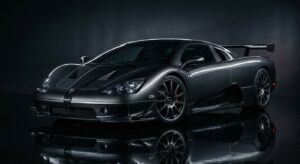
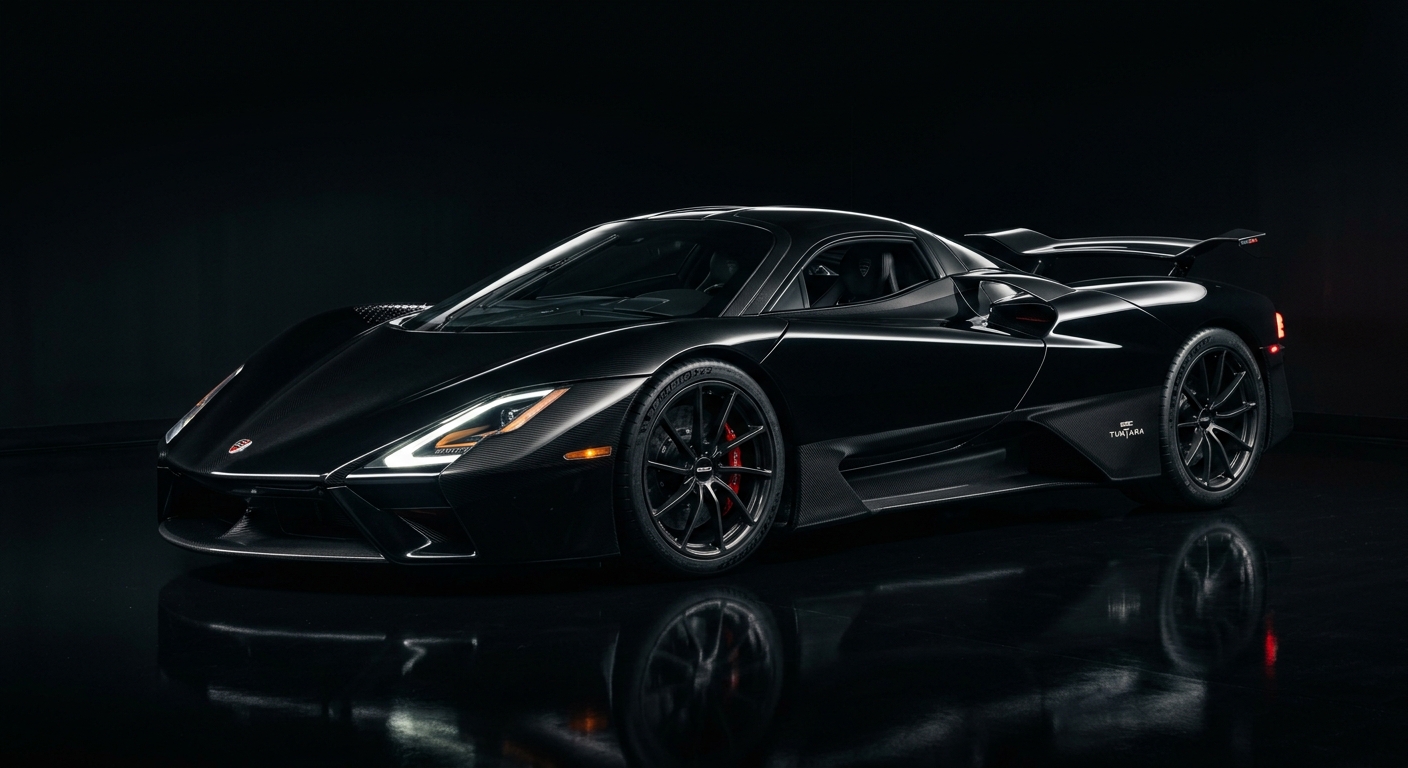
In the rarefied air of American hypercars, where Hennessey and Saleen have long held court, SSC North America’s Tuatara represents something altogether more ambitious. This isn’t just another big-power brute wrapped in carbon fiber, it’s a methodical assault on the very concept of automotive velocity, engineered from the ground up to rewrite the physics of what’s possible on four wheels.
The Tuatara emerges from Richland, Washington with a singular obsession: becoming the fastest production car on Earth. Where other manufacturers chase lap times or quarter-mile bragging rights, SSC has engineered every surface, every vent, every microscopic detail around achieving a theoretical top speed that flirts dangerously with 300mph.
Engineering for the Impossible
At the heart of the Tuatara beats a 5.9-liter twin-turbocharged V8 that SSC developed entirely in-house. This isn’t a modified LS or Coyote engine, it’s a bespoke powerplant designed to produce 1,750 horsepower on racing fuel while maintaining the reliability needed for sustained high-speed runs. The flat-plane crank design allows it to rev to 8,800rpm, generating a soundtrack that’s equal parts American muscle and European exotic.
The engine’s aluminum construction keeps weight to just 430 pounds, while the twin turbochargers are positioned to optimize both power delivery and thermal management. SSC claims this powerplant produces more horsepower per liter than any other production engine, a testament to the no-compromise approach that defines every aspect of the Tuatara.
Aerodynamics as Art Form
The Tuatara’s bodywork represents a masterclass in computational fluid dynamics made manifest. Every surface has been optimized for minimal drag while maintaining stability at speeds that would make a Formula 1 car nervous. The coefficient of drag measures just 0.279, achieved through active aerodynamics that constantly adjust to driving conditions.
The car’s distinctive silhouette isn’t just beautiful, it’s functional sculpture. Air flows over the teardrop cabin, through carefully positioned vents, and exits through an active rear diffuser that works in concert with a deployable rear wing. At maximum velocity, the Tuatara generates significant downforce while cutting through air with surgical precision.
Interior: Mission Control
Inside, the Tuatara balances exotic car drama with surprising usability. The carbon fiber monocoque provides exceptional rigidity while keeping weight to just 2,750 pounds. The driver sits low and forward, surrounded by controls that prioritize function over flash. Digital displays provide real-time aerodynamic data, power output, and the kind of telemetry information typically reserved for race cars.
The seats, while supportive enough for track work, accommodate longer journeys better than you might expect from a machine with such extreme capabilities. SSC understood that achieving maximum velocity requires comfort and confidence at triple-digit speeds for extended periods.
Performance Beyond Comprehension
The numbers surrounding the Tuatara’s performance exist in a realm typically reserved for fighter jets. SSC claims a top speed of 282.9mph based on official testing, with theoretical calculations suggesting even higher velocities are possible. The acceleration figures are equally staggering: 60mph arrives in just 2.5 seconds, while 200mph is dispatched in under 13 seconds.
These aren’t just marketing claims but the result of obsessive engineering focus. The seven-speed automated manual transmission has been calibrated specifically for high-speed stability, while the suspension setup prioritizes straight-line composure over canyon-carving agility.
The SSC Tuatara stands as America’s most convincing answer to European hypercar supremacy, combining obsessive engineering with the kind of straight-line performance that redefines what’s possible. While it may not carve corners with the precision of a McLaren or the heritage of a Bugatti, it achieves something arguably more important: it pushes the absolute boundaries of automotive velocity into previously uncharted territory.