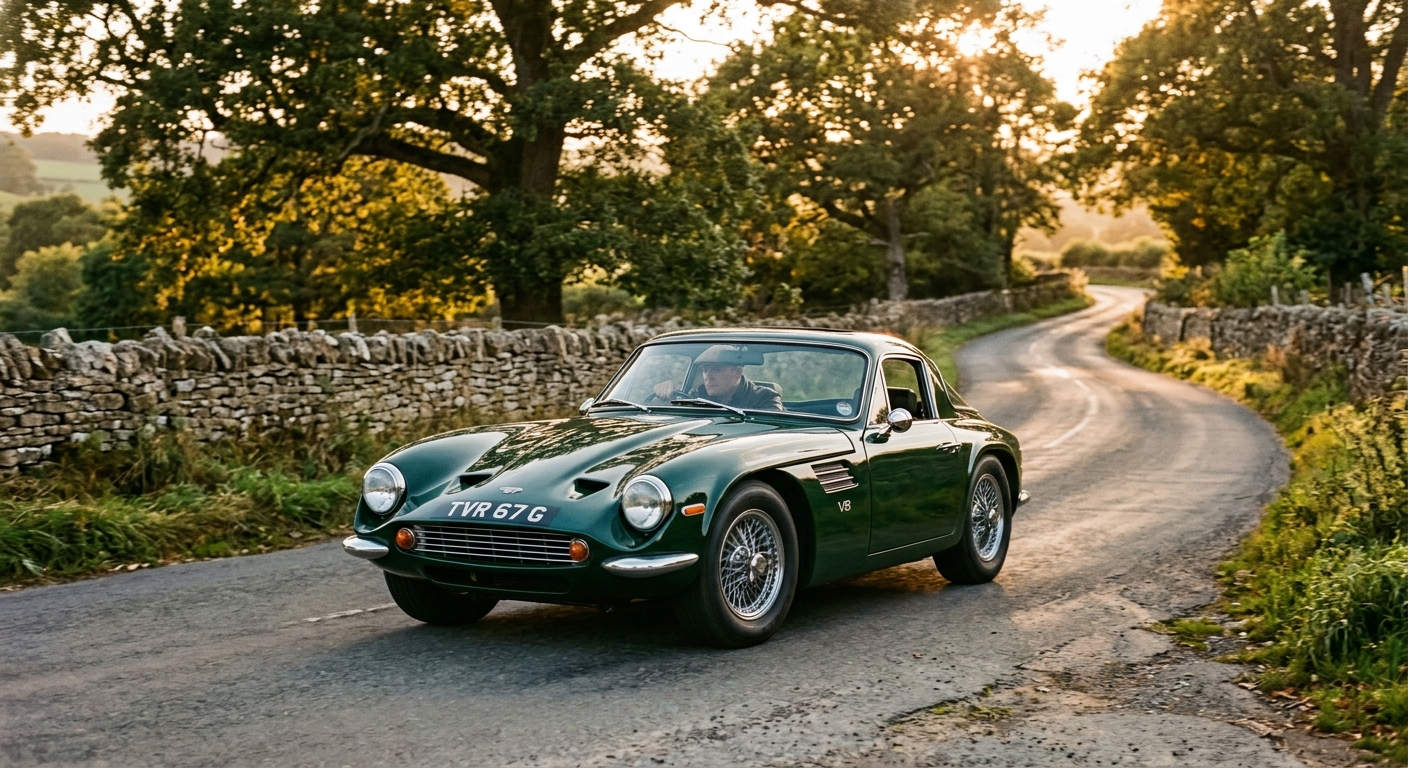
In an era when most British sports cars relied on finicky twin-cam engines and electrical systems that seemed allergic to moisture, TVR took a different path. The 1967 Tuscan V8 represented the Blackpool manufacturer’s bold answer to American muscle, wrapping a Ford small-block V8 in a lightweight fiberglass body that looked like it had been carved by the wind itself.
Raw Power Meets British Precision
The heart of the Tuscan V8 was Ford’s legendary 289 cubic-inch small-block, producing a robust 271 horsepower in its most potent form. Unlike the temperamental British engines of the era, this American powerplant delivered reliable thrust with a soundtrack that could wake the dead. The engine bay was a masterclass in functional packaging, with the V8 nestled low in the chassis to maintain the car’s razor-sharp handling balance.
What made the Tuscan special wasn’t just its engine, but how TVR integrated that power into their unique philosophy. The company’s founder, Trevor Wilkinson, believed in building cars that prioritized the driving experience above all else. Every component served a purpose, from the minimalist dashboard to the precisely weighted steering wheel that telegraphed every nuance of the road surface directly to the driver’s hands.
Fiberglass Innovation
The Tuscan’s bodywork represented cutting-edge technology for 1967. TVR’s fiberglass construction techniques allowed for complex curves and aerodynamic shapes that would have been impossible or prohibitively expensive in steel. The result was a body that weighed just over 400 pounds while maintaining structural rigidity that complemented the car’s sophisticated chassis dynamics.
The distinctive fastback profile wasn’t just for show. Wind tunnel testing revealed that the Tuscan’s shape generated genuine downforce at speed, helping to plant the rear wheels during hard cornering. The wraparound rear window and pillarless side glass created an airy cabin that felt more spacious than the car’s compact dimensions suggested.
Track-Bred Dynamics
Behind the wheel, the Tuscan V8 revealed its racing pedigree immediately. The steering was direct and communicative, requiring constant input but rewarding skilled drivers with unmatched precision. The independent front suspension and live rear axle might seem primitive by modern standards, but the geometry was carefully developed to provide neutral handling characteristics that could be adjusted with the throttle.
Acceleration was brutal by 1960s standards, with the lightweight Tuscan capable of reaching 60 mph in under six seconds. More impressive was the car’s ability to maintain composure at speed, with high-speed stability that put many contemporary supercars to shame. The four-wheel disc brakes, advanced for the era, provided stopping power that matched the engine’s performance.
The TVR Experience
Driving a Tuscan V8 was an exercise in automotive purity. There was no power steering to isolate the driver from the road, no sound deadening to muffle the V8’s roar, and certainly no electronic aids to intervene when physics took over. Every journey became an event, demanding attention and skill while rewarding commitment with an intensity that few modern cars can match.
The interior reflected TVR’s no-nonsense approach to sports car design. Gauges were clearly visible and logically arranged, while the seats provided excellent support during spirited driving. Build quality varied depending on when the car left the factory, but the fundamental engineering was sound, creating a machine that could handle both daily driving and weekend track sessions with equal aplomb.
The TVR Tuscan V8 stands as one of the most characterful sports cars ever built, combining American muscle with British engineering prowess in a package that still feels special today. With values climbing steadily and only 224 examples ever made, finding a good one requires patience and deep pockets. For those lucky enough to experience one, the Tuscan delivers an intensity and purity that modern cars simply cannot match.