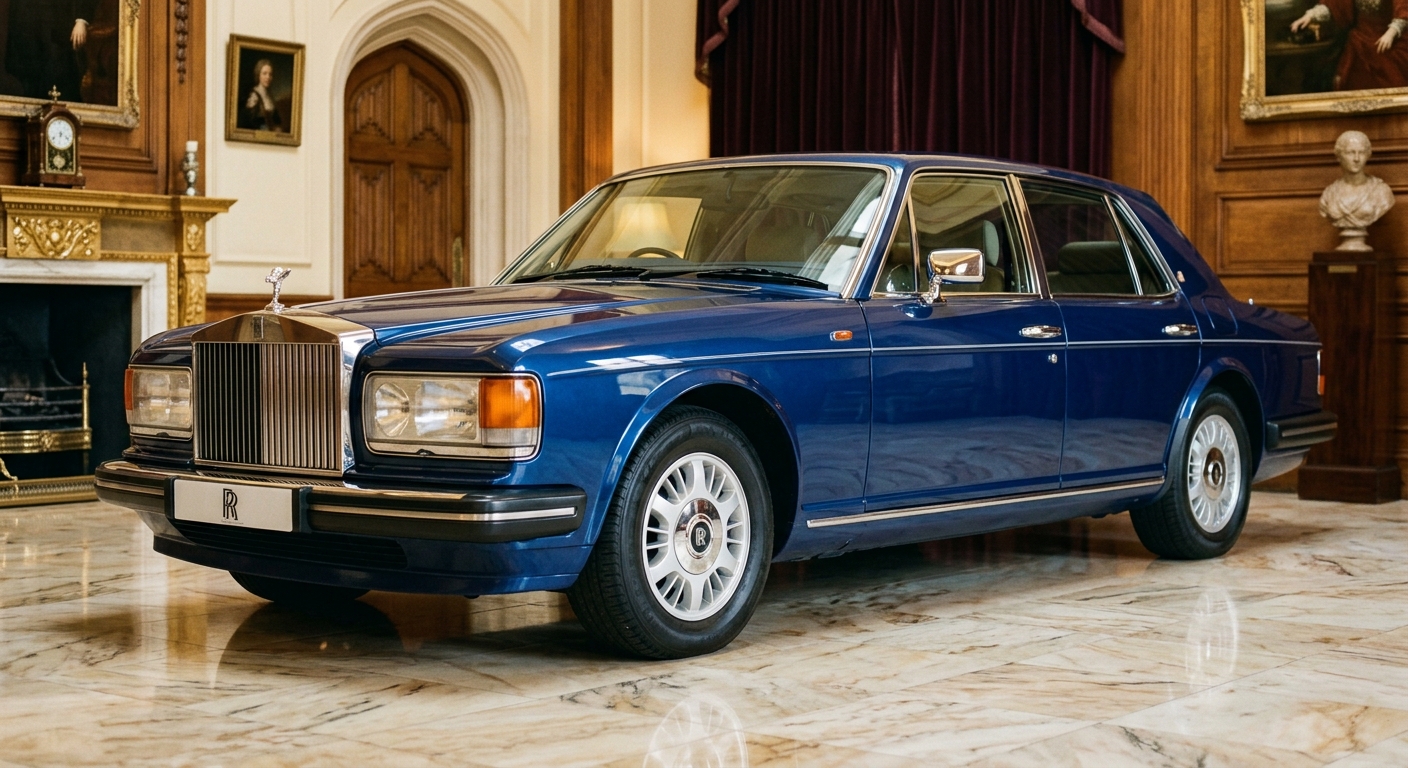
In 1998, the automotive world witnessed the end of an era. The final Rolls-Royce Silver Spur rolled off the production line at Crewe, marking the conclusion of nearly three decades of Britain’s most prestigious luxury sedan. This wasn’t just another model year changeover: it was the last hurrah of traditional English coachbuilding before BMW’s acquisition would forever alter the character of the marque.
The Twilight of Traditional Luxury
The Silver Spur represented everything that made Rolls-Royce legendary: hand-crafted perfection, unapologetic opulence, and engineering that prioritized refinement over efficiency. By 1998, this philosophy seemed almost quaint in a world increasingly obsessed with performance metrics and fuel economy. Yet stepping into a Silver Spur today feels like entering a time capsule of when luxury meant something entirely different.
Behind the wheel, the Silver Spur’s 6.75-liter V8 whispers rather than roars. This is the same basic engine architecture that powered Rolls-Royce sedans since the 1960s, continuously refined but never revolutionized. The result is a powertrain that delivers its 240 horsepower with the discretion of a well-trained butler, providing effortless forward motion without ever drawing attention to itself.
Craftsmanship in Every Detail
What sets the Silver Spur apart isn’t its performance figures, but its construction methodology. Each car required over 400 hours to build, with craftsmen hand-selecting wood veneers and stitching leather hides that would make furniture makers weep with envy. The dashboard alone contained more genuine wood than most modern homes, all book-matched and finished with techniques dating back centuries.
The ride quality defies modern understanding. Where contemporary luxury cars use electronic systems to manage comfort, the Silver Spur relies on old-school hydraulic self-leveling suspension that isolates occupants from the outside world with supernatural effectiveness. Road imperfections simply vanish, as if the car exists in a different dimension from the pavement below.
Interior Sanctuary
The rear cabin transforms transportation into theater. Rolls-Royce designed the Silver Spur primarily for passengers, not drivers, and it shows. The back seat offers limousine-like space, with individual reading lights, fold-down tables, and enough legroom to host a board meeting. The seats themselves, upholstered in Connolly leather and adjustable in multiple directions, provide support that rivals the finest furniture.
Sound insulation reaches obsessive levels. Rolls-Royce engineers packed the doors, floor, and roof with enough deadening material to muffle a rock concert. The result is a cabin so quiet that the loudest sound is often the tick of the analog clock, itself a precision timepiece worthy of Switzerland’s finest manufacturers.
Driving the Silver Spur
Piloting a Silver Spur requires a mindset adjustment. This isn’t a car you drive aggressively; it’s a vehicle you conduct, like a symphony orchestra. The steering is light but precise, the brakes progressive but never grabbing, and the throttle response measured in beats rather than milliseconds. Everything happens with deliberate grace, as if the car is gently suggesting rather than demanding your inputs.
The automatic transmission, a four-speed unit that seems almost primitive by today’s standards, shifts with such smoothness that passengers might assume the car runs on continuously variable power. Gear changes occur at precisely the right moment, chosen not for maximum efficiency but for optimum refinement.
The 1998 Silver Spur stands as automotive archaeology, preserving craftsmanship and values that modern luxury has largely abandoned. In a world of high-tech everything, sometimes the most revolutionary act is simply refusing to change. This final Silver Spur reminds us what we lost when luxury became about lap times rather than lasting impressions.