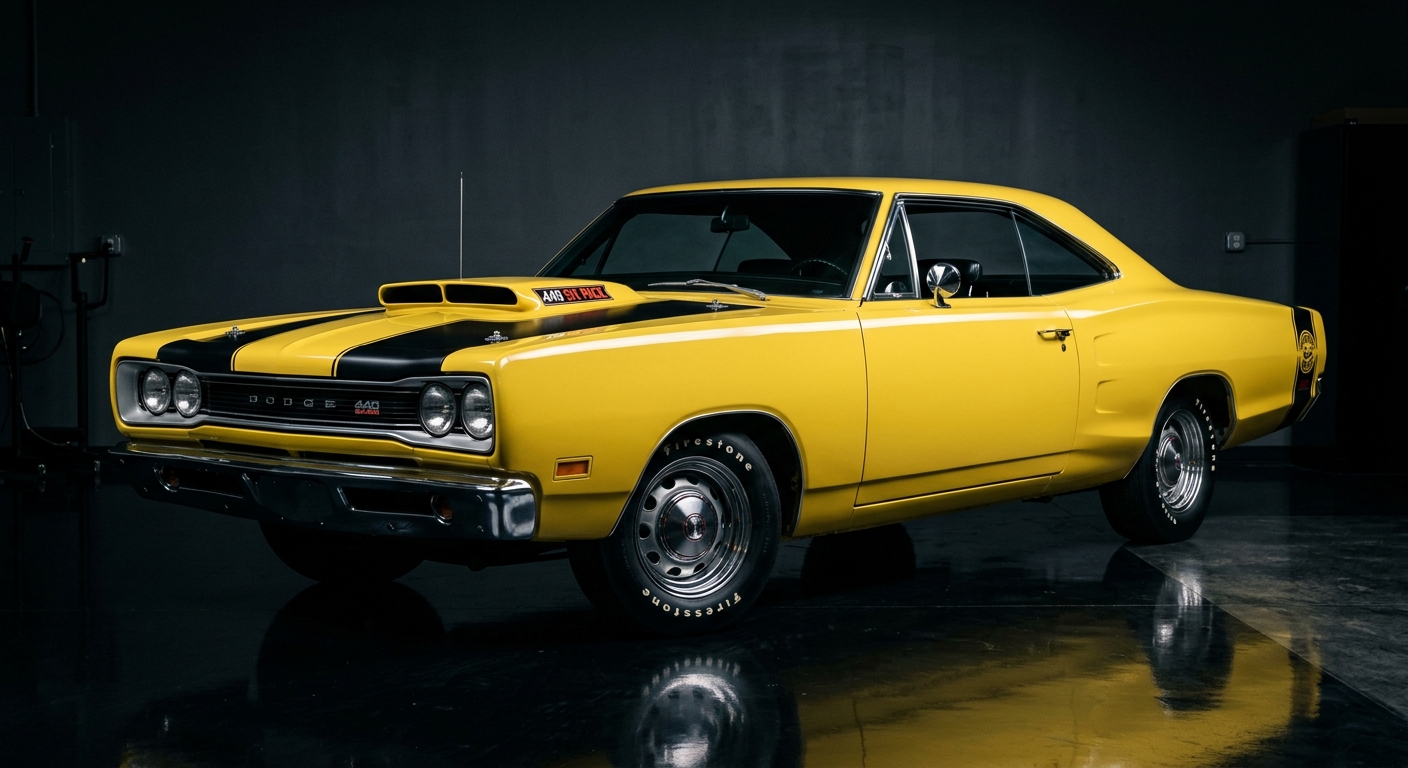
When Dodge unleashed the Super Bee in 1968, it wasn’t trying to be subtle. This was Chrysler’s answer to Plymouth’s Road Runner: a stripped-down, budget-conscious muscle car that delivered maximum performance per dollar. The 1969 model year brought refinements and the legendary 440 Six Pack option, creating what many consider the perfect balance of affordability and fury in the golden age of American muscle.
The Birth of Budget Muscle
The Super Bee concept was brilliantly simple: take the intermediate Coronet platform, strip away the luxury content, and stuff in the biggest, most powerful engines Dodge could offer. The base Super Bee came with the 383 cubic inch V8, but the real star was the 440 Six Pack, Dodge’s response to Plymouth’s 440+6 in the Road Runner.
Unlike many muscle cars that started life as family sedans, the Super Bee was purpose-built for performance. The suspension was tuned for handling, the interior was spartan but functional, and every design element served the greater goal of going fast for less money. At $3,138, it undercut many competitors while delivering genuine supercar performance.
440 Six Pack: Triple Threat Power
The 440 Six Pack wasn’t just about cubic inches, though it had plenty of those. The “Six Pack” referred to the trio of Holley two-barrel carburetors mounted on an Edelbrock intake manifold. The center carburetor handled idle and light throttle duties, while the outboard carbs kicked in under heavy acceleration, feeding all 440 cubic inches with a vengeance.
Officially rated at 390 horsepower, the 440 Six Pack was almost certainly underrated for insurance purposes. Real-world dyno tests suggest the engine produced closer to 425-450 horsepower, with a massive 490 lb-ft of torque available at just 3,200 rpm. This was blue-collar power at its finest: reliable, durable, and devastatingly effective.
The engine’s character was distinctly different from high-revving small blocks. The 440 was all about low-end grunt and mid-range punch. Floor the accelerator, and the Super Bee would squat, bark through its dual exhausts, and surge forward with surprising violence for such an unassuming package.
Beyond the Engine Bay
While the 440 Six Pack grabbed headlines, the Super Bee’s chassis deserves credit for handling all that power. The heavy-duty suspension included front and rear sway bars, heavy-duty springs, and oversized shock absorbers. The result was a car that could corner with surprising competence for its era, even if outright handling wasn’t its primary mission.
The four-speed manual transmission was the preferred choice among enthusiasts, offering positive shifts and the ability to keep the big-block in its power band. The TorqueFlite automatic was no slouch either, delivering consistent quarter-mile times and bulletproof reliability.
Inside, the Super Bee made no apologies for its budget origins. Vinyl bucket seats, a wood-grain steering wheel, and basic instrumentation were standard. But the simplicity was part of the charm – this was a car about driving, not luxury. The iconic cartoon Super Bee graphics on the rear quarter panels announced the car’s intentions to anyone within eyeshot.
Cultural Impact and Legacy
The Super Bee represented a democratization of performance. While cars like the Charger R/T and Challenger were moving upmarket, the Super Bee kept the muscle car dream accessible to younger buyers and blue-collar enthusiasts. It proved that serious performance didn’t require a premium price tag or luxury appointments.
Today, the 1969 Super Bee 440 Six Pack is recognized as one of the most authentic muscle cars of the era. It wasn’t the fastest or most sophisticated, but it captured the raw, uncompromising spirit that defined American performance in the late 1960s. Values have climbed steadily as collectors recognize its significance in muscle car history.
The 1969 Dodge Super Bee 440 Six Pack represents everything right about the original muscle car era: honest performance, accessible pricing, and zero pretense. It’s a machine that prioritizes thrills over comfort, making every drive an event worth remembering. In today’s market of sanitized performance, the Super Bee’s raw character feels more precious than ever.