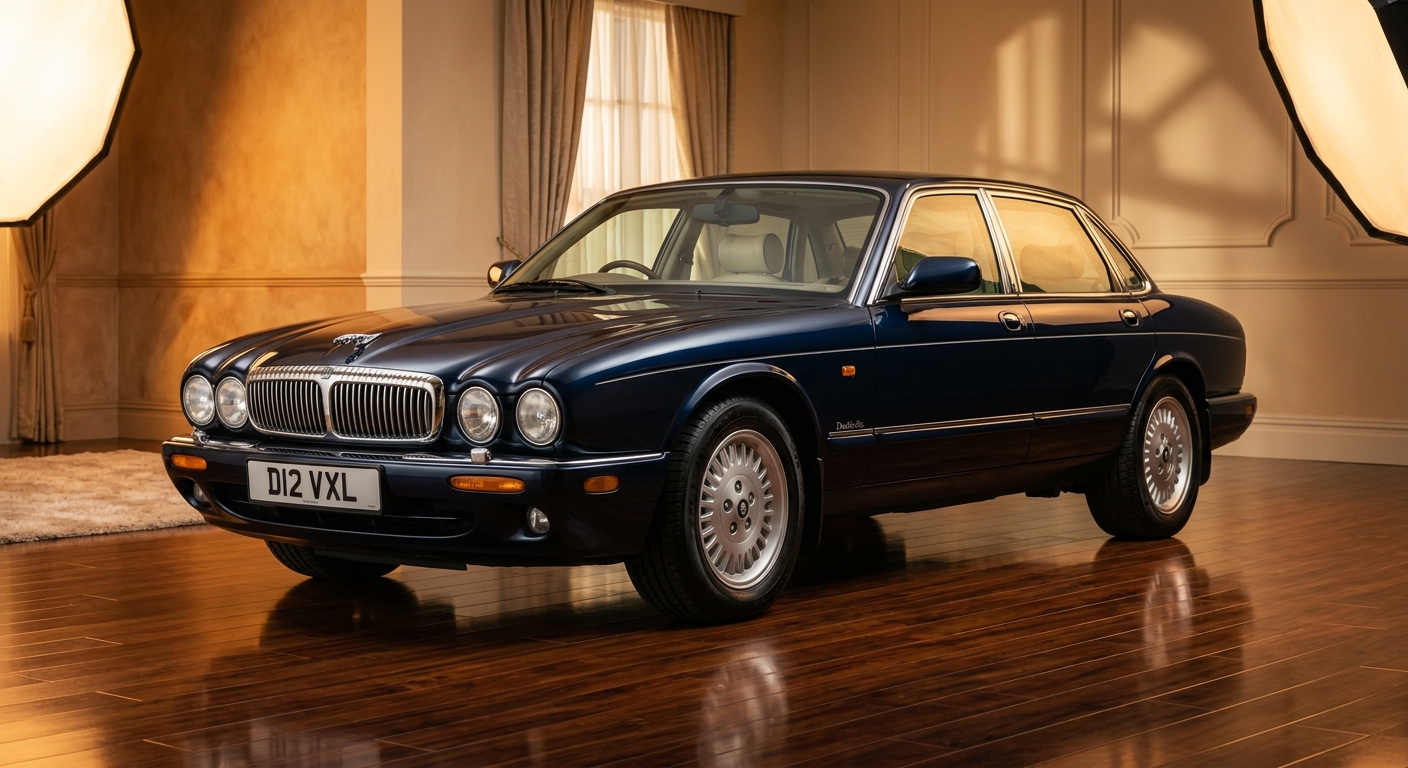
In 1996, as the automotive world rushed headlong into an era of efficiency and electronics, Daimler quietly built what would become the final chapter in one of motoring’s most distinguished bloodlines. The Double-Six V12 represented the last hurrah of Britain’s most exclusive luxury saloon, a car that prioritized grace over pace and whispered refinement over shouty performance.
This was luxury motoring from a bygone era, when a car’s worth was measured not in lap times or fuel economy figures, but in the quality of its leather, the silence of its ride, and the effortless surge of its magnificent V12 engine. The Double-Six wasn’t just transportation; it was a statement that some things should never be hurried.
The Soul of British Luxury
Behind the distinctive fluted grille and leaping cat mascot lay Jaguar’s legendary 6.0-liter V12, an engine that traced its lineage back to the E-Type and represented the pinnacle of smooth, refined power delivery. In the Double-Six, this magnificent powerplant produced 318 horsepower, but the figures told only part of the story. This was an engine that delivered its performance with the cultured restraint of a Savile Row tailor, never raising its voice above a cultured whisper.
The V12’s character defined the entire driving experience. Press the accelerator and the big Daimler would gather speed with the inevitability of a rising tide, accompanied by nothing more than a distant, aristocratic growl from the exhaust. This wasn’t acceleration in the modern sense; it was automotive poetry in motion.
Craftsmanship in Every Detail
Step inside the Double-Six and you entered a world where attention to detail bordered on the obsessive. The cabin was swathed in the finest Connolly leather, hand-selected and crafted with techniques that hadn’t changed in decades. Real wood veneers, carefully book-matched and polished to a mirror finish, adorned the dashboard and door cappings. Every switch clicked with mechanical precision, every surface felt substantial to the touch.
The seats were designed for long-distance comfort rather than sporty support, enveloping occupants in sumptuous leather that would only improve with age. Rear passengers enjoyed limousine-like space and their own climate controls, reclining seats, and fold-down picnic tables. This was a car built for those who appreciated the journey as much as the destination.
The Art of Effortless Progress
On the road, the Double-Six demonstrated why the British had mastered the art of luxury motoring. The suspension, tuned for compliance rather than cornering prowess, absorbed road imperfections with aristocratic disdain. Wind noise was virtually non-existent, tire roar banished to another world entirely. At motorway speeds, conversation could be conducted in hushed tones.
The steering was light and precise without being overly direct, allowing the driver to guide rather than wrestle the big saloon through corners. This wasn’t a car that encouraged spirited driving; it rewarded restraint and rewarded those who understood that true luxury meant never having to hurry.
A Dying Breed
The 1996 model year marked the end of an era. Jaguar’s decision to discontinue the V12 engine meant that the Double-Six’s days were numbered, making this final iteration a poignant farewell to a philosophy of luxury that was rapidly becoming extinct. While competitors embraced smaller, more efficient engines and digital dashboard displays, Daimler remained steadfastly analog and unapologetically thirsty.
Today, the 1996 Double-Six V12 stands as a monument to a different approach to luxury motoring. It represents the last time a major manufacturer would prioritize absolute refinement over practicality, craftsmanship over cost-cutting, and character over efficiency. For those who experienced it, the Double-Six remains the gold standard by which all luxury saloons are measured.
The 1996 Daimler Double-Six V12 represents the end of an era when luxury cars prioritized refinement above all else. Its magnificent V12 engine and uncompromising approach to comfort make it a rolling time capsule of British automotive excellence. For those seeking true luxury motoring heritage, few cars deliver such character and presence at today’s remarkably accessible prices.