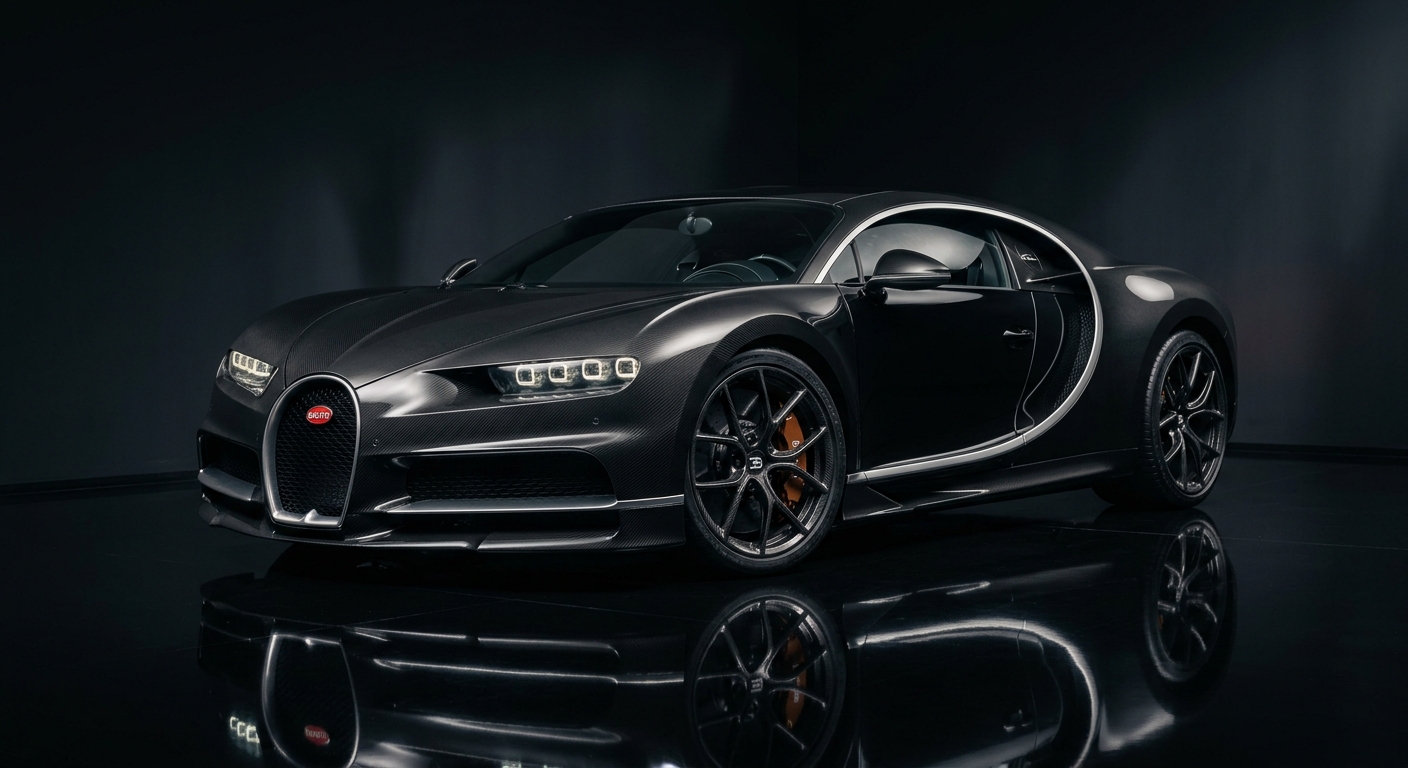
When Bugatti set out to create the Veyron’s successor, they faced an impossible task: how do you improve upon automotive perfection? The answer, it turns out, involves adding another 300 horsepower, refining every surface, and charging three million dollars for the privilege. The result is the Chiron, a hypercar that doesn’t just push boundaries but obliterates them entirely.
The Numbers Game
Let’s address the elephant in the room first: the specifications. The Chiron’s quad-turbocharged 8.0-liter W16 engine produces 1,479 horsepower and 1,180 lb-ft of torque. These aren’t numbers; they’re geological forces compressed into mechanical form. The engine alone weighs more than some entire sports cars, yet it propels this 4,400-pound monument to excess from 0-60 mph in just 2.3 seconds.
But raw power is only part of the equation. Bugatti’s engineers spent countless hours ensuring the Chiron could handle these forces without self-destructing. The transmission is a seven-speed dual-clutch unit that manages power delivery with the precision of a Swiss chronometer. The all-wheel-drive system splits torque intelligently, ensuring maximum grip regardless of surface conditions.
Design Philosophy
Where the Veyron was revolutionary, the Chiron is evolutionary, and that’s precisely the point. Every line, every vent, every surface serves both aesthetic and functional purposes. The signature horseshoe grille isn’t just Bugatti heritage; it’s a carefully calculated air intake that feeds the hungry W16. The side scoops aren’t styling flourishes; they’re essential cooling ducts that prevent the engine from melting itself.
The interior represents the pinnacle of automotive luxury. Hand-stitched leather covers nearly every surface, while carbon fiber trim adds technical credibility. The instrument cluster features both analog gauges and a digital display, bridging traditional craftsmanship with modern technology. Every control falls perfectly to hand, creating an environment that’s both opulent and purposeful.
The Driving Experience
Describing what it’s like to drive the Chiron feels almost futile. At low speeds, it’s surprisingly docile, purring through city streets with the refinement of a luxury sedan. The ride quality is remarkable considering the performance potential lurking beneath. Visibility is better than expected, though parking this $3 million sculpture still requires considerable courage.
Engage the full performance potential, however, and reality bends. The acceleration doesn’t build progressively; it hits like a physical force. Your internal organs rearrange themselves as the Chiron hurls itself toward the horizon. The all-wheel-drive system claws at the asphalt, finding grip where physics suggests none should exist.
The handling defies expectations for a car of this size and weight. The steering is precise and communicative, while the adaptive suspension manages to keep the Chiron composed even during spirited cornering. It’s not a lightweight sports car, but it moves with surprising agility for something that tips the scales at over two tons.
Engineering Marvel
The Chiron’s technical achievements extend far beyond its powertrain. The active aerodynamics adjust constantly, optimizing downforce and drag depending on driving conditions. The cooling system rivals that of a small building, with ten radiators working overtime to manage temperatures. The carbon fiber monocoque provides incredible strength while keeping weight in check.
Perhaps most impressively, Bugatti engineered the Chiron to be reliable. This isn’t a temperamental track toy that breaks if you look at it wrong. It’s designed to be driven regularly, maintained properly, and enjoyed without constant mechanical drama. The fact that it can achieve this while producing nearly 1,500 horsepower borders on miraculous.
The Chiron represents automotive engineering at its absolute peak, a machine that pushes every boundary while remaining surprisingly civilized. At $3 million, it’s not transportation; it’s a rolling statement that some things are worth doing simply because they can be done. In a world increasingly focused on efficiency and electrification, the Chiron stands as a glorious monument to internal combustion excess.