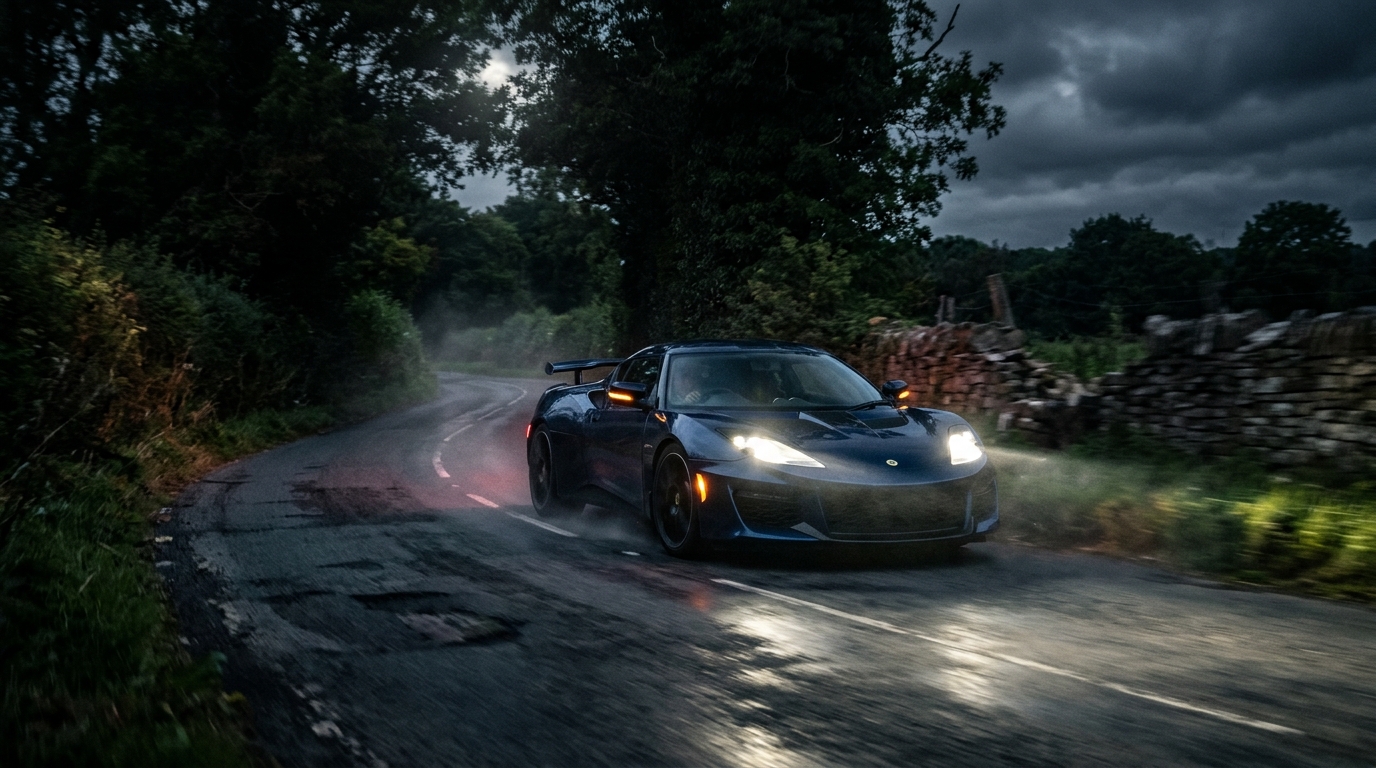
It is a few minutes past midnight, the pubs are dark, and the only company on this ribbon of tarmac is a fox that wants nothing to do with us. The 2021 Lotus Evora GT idles behind my shoulder blades with a mechanical rasp, the engine ticking as it warms, the cabin smelling faintly of Alcantara and hot metal. This is exactly the hour the Evora was built for.
Hethel’s Last Great Grand Tourer
The Evora arrived in 2008 as Lotus’s first all-new car in years, and the 2021 Evora GT sits at the end of that story. Powered by a Toyota-sourced 3.5-litre V6, the Evora has always been Lotus’s attempt at a car that adds some daily-driver practicality to the brand’s usual dedication to lightness. By 2021 the Evora line had been honed through the 400, the Sport 410, and the GT410, and the Evora GT was the culmination of all of it, with Lotus confirming it as the final iteration of the car as the factory pivoted toward the Emira. Production was limited and the car was sold in the US market, which makes finding one in the wild a small event.
Underneath is the familiar bonded aluminium chassis, with the engine mounted amidships and an aluminium subframe up front and aft. Lotus has always chased lightness rather than horsepower, and the Evora GT keeps that faith. Our test car carried the aerodynamic package with the carbon fibre rear wing and diffuser, a bonded front splitter, and a titanium exhaust that does a great deal of the talking tonight.
The Drive: Midnight on the B-Road
The first thing you notice at night is how low and small the car feels from behind the wheel. Visibility out the front is superb, with the wings visible over the dash and the road falling away in front of you. The Evora GT is not wide by modern standards, which matters enormously on a narrow Welsh or Yorkshire back road where oncoming headlights appear from nowhere. You can place it within a hand’s width of the verge and trust it completely.
The headlights are a mixed blessing. They are conventional halogen-era thinking by today’s standards, adequate rather than dazzling, and on a properly black road you find yourself driving to the light rather than the other way around. In a strange way that suits the car. It slows you down just enough to listen, and there is plenty to hear. The supercharged V6 builds a layered howl, the supercharger whine sits underneath, and in the right tunnel or between two stone walls the titanium exhaust crackles on the overrun. At night, with no traffic noise to compete with, it carries for miles.
Steering and Chassis
Here is where the Evora GT earns its reputation. The steering is hydraulic, not electric, and the feedback through the rim is a revelation if you have spent time in modern cars. You feel the camber of the road, the paint lines, the faintest change of surface, and you feel it all at three in the morning when your senses are heightened and the road is yours alone. The chassis is beautifully balanced, with a front-end bite that inspires immediate confidence and a rear that rotates progressively when you ask it to.
The ride deserves a mention. Lotus tuned the Evora GT with Bilstein dampers and Eibach springs, and it rides with a suppleness that lets you carry speed over broken surfaces that would unsettle a stiffer rival. On a patchy B-road at night, where you cannot see every pothole until you are on it, that compliance is a real asset.
Gearbox and Power
Our car had the six-speed manual with the open-gate-style short throw and a mechanical action that feels exactly like something from a lighter, more analogue era. A six-speed automatic with paddles was also offered, but the manual is the one to have. The supercharged 3.5-litre produces 416 PS in this guise, and while that is not a staggering figure today, in a car that weighs roughly 1,300 kg it is more than enough to make you laugh out loud on a dark straight.
Living With It
Practicality is relative. There is a pair of rear occasional seats best reserved for bags or small children, and getting in and out over the wide sill takes a certain technique. But the cabin is more usable than a Lotus has any right to be, the touchscreen infotainment is basic yet functional, and long motorway stints are surprisingly relaxed once the revs settle. The Evora GT is a car you can genuinely drive to a track day or a night-time meet and home again.
The Evora GT is also a farewell. It is one of the last chances to buy a Lotus that feels like it was built by people who care more about steering feel than screen size, and as prices of analogue sports cars climb, that matters.
The 2021 Lotus Evora GT is a hand-built, hydraulic-steered love letter to driving, and the best place to read it is a deserted B-road after midnight. It is not the fastest car in its price bracket, but it may be the most rewarding, and when the last Evora leaves Hethel an analogue era leaves with it.