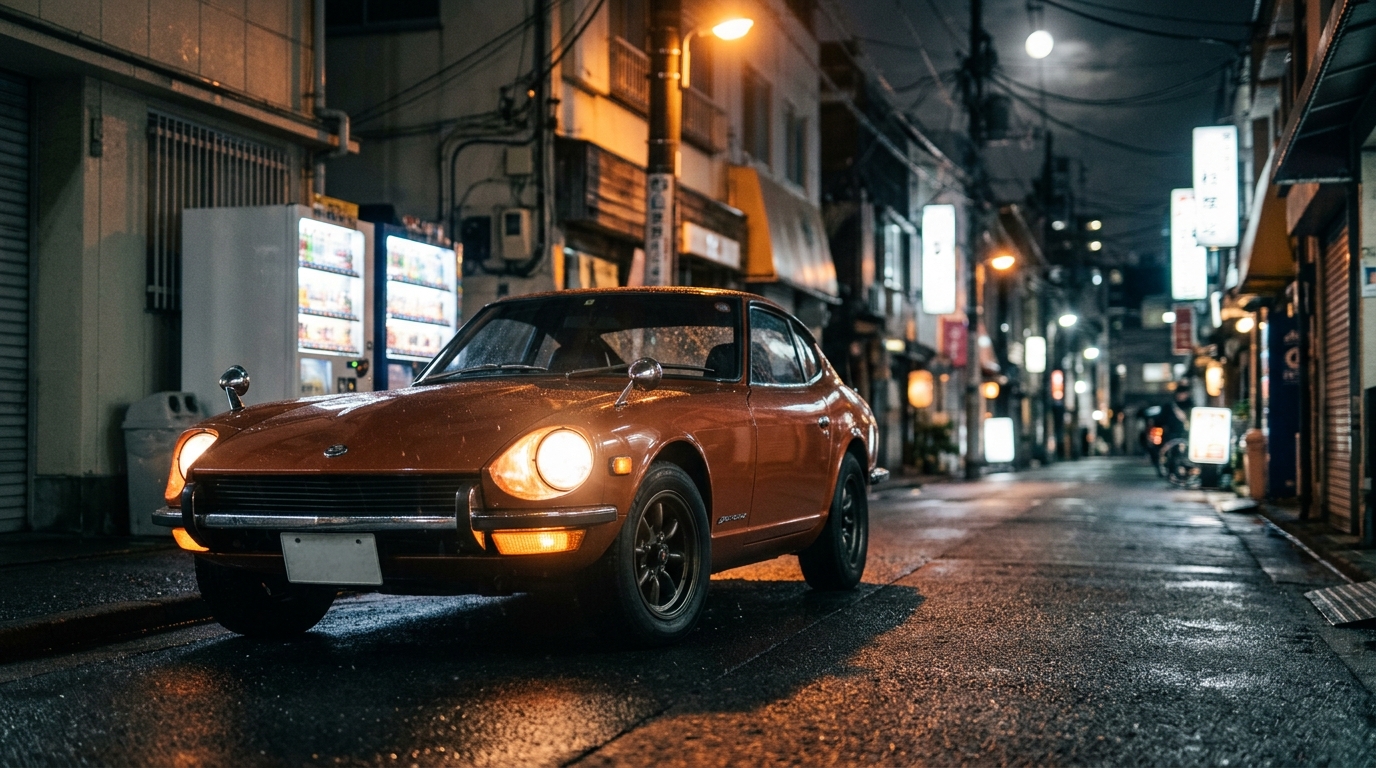
It is just past midnight, the sodium lamps are painting the wet asphalt amber, and the long hood of a 1970 Datsun 240Z is ticking as it cools. In 1970 this car arrived in America like a prank on the establishment: a genuine, beautiful, six-cylinder sports car from Japan that cost about as much as a loaded family sedan. Fifty-plus years later, it still owns the night.
The car that changed the game
Before the 240Z, the affordable sports car meant British roadsters, charming but fragile, with a reputation for oil leaks and electrical gremlins. Datsun, led in the US by the persistent Yutaka Katayama, wanted something different: a grand tourer with European looks, Japanese reliability, and a price anyone with a steady job could manage. The design, shaped by Yoshihiko Matsuo and the team around Albrecht Goertz’s consulting influence, gave the world a long hood, a short rear deck, and a fastback silhouette that still looks fresh under streetlights.
It debuted in Japan as the Fairlady Z in late 1969 and reached American showrooms as the Datsun 240Z. The sticker price was roughly 3,526 dollars, and dealers promptly added markups because demand was ferocious. Buyers waited. Enthusiasts argued about it. Then they bought it anyway.
Driving it after dark
Slide into the low bucket seat and the cabin feels purposeful and slightly cramped in the best way. The three-spoke wheel sits close, the gauges glow a soft green-white, and the big tachometer and speedometer sit in deep individual hoods that kill glare on a dark road. There is no distracting clutter. Everything you need is in front of you.
Turn the key and the 2.4-litre inline-six wakes with a dry, metallic bark. Its single overhead cam design and twin SU-type carburetors give it a sound that is part rasp, part wail, and utterly addictive in tunnels and under overpasses at 2 a.m. The 151 horsepower on tap does not sound like much today, but the car weighs only around 2,300 pounds, so it feels eager and light on its feet. Second gear pulls hard, and the engine loves to rev past 5,000 rpm.
Headlights are the honest weak spot. The sealed-beam units of the era throw a yellowish, modest pool of light, and on an unlit back road you learn to respect your speed. That is part of the charm: the car invites you to drive with attention, trusting the steering rack and the independent suspension all around, a MacPherson strut setup that was sophisticated for a car this cheap. The steering is quick and communicative, and the chassis telegraphs everything through the thin-rimmed wheel.
Why it still matters
The 240Z won rallies, including the 1971 and 1973 East African Safari Rally, and dominated SCCA racing in the hands of Bob Sharp and others. More importantly, it proved Japanese manufacturers could build desirable cars, not just sensible ones. Without the Z, there is no later wave of Japanese performance icons. Today clean examples have climbed well into six figures, and rust remains the great enemy, especially in the floors, rocker panels, and the area around the battery tray.
Park one under a lone streetlight and walk away slowly. You will turn around twice.
*Production figure is approximate for the 240Z across its 1969 to 1973 run, with strong US sales from 1970 onward.
Editor’s verdict: The 1970 Datsun 240Z is the rare classic that is as joyful to drive as it is important to history. Rust-free examples are getting scarce, so find a good one and take it out after dark, where that inline-six sings loudest.