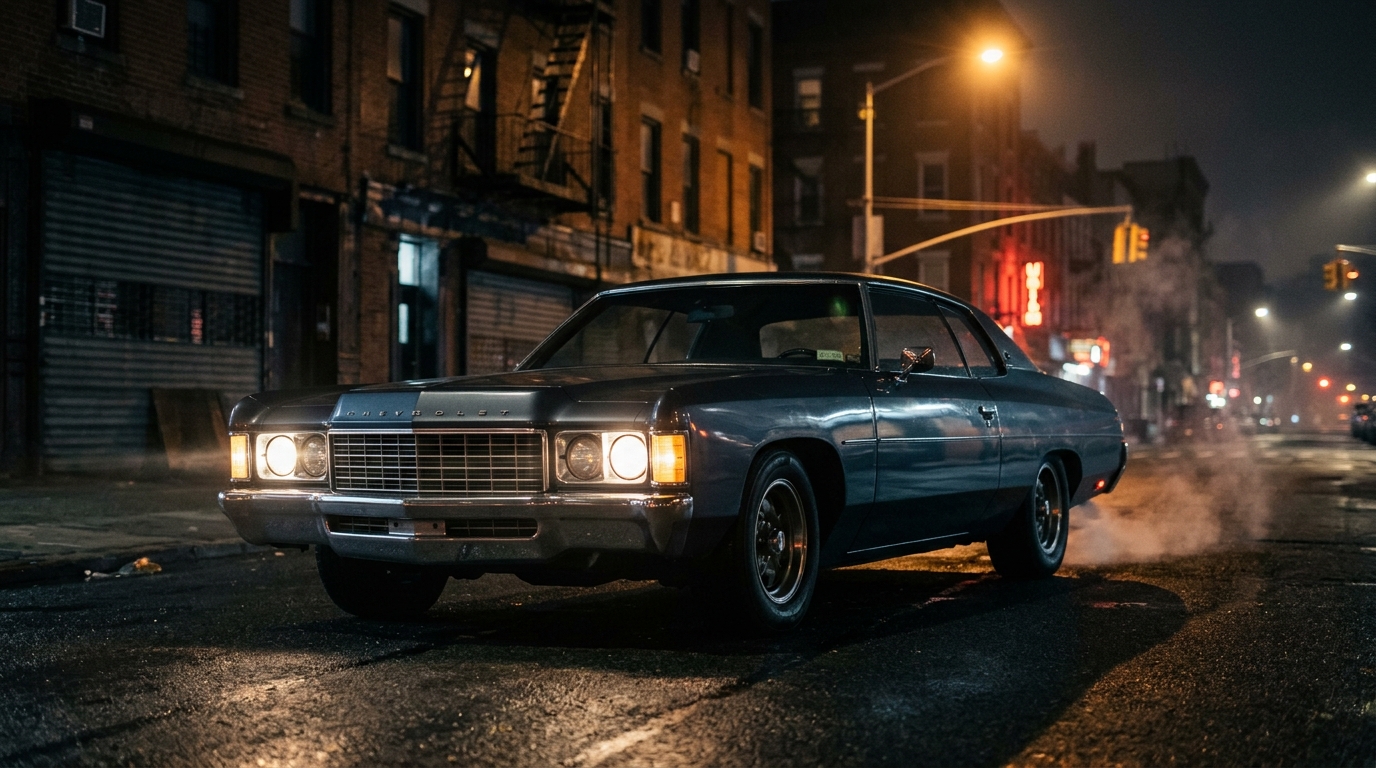
Somewhere past midnight, on an empty four-lane boulevard, a 1971 Bel Air rolls under the amber glow of sodium streetlights, and the whole scene feels borrowed from a different decade. The hood stretches out ahead like a runway, the chrome catches every passing lamp, and a low burble rolls out of the tailpipes that sounds equal parts Detroit and a Tuscan hillside at dusk. Call it the Italian-American hybrid: American bulk, with a growl that has some operatic drama in it.
The Last of the Big Chevys
The 1971 model year marked a major turning point for Chevrolet’s full-size lineup. For 1971, GM introduced an all-new full-size platform with a coil-spring suspension at all four corners and a dramatically larger body. The cars were bigger, heavier, and more rounded than the sharp-edged models of the late 1960s, and the whole range was re-engineered around the idea of a quiet, smooth ride. The Bel Air name, by this point, sat below the Impala and Caprice as the entry-level full-size Chevy, available as a four-door sedan, a four-door hardtop-style sedan, and a station wagon variant in some years.
It is worth being honest about where the Bel Air sat in the hierarchy. The 1971 Bel Air was the budget full-size Chevrolet, which means it traded some of the chrome trim and interior plushness of the Caprice for a plainer, more affordable package. That is exactly its charm today. It is the sleeper of the big Chevy family, a car built to haul families and commuters that happens to share its bones with some of the most comfortable cruisers of the era.
Behind the Wheel After Dark
Climb inside and the first thing you notice is the sheer width of the bench seat and the thin, enormous steering wheel. The horizontal strip speedometer glows a soft green-white at night, and the gauges are simple and legible. There is no clutter and no touchscreen glare to wreck your night vision. Everything about the cockpit encourages you to settle back and let the road unspool.
The headlights are the era’s weak point. Sealed-beam units of this period put out a modest, yellowish pool of light by modern standards, and the dual round lamps on the 1971 Bel Air will not cut through darkness like a modern LED or HID setup. On a rural road you learn to drive within your lights and trust your instincts. That limitation is part of the experience: night driving in a car like this is slower, more deliberate, and far more atmospheric. The glow of oncoming headlights, the reflections on the long hood, and the dim amber of the dash all combine into something genuinely cinematic.
The Growl
The sound is the star of any nighttime outing. Depending on how it was optioned, a 1971 Bel Air could carry anything from a modest inline-six or small-block V8 up to the big-block Turbo-Jet 402 or the 454. The mid-range option that many buyers chose, the 350 V8, delivers a smooth, mellow burble, while the big-block variants bring a deeper, lazier rumble that echoes off the walls of empty streets and underpasses. In the quiet of the small hours that sound carries for blocks, a low and unhurried growl with real weight behind it.
It is not a fast car by modern standards, and with the compression ratios lowered across GM in 1971 to run on lower-lead fuel, power ratings were reduced from the previous year. But the torque is effortless and the delivery is smooth. Squeeze the throttle on an empty road and the nose lifts gently as the big sedan gathers speed with a muscular, unhurried shove.
Ride and Handling
Handling is where honesty matters. The steering is light and slow, with a lot of play on center, and the body leans noticeably in corners. This is a boulevard cruiser, not a back-road scalpel. The new-for-1971 suspension tuning favored comfort, and it delivers: bumps and expansion joints disappear under the soft springs, and the long wheelbase gives the car a floating, magic-carpet feel at highway speeds. Drum brakes were still common on lower trims, with front discs optional, so smart drivers leave generous following distances.
Living With It
As a classic today, the 1971 Bel Air is refreshingly approachable. Parts for the GM full-size platform are widely available, the mechanicals are simple and well understood, and values remain accessible compared to the Impala and Caprice, especially for sedans. It is a car you can actually use: take it to a late-night diner, a cruise-in, or a drive-in revival screening, and it fits the setting perfectly. Just keep an eye out for rust in the rear quarters, trunk floor, and lower body panels, and check the condition of the frame on any prospective purchase.
Editor’s verdict: The 1971 Bel Air is not fast, not sharp, and not subtle, and that is precisely why it works after dark. It is an honest, affordable slice of Detroit at its softest and most comfortable, with a growl that sounds best when the streets are empty. Buy a clean one, keep the lights low, and let the midnight do the rest.