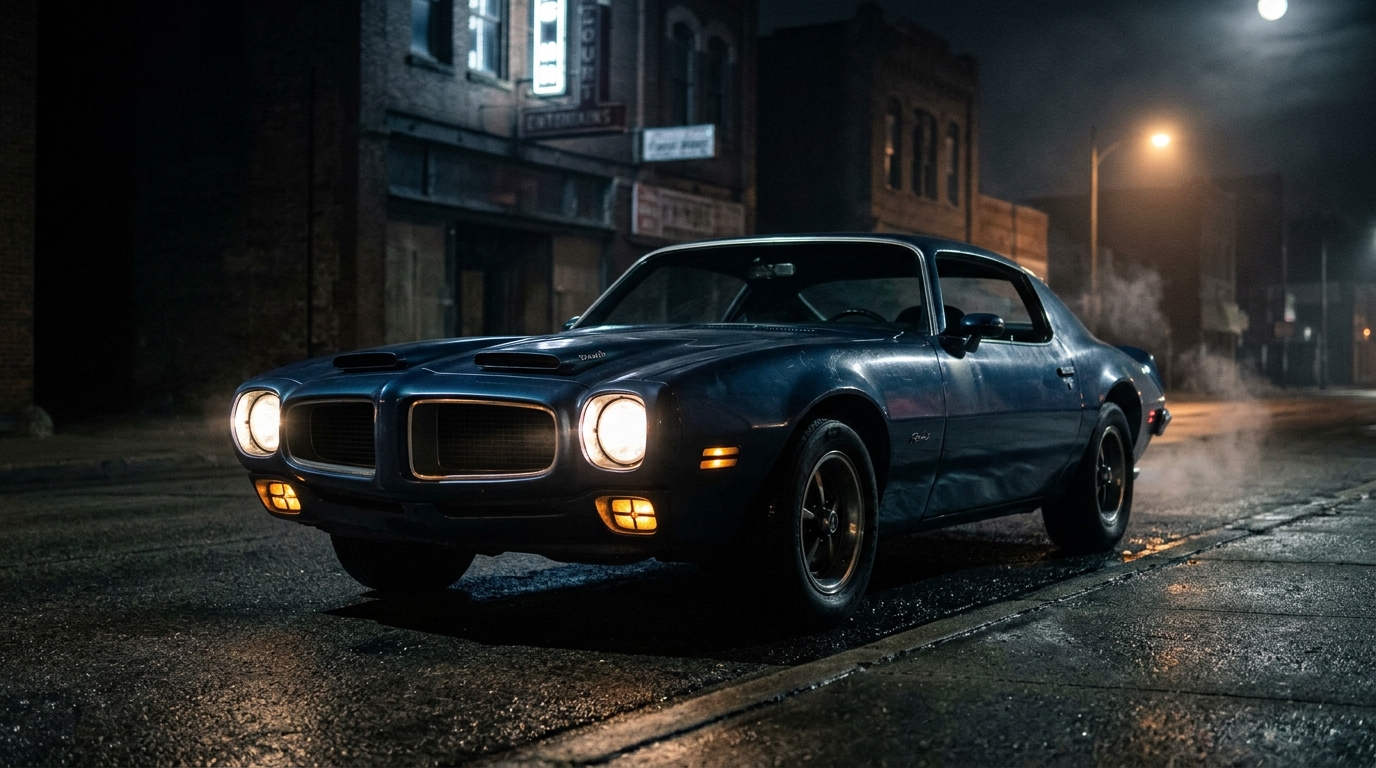
It is past midnight on an empty four-lane, the kind of road where the only company is a string of sodium lamps ticking past the windshield. Somewhere ahead of you, the long hood of a 1970 Firebird Formula rolls out of one pool of orange light and into the next, and the 400 V8 under it is murmuring like it knows exactly what it is. This is the car that gave you most of a Trans Am for a lot less money, and after dark it makes the most sense of all.
The Car Pontiac Almost Didn’t Build
The 1970 Firebird has a strange birth story. The second-generation F-body was meant to debut in the fall of 1969 as a 1970 model, but General Motors was juggling a deep product schedule and a bruising strike season, and the redesigned Camaro and Firebird slipped. The cars did not reach showrooms until February 1970, which is why enthusiasts often call them 1970 and a half cars. When they finally arrived, they were a clean break from the first generation: lower, wider, and far more European in their proportions, with a long hood, short deck, and a semi-fastback roofline that suited Pontiac’s performance image perfectly.
The lineup that year ran from the base Firebird and the Esprit to the Formula 400 and the flagship Trans Am. The Formula sat in the sweet spot. It borrowed the Trans Am’s brawny mechanicals but skipped some of the flash, which made it the sleeper choice for buyers who wanted the muscle without the full price and the full wing. The name itself, Formula, was Pontiac’s shorthand for a no-nonsense performance package built around a big engine and a firm chassis.
What Makes a Formula a Formula
The visual signature of the 1970 Formula is the body-colored Endura front end, a flexible urethane nose that was a genuine piece of 1970 industrial design. Pontiac had pioneered the material on the GTO, and on the Firebird it gave the car a seamless, bumper-free face that looked modern next to its chrome-bumpered rivals. Above it sat twin hood scoops, functional-looking gills that told everyone in your rearview mirror exactly what they were dealing with. Inside, the Formula carried the full Pontiac driver-focused treatment, with a deeply hooded dash, a pod of round gauges, and bucket seats that hugged you better than the bench seats of the era’s family sedans.
Under the hood, the 1970 Formula 400 used Pontiac’s 400 cubic inch V8 in a state of tune that reflected the Firebird’s mission. The standard Formula 400 engine was rated at 330 horsepower and 430 lb-ft of torque, while the optional Ram Air setup lifted output and bolstered the car’s drag strip credentials. The Ram Air variants used functional hood scoops and a more aggressive tune, delivering the sort of off-the-line shove that made the Pontiac 400 legendary. Whichever version you chose, the torque arrived low and stayed late, which is the real secret of why these cars feel so effortless on a dark open road.
Driving It After Dark
Night is when a muscle car reveals its personality. In daylight, the Formula is a handsome shape with a loud voice. After sunset, it becomes a mood. The glow from the gauge cluster, a warm amber wash across the dash, feels like a cockpit built for a different era of driving, one without screens or alerts. The long hood stretches ahead of you into the dark, and the twin scoops catch the light from passing street lamps in a way that makes the whole front end feel alive.
The Pontiac 400 is a torque monster, and at night, when the road is empty and the air is cool, it pulls with a deep, unhurried authority. Open the throttle in the mid range and the whole car squats and surges, the exhaust note rolling through the quiet like thunder over a flat field. There is no turbo whistle, no synthetic sound track, just a big V8 breathing through a pair of pipes and the rhythmic thump of an engine that was designed for exactly this kind of unobserved acceleration.
Visibility is where you remember you are driving a half-century-old car. The factory sealed-beam headlamps of 1970 are modest by modern standards, producing a warm, yellowish pool of light that falls off quickly at the edges. On a dark country road you drive into the beam rather than past it, which encourages a sensible pace and a heightened attention to the road ahead. Many owners swap in modern halogen or LED-based sealed-beam replacements, which sharpen the throw without spoiling the look. The Formula’s low seating position and long hood also mean you are very aware of the road surface and the shape of the corners ahead, which adds to the sense of connection.
The chassis is more capable than its muscle car reputation suggests. The Formula received the firmer suspension tuning Pontiac reserved for its performance models, with front and rear anti-roll bars, and the steering offers decent weight if not a lot of feedback. It still leans into corners and rewards smooth inputs rather than aggression, but on a quiet backroad at night, with traffic gone and the road wide open, the car feels planted and confident. Power drifts through long sweepers with a satisfying rear-biased balance, and the torque-rich V8 means you rarely need to chase revs to stay in the sweet spot.
The Budget Trans Am Argument
The Trans Am was the glamour car, with its racing-inspired stripes, spoilers, and top-shelf pedigree. But the Formula gave you much of the same driving substance for less money. For buyers who cared more about how a car drove than how it looked on the boulevard, the Formula was the smarter purchase. It had the engine, the suspension upgrades, and the Endura nose, and it left off the trim that added cost without adding speed. Today that logic still holds, and a well-sorted Formula 400 can deliver the same night-driving thrills as its pricier sibling, often at a more approachable entry point for collectors.
Second-generation Firebirds have also become some of the most beloved classics of the muscle era, thanks to their timeless shape and rich performance heritage. The Formula’s blend of Pontiac engineering, understated looks, and genuine capability makes it one of the most rewarding ways to experience classic American muscle after the sun goes down.
Editor’s verdict: The 1970 Firebird Formula 400 is the muscle car for people who would rather drive than pose, and after midnight it is a quiet, rumbling revelation. It gives you the Pontiac 400, the firm chassis, and the unmistakable Endura nose without the Trans Am price premium. Find a clean one, point it down an empty road under the orange lamps, and you will understand why this budget Trans Am never needed to shout.