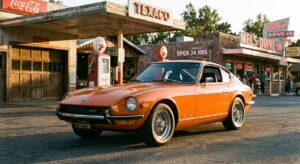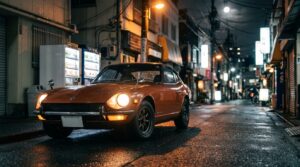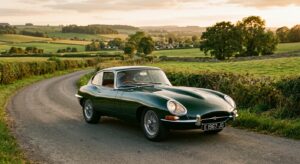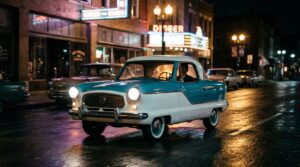
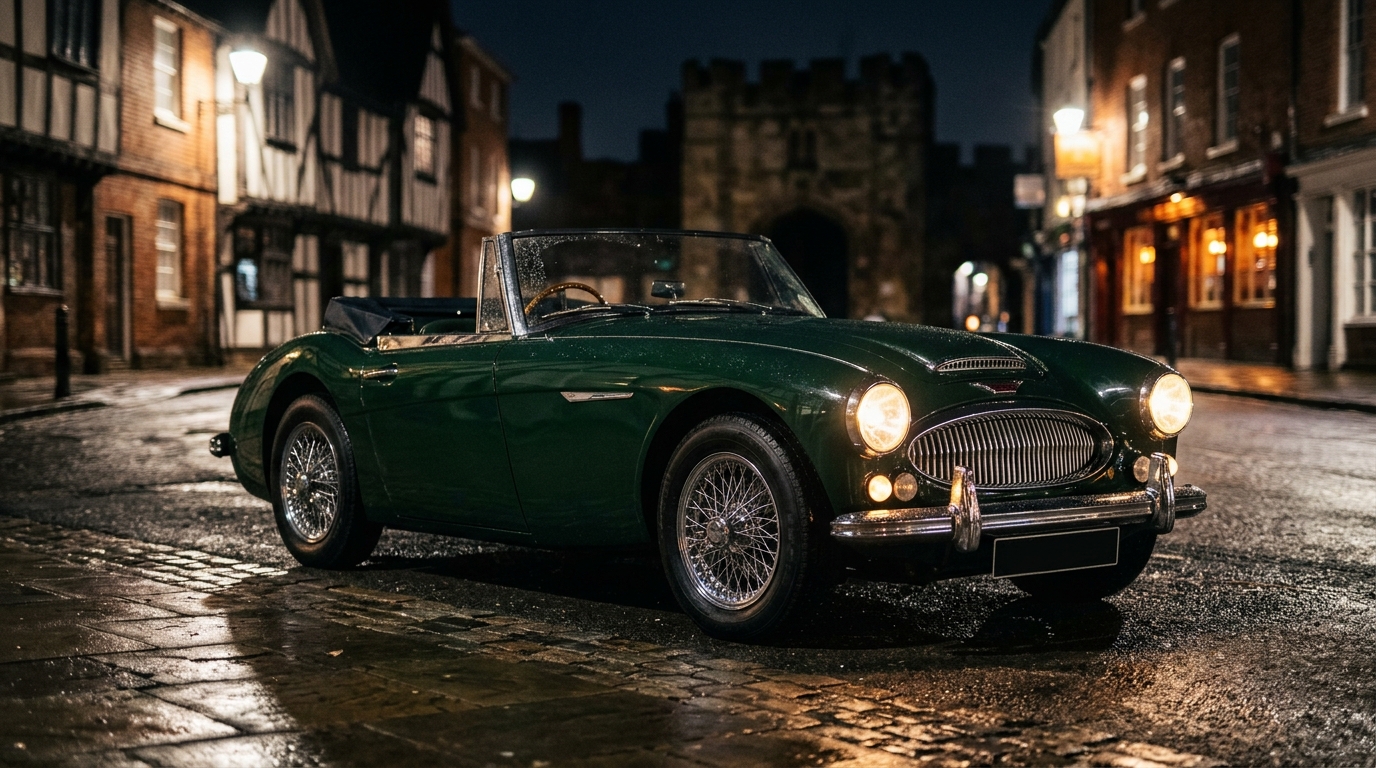
The streets are empty, the sodium lamps hum overhead, and a long bonnet stretches out ahead of you in the glow of two yellowed headlamps. At that hour, with the six-cylinder rumbling through the side exhaust and the dashboard glowing a soft orange, the Austin-Healey 3000 feels like the best-kept secret on British asphalt.
A quick note on that headline: Maranello is Ferrari territory, and the Healey is a pure Warwick-and-Abingdon product. But Enzo himself reportedly kept an eye on how Donald Healey’s big roadster sold in America, and after midnight on an empty road, this car earns the grand-touring grandeur that title suggests.
The Last of the Big Healeys
The 1967 model year is a bookend. The Austin-Healey 3000 Mk III, internally known as the BJ8, was in its final full season of production before the line ended in December 1967. It was built at the British Motor Corporation’s MG plant in Abingdon, and the Mk III represented the most refined and powerful evolution of the original 100-Six lineage that began in 1956.
Beneath that long, sweeping bonnet sits BMC’s venerable C-series 2,912 cc inline-six. In Mk III form, with twin 2-inch SU HD8 carburettors, it makes 150 horsepower (gross) at 5,250 rpm and about 173 lb-ft of torque at 3,000 rpm. That is an old-school, low-revving, torque-rich engine, and it defines everything about how the car feels.
Driving After Dark
Press the starter and the C-series settles into a deep, gravelly idle that reverberates off garage doors and brick walls. At night, sound is the Healey’s headline act. The exhaust note is a rich, woofling baritone that rises to a hard-edged bark as you climb the revs, and with the quiet of a midnight road, you hear every pulse through the side-exit pipes.
The BJ8 Mk III gets a proper wood-veneer dashboard and a centre console, a genuine step up in cabin ambiance over earlier cars. After dark, the white-on-black instruments glow gently, and the whole cockpit feels intimate and purposeful. The gearbox is a four-speed manual with overdrive on third and fourth, a combination that lets you relax into long motorway-style stretches with a flick of the switch.
Headlamps and Visibility
Here is where honesty matters. The Healey’s Lucas sealed-beam headlamps, by modern standards, are dim, and the 12-volt electrics of the era were never a strength. Expect a warm, yellowish pool of light that illuminates the road ahead adequately but never generously. Fast night driving in a stock car demands respect: you drive to your lights, not beyond them. Many owners fit modern halogen conversions in period-correct housings, which transforms night usability without spoiling the looks.
The low seating position and long bonnet mean you sit nearly over the rear axle with the road unrolling far ahead of you. With the hood down on a warm night, the starfield above is part of the experience. With the hood up, the cockpit is snug, and rain on the fabric is oddly soothing.
Handling and Ride
Do not mistake charm for sharpness. The 3000 rides on a ladder-style steel chassis with independent front suspension via coil springs and wishbones, and a live rear axle on semi-elliptic leaf springs. Steering is a lever-arm-style cam and peg setup that is heavy at parking speeds and communicative on the move. The car rolls, it understeers when pushed, and over bumps the live axle can skip. But the Mk III gained front disc brakes (standard on this series), which gives genuinely confident stopping power compared to earlier drum-braked Healeys.
Ground clearance is another famous quirk. The low-slung exhaust and sump mean you learn to watch speed humps closely. At night, with limited visibility of the road surface, that vigilance matters even more.
A Little History
Donald Healey unveiled the original Healey 100 at the 1952 Earls Court Motor Show, and Leonard Lord of Austin famously struck a deal on the spot to build it in volume. The big Healey grew through the 100-4, the 100-Six, and finally the 3000 range, adding displacement and polish along the way. The Mk III was the zenith. Production of the 3000 Mk III ran from 1964 through 1967, and the model’s racing and rally pedigree, including Pat Moss’s Liege-Rome-Liege victory in a 3000 in 1960, helped cement its reputation.
Emissions and safety regulations, plus rising costs and the fraying of the British Leyland empire, spelled the end. The last cars were built in December 1967, with production totalling just over 42,000 3000s across all marks.
Editor’s verdict: The 1967 Austin-Healey 3000 Mk III is not the quickest or sharpest classic you can buy, but after dark it is among the most atmospheric. That growling six, the glowing dash, and the long bonnet make every empty road feel like a stage, and the final-year BJ8 is the one to own.