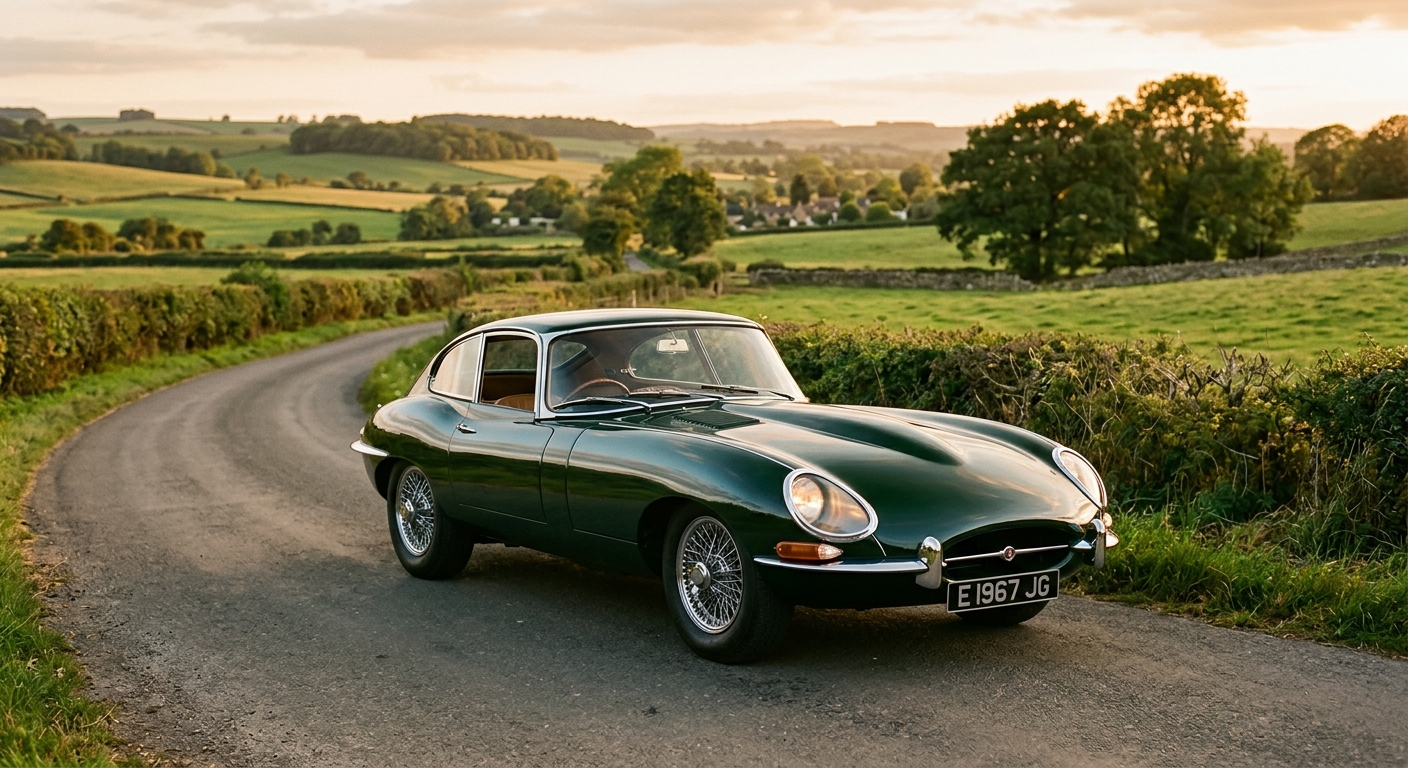
When Enzo Ferrari himself declares a car “the most beautiful ever made,” the automotive world takes notice. The Jaguar E-Type didn’t just turn heads when it debuted at the 1961 Geneva Motor Show, it stopped traffic, redefined automotive aesthetics, and established a new benchmark for what a sports car could be. By 1967, the Series 1 4.2-liter version had reached its evolutionary peak, combining Malcolm Sayer’s aerodynamic artistry with refined mechanical sophistication.
The Art of Motion
Malcolm Sayer wasn’t just a designer; he was an aerodynamicist who sculpted with mathematics and wind tunnels. Every curve of the E-Type serves both form and function, from the elongated bonnet that houses the straight-six engine to the distinctive rear haunches that echo the D-Type race car’s DNA. The Series 1’s covered headlights and slender bumpers create an unbroken visual flow that later Series would compromise for safety regulations.
The 4.2-liter version, introduced in 1964, represented the sweet spot of E-Type evolution. Jaguar had addressed the early cars’ temperamental nature while preserving their essential character. The larger displacement XK engine provided more torque, making the car more tractable in everyday driving without sacrificing the performance that made it famous.
Driving Poetry
Behind the wheel, the E-Type reveals why it captured imaginations worldwide. The driving position places you low and forward, with the long bonnet stretching ahead like a rocket ship. The XK 4.2-liter inline-six delivers its 265 horsepower with a mechanical symphony that builds to a crescendo at 5,500 rpm. This isn’t just an engine; it’s a musical instrument that happens to produce motion.
The four-speed manual transmission, now equipped with synchromesh on first gear for 1967, slots between ratios with purposeful precision. Each shift feels deliberate, connecting driver to machine through mechanical feedback that modern cars have sanitized away. The steering wheel, thin and large in the British tradition, communicates every nuance of the road surface through your fingertips.
The Independent Spirit
Jaguar’s independent rear suspension was revolutionary for a production sports car in 1961, and by 1967, the system had been refined to near-perfection. Unlike the solid-axle American muscle cars of the era, the E-Type danced through corners with a grace that belied its straight-line performance. The unequal-length wishbones and coil-over dampers provided handling that could embarrass cars costing twice as much.
The disc brakes all around, another advanced feature for the time, provide stopping power that matches the acceleration. However, like all aspects of the E-Type, they require proper technique and respect. This is a car that rewards smooth inputs and punishes ham-fisted driving, teaching lessons in automotive etiquette that modern stability systems have made obsolete.
Cultural Impact
The E-Type’s influence extends far beyond automotive circles. It became a symbol of the swinging sixties, appearing in films, adorning bedroom walls, and representing the optimistic spirit of the era. Austin Powers drove one, George Best owned one, and countless others dreamed of one. The car embodied accessible exoticism at a price point that, while still expensive, was within reach of successful professionals rather than just the ultra-wealthy.
Production of nearly 73,000 E-Types over 14 years proved that beauty and performance could coexist with commercial success. The Series 1 4.2, produced from 1964 to 1968, represents approximately 25,000 of those cars, making it the most numerous and arguably the most desirable variant.
The 1967 E-Type Series 1 4.2 represents automotive perfection frozen in time, a moment when engineering prowess and artistic vision converged to create something truly transcendent. More than half a century later, it remains the standard by which all beautiful sports cars are measured. When Enzo Ferrari called it the most beautiful car ever made, he wasn’t just offering praise, he was acknowledging the creation of an immortal masterpiece.