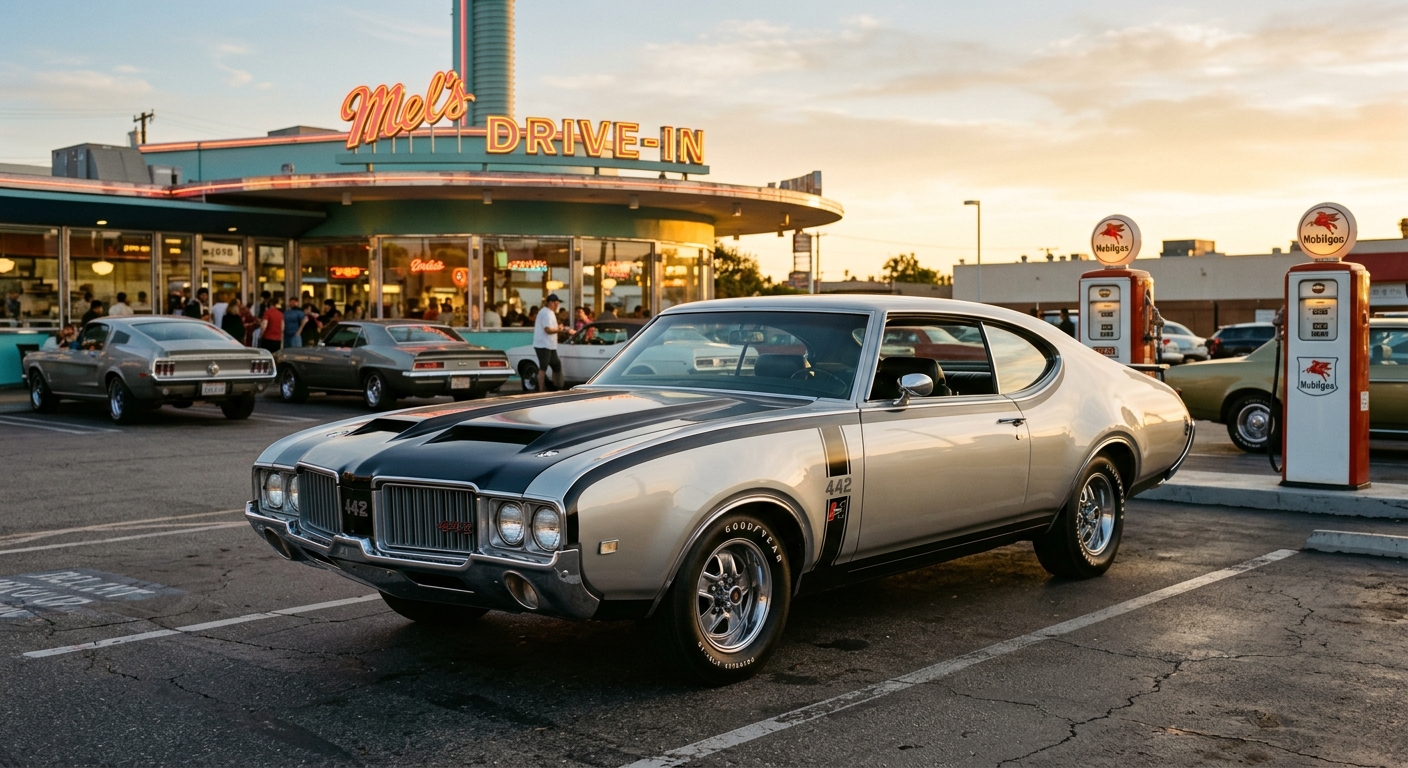
In 1968, when muscle car mania reached fever pitch, Oldsmobile partnered with aftermarket legend George Hurst to create something truly special. The Hurst/Olds wasn’t just another factory hot rod; it was a rolling statement that combined Oldsmobile’s engineering prowess with Hurst’s performance reputation. With its distinctive silver and black paint scheme and that unmistakable Force-Air hood, the Hurst/Olds 442 became an instant icon of American automotive excess.
The Birth of a Legend
The 1968 Hurst/Olds represented a unique collaboration in automotive history. Unlike typical manufacturer-tuner relationships, this partnership saw George Hurst’s company actually take delivery of completed 442s from Oldsmobile’s factory, then perform extensive modifications before selling them through select Oldsmobile dealers. This unusual arrangement meant each car carried both Oldsmobile and Hurst warranties, legitimizing the performance modifications in ways that typical aftermarket tuners couldn’t match.
At the heart of every Hurst/Olds sat Oldsmobile’s mighty 455 cubic inch V8, force-fed by a specialized induction system that gave the car its aggressive appearance and distinctive exhaust note. The engine produced a conservative 390 horsepower rating, though most experts agree the actual output was significantly higher. This was the era of insurance-driven underreporting, after all.
Visual Impact and Design
Nothing on the road looked quite like a Hurst/Olds. The mandatory Firefrost Gold and Black paint scheme wasn’t just distinctive; it was borderline outrageous. The dual-scooped Force-Air hood dominated the front end, while Hurst’s signature shifter knob proclaimed the car’s performance credentials to anyone who glanced inside. Racing stripes, unique wheels, and tasteful Hurst badging completed a package that managed to be both elegant and aggressive.
The interior received equal attention, with special door panels, custom instrumentation, and that famous Hurst Dual-Gate shifter. The shifter allowed drivers to operate the automatic transmission in full manual mode, providing much of the control of a manual transmission with the convenience of an automatic. It became so popular that GM eventually licensed the design for use across multiple brands.
Performance and Driving Experience
Behind the wheel, the Hurst/Olds delivered exactly what its appearance promised. The big 455 produced massive torque from idle, making effortless acceleration the car’s defining characteristic. While precise 0-60 times varied depending on rear axle ratio and other options, most examples could reach 60 mph in well under 6 seconds, with quarter-mile times consistently in the mid-13-second range.
The Force-Air induction system didn’t just look dramatic; it actually improved performance by providing cooler, denser air to the carburetor. The system included functional hood scoops that created positive pressure at speed, effectively force-feeding the engine. Combined with a carefully tuned exhaust system, the result was both visual theater and genuine performance enhancement.
Handling and Dynamics
While straight-line acceleration was the Hurst/Olds’ forte, the underlying 442 chassis provided surprisingly competent handling for such a large, powerful car. The heavy-duty suspension, front and rear stabilizer bars, and wide-oval tires gave the car reasonable composure through corners, though its true element remained wide-open highways and drag strips.
The power steering was appropriately weighted for a muscle car, providing enough feedback to inspire confidence without becoming tiring in traffic. Four-wheel drum brakes were standard, though front discs were available and highly recommended given the car’s performance potential.
Legacy and Collectibility
Only 515 Hurst/Olds 442s were built for 1968, making them among the rarest muscle cars of the era. This scarcity, combined with their unique history and unmistakable appearance, has made them highly sought after by collectors. The partnership between Oldsmobile and Hurst continued through 1972, but the original 1968 model remains the most coveted.
Today, finding an original Hurst/Olds in good condition requires both patience and deep pockets. The distinctive paint scheme means that authenticity is relatively easy to verify, but restoration costs can be substantial due to the car’s unique components and trim pieces.
The 1968 Hurst/Olds 442 remains one of the most charismatic muscle cars ever built, combining genuine performance with unforgettable style. Its rarity ensures it will always be special, but the real magic lies in that perfect collaboration between two American performance legends. In a world of modern efficiency and digital interfaces, the Hurst/Olds reminds us when horsepower was king and subtlety was for Europeans.