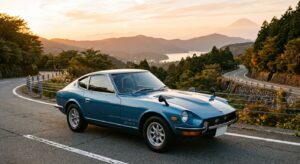
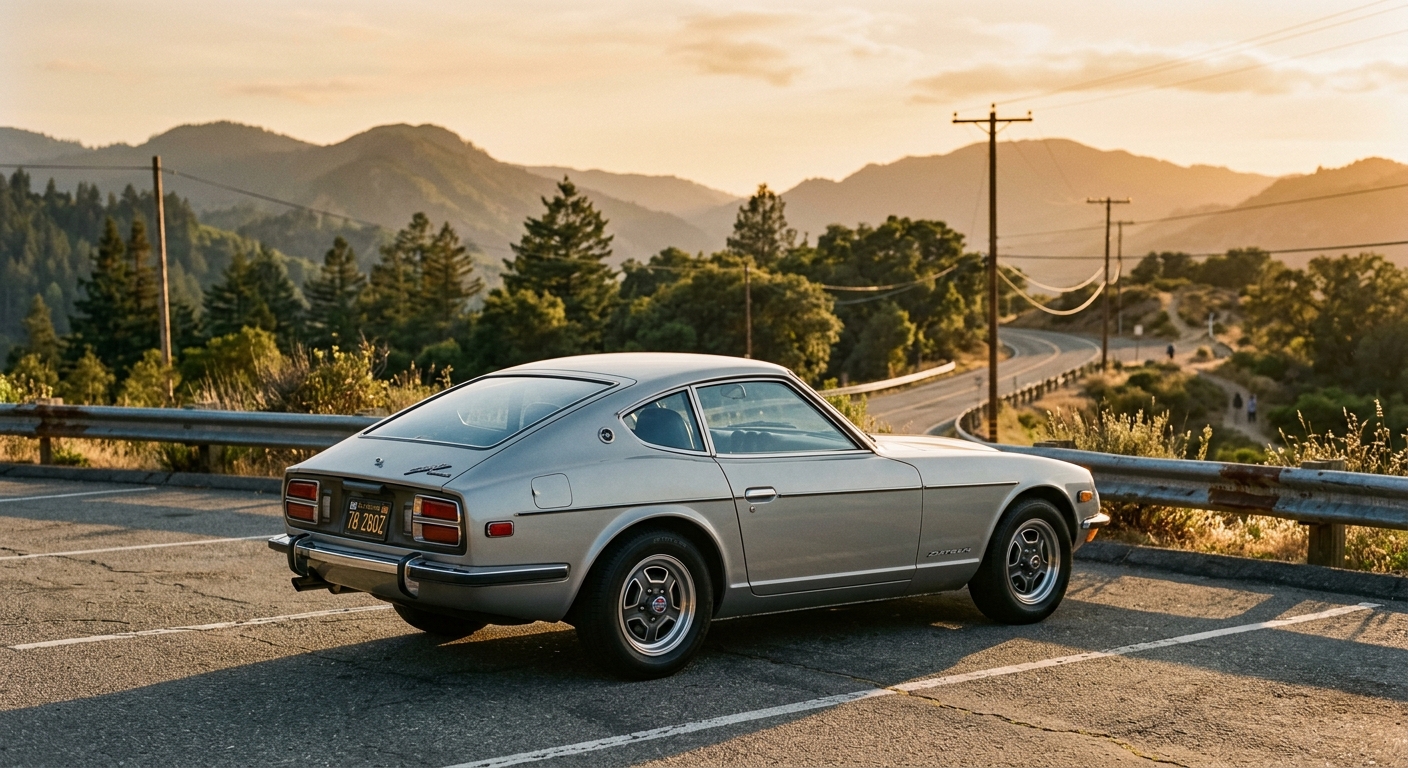
By 1978, the Datsun Z-car had already revolutionized the sports car world, proving that Japan could build machines that rivaled Europe’s finest at half the price. The 280Z represented the final evolution of the original S30 generation, carrying forward the pure design language that made the 240Z famous while addressing the regulatory realities of the late 1970s.
The Last of the Original Breed
The 280Z arrived for the 1975 model year as emissions regulations tightened and safety standards evolved. While purists mourned the loss of the 240Z’s raw simplicity, the 280Z offered a more refined interpretation of the Z-car formula. The 2.8-liter L28 inline-six produced 170 horsepower in 1978 form, down from earlier years due to increasingly stringent emissions controls, but still delivered the smooth power delivery that made the Z-car special.
Behind the wheel, the 280Z reveals why these cars became icons. The long hood stretches ahead, interrupted only by the distinctive power bulge that hints at the straight-six beneath. The driving position is low and purposeful, with a three-spoke steering wheel that connects you directly to the front wheels. The shifter for the five-speed manual falls perfectly to hand, clicking through gears with mechanical precision that modern cars have lost in pursuit of refinement.
Engineering Excellence
What set the Z-car apart was its sophisticated engineering packaged in an affordable sports car. Independent suspension at all four corners was still exotic in 1978, yet Datsun made it standard equipment. MacPherson struts up front and semi-trailing arms at the rear provided handling that embarrassed cars costing twice as much. The rack-and-pinion steering offered feedback that let you feel every nuance of the road surface.
The L28 engine represents the pinnacle of Datsun’s inline-six development. Fuel injection, introduced on the 280Z, provided crisp throttle response and improved drivability compared to the carbureted 240Z and early 260Z models. The engine pulls strongly from 2,000 rpm, building to a satisfying crescendo at 6,000 rpm with a soundtrack that’s distinctly Japanese yet thoroughly sporting.
Design That Defined a Generation
Count Albrecht Goertz’s timeless design reached its most mature expression with the 280Z. The addition of larger bumpers for crash compliance actually enhanced the car’s proportions, giving it a more substantial presence. Chrome bumpers on early models would give way to body-colored units, but the 1978 model year still featured the more attractive metallic finish.
Inside, the 280Z offered a level of equipment that seemed luxurious for a sports car. Air conditioning, power steering, and a comprehensive gauge package came standard or as popular options. The seats provided excellent support during spirited driving while remaining comfortable for longer journeys, making the Z-car a genuine grand tourer rather than a weekend-only toy.
Cultural Impact
The 280Z’s significance extends far beyond its mechanical specifications. It proved that sports cars didn’t need to be temperamental or unreliable to be exciting. While Italian and British sports cars spent more time in shops than on roads, the Datsun started every morning and asked only for basic maintenance. This reliability, combined with genuine performance and striking looks, created a new category of affordable exotic.
Today, clean 280Zs command serious money, with pristine examples bringing prices that seemed impossible just a decade ago. The combination of emerging classic status and the eternal appeal of the original Z-car design has created a strong collector market. Yet these cars remain accessible enough that enthusiasts can still experience what made them special without breaking the bank.
The 1978 Datsun 280Z stands as proof that the best sports cars aren’t always the fastest or most expensive. With prices rising rapidly, now might be the last chance to own a piece of automotive history that changed everything. This is Japan’s sports car revolution distilled into one timeless, accessible package.