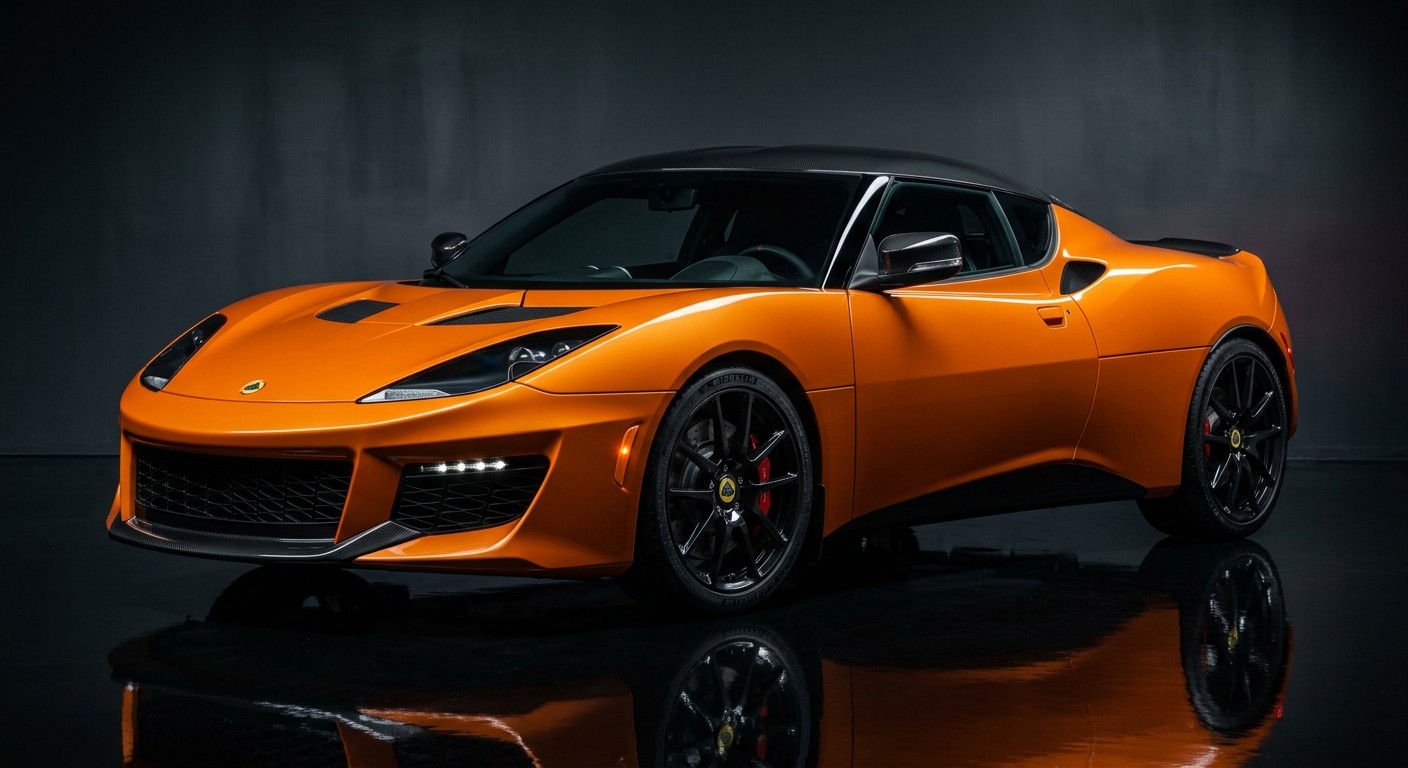
In an era where supercars have become increasingly digital and disconnected, the 2015 Lotus Evora 400 arrives as a refreshing reminder of what pure driving is supposed to feel like. This isn’t just another pretty face with a big horsepower number, it’s a precision instrument built by engineers who understand that the connection between driver and machine matters more than straight-line bragging rights.
The Hethel Formula
The Evora 400 represents Lotus at its most focused. Built at the legendary Hethel factory where Colin Chapman’s philosophy of “simplify, then add lightness” still echoes through every corridor, this machine tips the scales at just 3,153 pounds. That’s nearly 400 pounds lighter than a Porsche 911 Carrera S, and the difference is immediately apparent the moment you drop into the carbon fiber racing seats.
The Toyota-sourced 3.5-liter V6 has been thoroughly reworked by Lotus engineers, with a supercharger breathing 400 horsepower and 302 lb-ft of torque into what becomes an intoxicating cocktail of power and precision. But raw numbers only tell part of the story. This engine’s real magic lies in its delivery, building power in a linear, predictable surge that gives you complete confidence to explore its full potential.
Analog Perfection
Where modern supercars rely on computers to manage every aspect of the driving experience, the Evora 400 trusts you to handle the job. The six-speed manual transmission is a masterpiece of mechanical precision, with a shifter that snicks between gates with the satisfying click of a fine Swiss watch. There’s no dual-clutch wizardry here, just pure mechanical connection that rewards smooth technique and punishes ham-fisted inputs.
The suspension setup borders on telepathic. Lotus has tuned the Bilstein dampers and Eibach springs to communicate every detail of the road surface directly to your fingertips, yet somehow manages to remain civilized enough for daily use. It’s a balancing act that few manufacturers can achieve, requiring the kind of chassis expertise that only comes from decades of racing experience.
Track Day Hero
On track, the Evora 400 reveals its true nature. The Michelin Pilot Sport Cup 2 tires provide phenomenal grip, while the aerodynamic package, including that dramatic rear wing, generates genuine downforce rather than just looking aggressive. The brakes, upgraded with larger discs and improved cooling, provide fade-free stopping power lap after lap.
But it’s the steering that truly sets this car apart. In an age of variable-ratio, electrically assisted systems, the Evora’s hydraulic rack feels like a direct neural link to the front wheels. Turn-in is immediate, feedback is constant, and the car responds to your inputs with surgical precision. This is how steering used to feel before computers got involved, and it’s a sensation that modern drivers have largely forgotten.
The Reality Check
Living with an Evora 400 requires commitment. The cabin is snug, visibility is limited, and the ride quality can be punishing on poor surfaces. The infotainment system feels a generation behind the competition, and build quality, while much improved from earlier Lotus efforts, still lacks the consistency of German rivals. But these compromises are part of the package, trade-offs made in service of the driving experience.
The Evora 400 represents something increasingly rare in the modern automotive landscape: a supercar that trusts the driver to be part of the equation. It’s not the fastest, the most luxurious, or the most technologically advanced, but it might just be the most rewarding to drive. In a world of digital perfection, sometimes analog soul is exactly what you need.