While most muscle car enthusiasts were brawling in the streets with their Chevelles and GTOs, Buick quietly built one of the most sophisticated yet devastating performers of the era. The 1971 Skylark GSX represented Buick’s final statement in the muscle car wars, combining genteel luxury with raw, uncompromising power that could humble any street rival.
The Sleeper Supreme
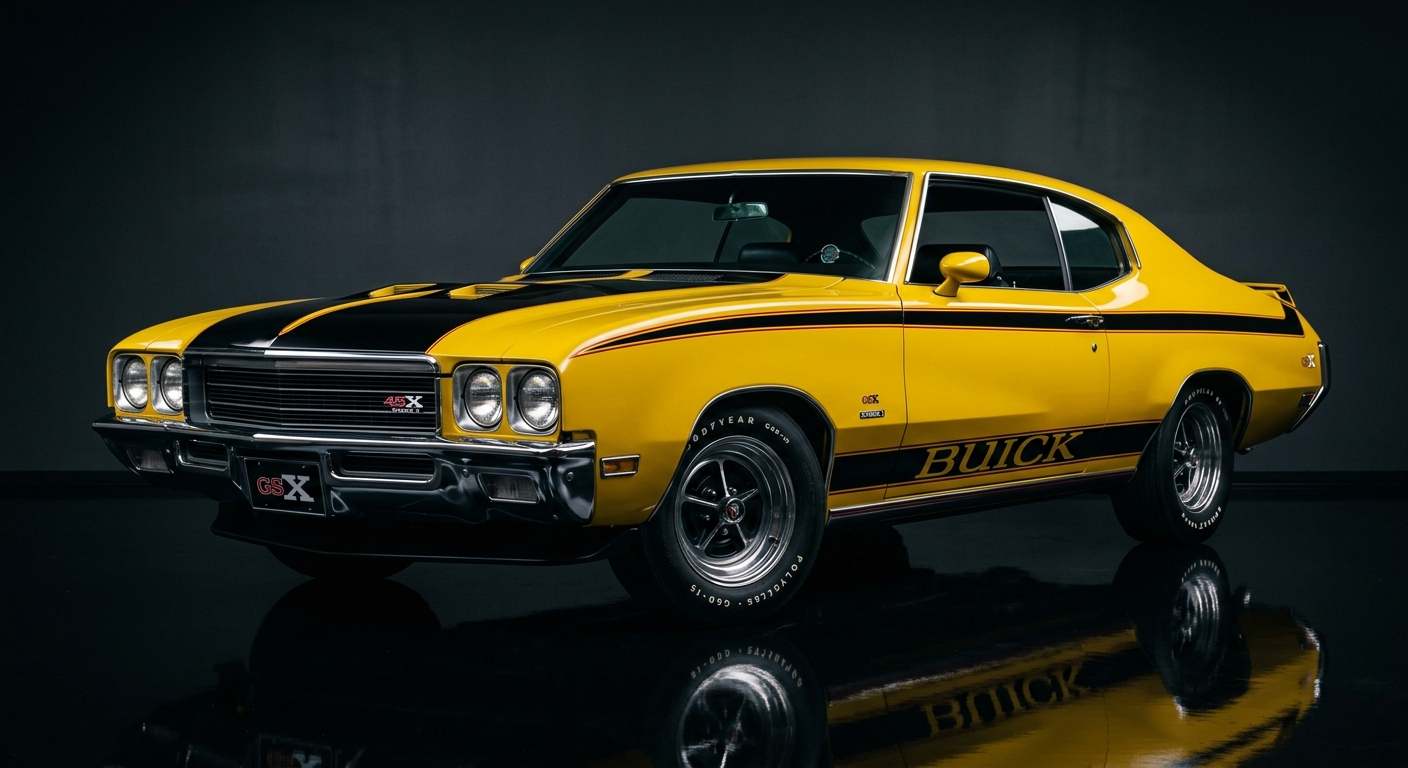
The GSX wasn’t just another muscle car; it was Buick’s answer to critics who claimed the brand was too refined for serious performance. Beneath that understated exterior lurked the legendary Stage 1 455 cubic inch V8, an engine that produced more torque than any other production motor of its time. With 510 lb-ft of twist available at just 2800 rpm, the GSX could launch off the line with authority that left flashier competitors struggling in its wake.
What separated the GSX from its more famous siblings was its sophisticated approach to power delivery. While other muscle cars relied on raw aggression, Buick engineered refinement into every component. The Stage 1 engine featured a high-lift cam, large port cylinder heads, and a Rochester Quadrajet carburetor that provided smooth power across the entire rev range. The result was a muscle car that could cruise comfortably on the highway yet unleash devastating acceleration when provoked.
Design Philosophy
The GSX’s visual presence struck a perfect balance between subtlety and menace. Unlike the cartoonish graphics and wild colors favored by other manufacturers, Buick chose a more mature aesthetic. The functional hood scoops, modest stripes, and carefully placed GSX badges announced the car’s intentions without resorting to theatrics. Available in Saturn Yellow or Apollo White with contrasting black accents, the GSX looked fast even at rest.
Inside, the cabin reflected Buick’s luxury heritage while acknowledging the car’s performance mission. Bucket seats, a center console, and full instrumentation created a driver-focused environment, but the materials and build quality exceeded anything found in competing muscle cars. The attention to detail extended to functional elements like the heavy-duty suspension components and upgraded cooling systems that ensured consistent performance under demanding conditions.
The Driving Experience
Behind the wheel, the GSX delivered an experience unlike any other muscle car of the era. The Stage 1 engine’s massive torque output meant that acceleration felt effortless rather than violent. Where other muscle cars required high RPMs and aggressive shifting to access their power, the GSX pulled strongly from idle. This characteristic made it devastatingly effective in real-world driving situations where raw power mattered more than peak horsepower numbers.
The chassis setup prioritized stability and control over outright handling prowess. The heavy-duty suspension components and wider tires provided confident straight-line stability, while the well-weighted steering offered feedback that was uncommon in American performance cars of the period. The overall package felt more European in its refinement, yet unmistakably American in its power delivery.
Cultural Impact and Legacy
The 1971 GSX arrived at the twilight of the muscle car era, just as emissions regulations and insurance costs began choking the life from high-performance American cars. Only 124 units were produced, making it one of the rarest and most coveted muscle cars ever built. This scarcity, combined with the car’s exceptional performance credentials, has elevated the GSX to legendary status among collectors.
The GSX proved that muscle cars didn’t have to sacrifice sophistication for performance. It demonstrated Buick’s engineering capabilities while serving as a farewell to an era when American manufacturers competed fiercely to build the fastest, most powerful cars possible. Today, surviving examples command enormous respect and astronomical prices, testament to the car’s enduring appeal and historical significance.
The 1971 Buick Skylark GSX stands as proof that the most memorable performance cars often come from unexpected sources. With its legendary Stage 1 engine and sophisticated execution, it represents the pinnacle of American muscle car engineering wrapped in a package that prioritized refinement over raw theatrics. For those fortunate enough to experience one, the GSX delivers an unforgettable reminder of what made the muscle car era truly special.