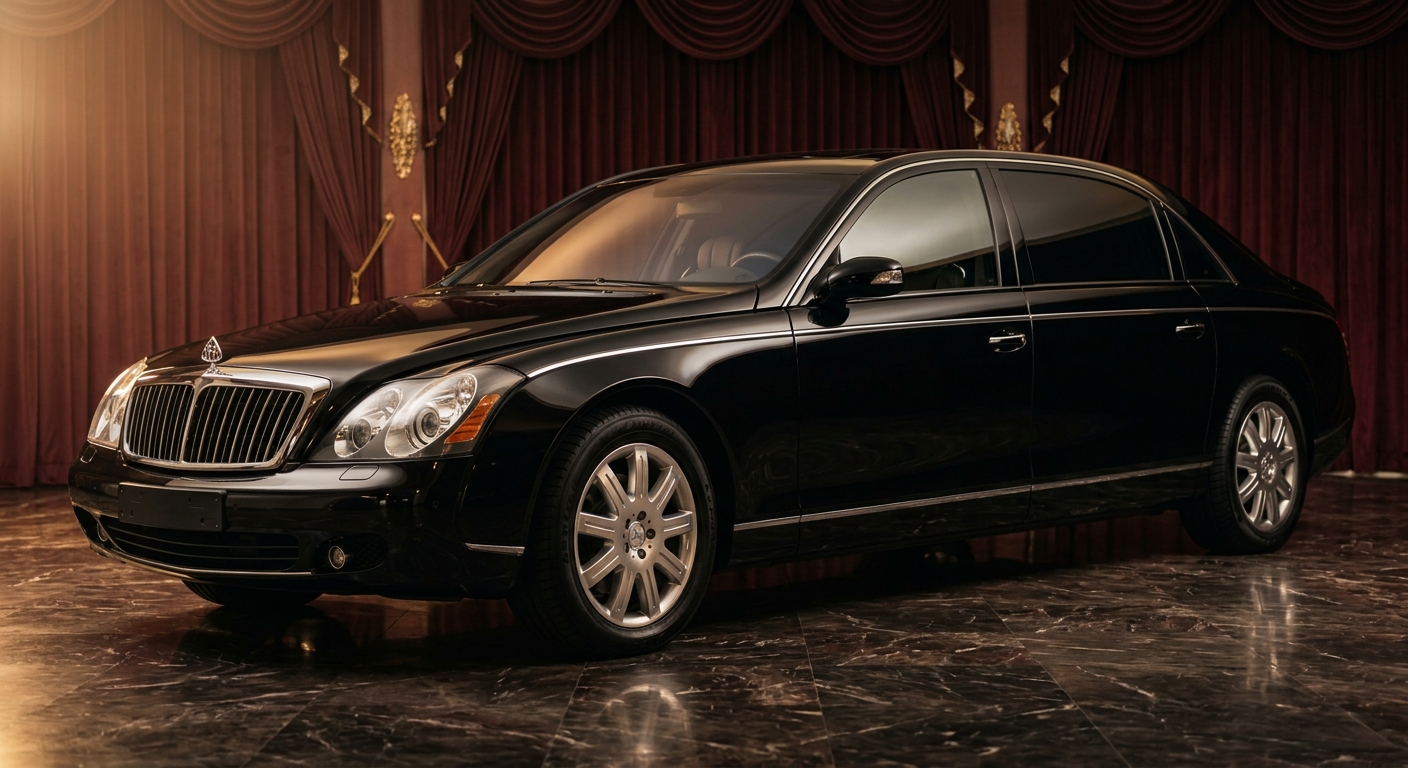
When Mercedes-Benz decided to resurrect the Maybach name in 2002, they weren’t aiming to compete with Bentley or even Rolls-Royce. They were creating something entirely new: a mobile palace that would make even the most extravagant luxury car seem quaint. The Maybach 62, with its cathedral-like interior and price tag approaching $400,000, represented the absolute pinnacle of automotive excess at the dawn of the new millennium.
A Fortress of Solitude
Sliding into the rear cabin of a Maybach 62 is less like entering a car and more like stepping into a private jet’s first-class cabin. The 62’s extended wheelbase creates a rear compartment so vast that passengers can fully recline without their feet touching the front seats. Every surface is swathed in the finest Nappa leather, with wood trim sourced from trees that were likely saplings when the original Maybach company folded in the 1940s.
The attention to detail borders on the obsessive. Rear passengers command their environment through a central control unit that manages everything from seat massage intensity to the champagne cooler temperature. The panoramic glass roof can be darkened at the touch of a button, transforming the cabin into a cocoon of privacy. Even the ashtrays are crafted from crystal, though one suspects most Maybach owners have people to handle their smoking for them.
Power Befitting Royalty
Beneath the Maybach’s imposing hood lies a 5.5-liter twin-turbocharged V12 that produces 543 horsepower and 664 lb-ft of torque. These numbers might seem modest by today’s hypercar standards, but in 2000, they were staggering for a 6,000-pound luxury barge. The engine’s primary mission isn’t raw acceleration but rather the effortless delivery of power that makes highway speeds feel like a gentle cruise.
The seven-speed automatic transmission shifts with the deliberate smoothness of a well-oiled bank vault door. This isn’t a car built for corner carving or quarter-mile runs; it’s engineered to transport its occupants in absolute serenity while the outside world blurs past the triple-sealed windows. Road noise is so thoroughly banished that conversations can be conducted in whispers.
The Price of Perfection
At launch, the Maybach 62 commanded a price that could buy a modest home in most American cities. Yet for the ultra-wealthy clientele it courted, the price was almost irrelevant. What mattered was exclusivity, craftsmanship, and the ability to travel in a manner befitting one’s station. Each car required over 900 hours to assemble, with much of the interior work completed by hand.
The driving experience is unlike anything else on the road. The 62 glides over imperfections with the serenity of a cruise ship, its adaptive air suspension continuously adjusting to maintain perfect composure. The steering is light and precise enough for city maneuvering, though most owners would never dream of piloting this beast themselves.
The Maybach 62 remains one of the most audacious automotive statements ever created, a rolling monument to the idea that there is no substitute for absolute luxury. While the brand struggled commercially and was eventually discontinued, these early Maybachs now stand as fascinating time capsules from an era when automotive excess knew no bounds. For those fortunate enough to experience one, the 62 delivers on every promise of ultimate luxury motoring.