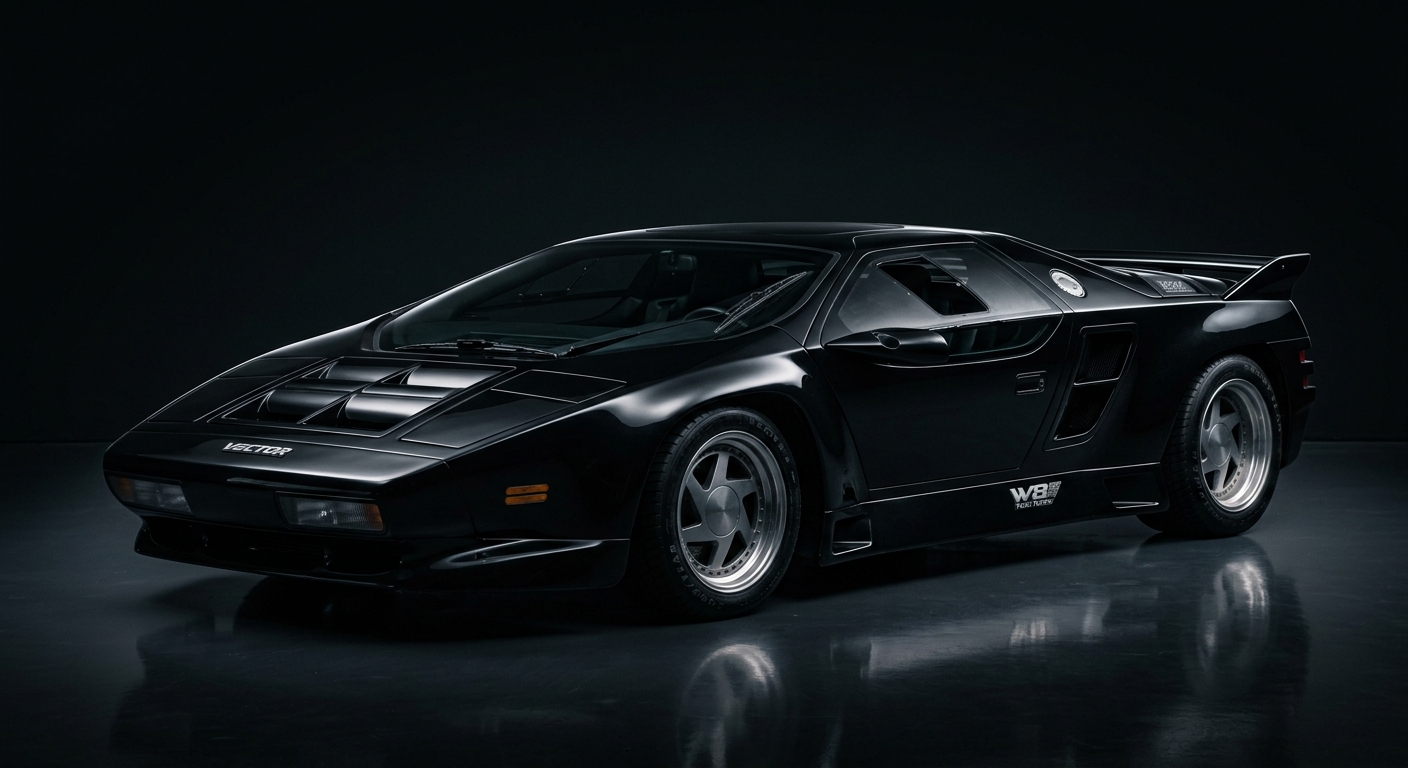
In the annals of automotive excess, few machines embody pure American supercar ambition quite like the Vector W8 Twin Turbo. This was Gerald Wiegert’s fever dream made manifest: a street-legal jet fighter that promised to embarrass European exotics with raw V8 power and space-age technology. While only 17 examples ever reached production, the W8 remains one of the most audacious automotive projects ever attempted on American soil.
The Birth of an American Icon
The Vector story begins in the early 1970s when Gerald Wiegert, a former Chrysler designer, set out to create the ultimate American supercar. His vision was uncompromising: build something that looked like it belonged on an aircraft carrier rather than a public road. The W8’s design was pure aggression, with its knife-edge wedge profile, fighter jet-inspired cockpit, and aerodynamic elements that served both form and function.
Development dragged on for nearly two decades, with prototypes appearing at auto shows throughout the 1980s. The production W8 finally arrived in 1991, though by then, the automotive landscape had shifted dramatically. What remained constant was Wiegert’s unwavering commitment to excess in every conceivable dimension.
Heart of Darkness: The Powertrain
At the core of the W8 sat a modified Chevrolet small-block V8, but calling it a simple Chevy motor would be like calling a Formula 1 car a basic race car. Vector’s engineers completely rebuilt the 350 cubic inch engine with twin Garrett turbochargers, custom internals, and sophisticated engine management systems. The result was a claimed 625 horsepower and 650 lb-ft of torque, figures that were genuinely shocking for the early 1990s.
Power traveled through a three-speed automatic transmission borrowed from the General Motors parts bin, a choice that raised eyebrows among purists but made sense given the engine’s massive torque output. The transmission featured paddle shifters mounted on the steering wheel, a relatively exotic feature at the time.
Fighter Jet Technology
Vector claimed extensive use of aerospace technology and materials throughout the W8’s construction. The chassis employed advanced composites and honeycomb structures similar to those found in military aircraft. The suspension featured active damping systems that could adjust in real-time based on driving conditions.
The cockpit was pure science fiction, with digital displays providing engine data, a heads-up display projecting information onto the windshield, and controls that looked more appropriate for a stealth bomber than a sports car. Vector even claimed the W8 could survive a nuclear electromagnetic pulse, though this feature was never independently verified.
Performance and Dynamics
On paper, the W8’s performance credentials were staggering. Vector claimed a top speed of 242 mph and 0-60 acceleration in just 3.9 seconds. Independent testing was limited given the car’s extreme rarity, but those fortunate enough to drive the W8 reported acceleration that lived up to its outrageous specifications.
The driving experience was reportedly as intense as the specifications suggested. The W8’s low, wide stance and massive power output created a machine that demanded respect and skill. The steering was heavy but precise, and the brakes, sourced from racing applications, provided stopping power to match the straight-line performance.
Daily Reality
As a practical matter, the W8 was virtually unusable in normal driving conditions. The seating position was extremely low, visibility was compromised by the fighter jet-style canopy, and the ride quality was punishing on anything but smooth surfaces. Climate control was marginal at best, and the complex electronic systems proved troublesome in real-world conditions.
Legacy and Collectibility
Production of the W8 effectively ended in 1993 when Vector’s financial troubles reached a crescendo. Megatech, an Indonesian company, eventually acquired Vector’s assets, but the original W8 program was finished. Today, surviving examples are among the most sought-after American supercars ever built.
The W8’s legacy extends far beyond its production numbers. It represented the absolute pinnacle of 1990s automotive excess and proved that American engineers could build something genuinely exotic when unleashed from conventional constraints. While European manufacturers focused on refinement and balance, Vector chose pure, unfiltered aggression.
The Vector W8 Twin Turbo stands as automotive proof that sometimes the most memorable machines are born from pure, uncompromising vision rather than market research and focus groups. While only 17 lucky souls ever owned one of these rolling statements of American excess, the W8’s legacy as the ultimate expression of supercar madness remains untouchable. In a world of increasingly sanitized supercars, the Vector reminds us that sometimes crazy is exactly what we need.