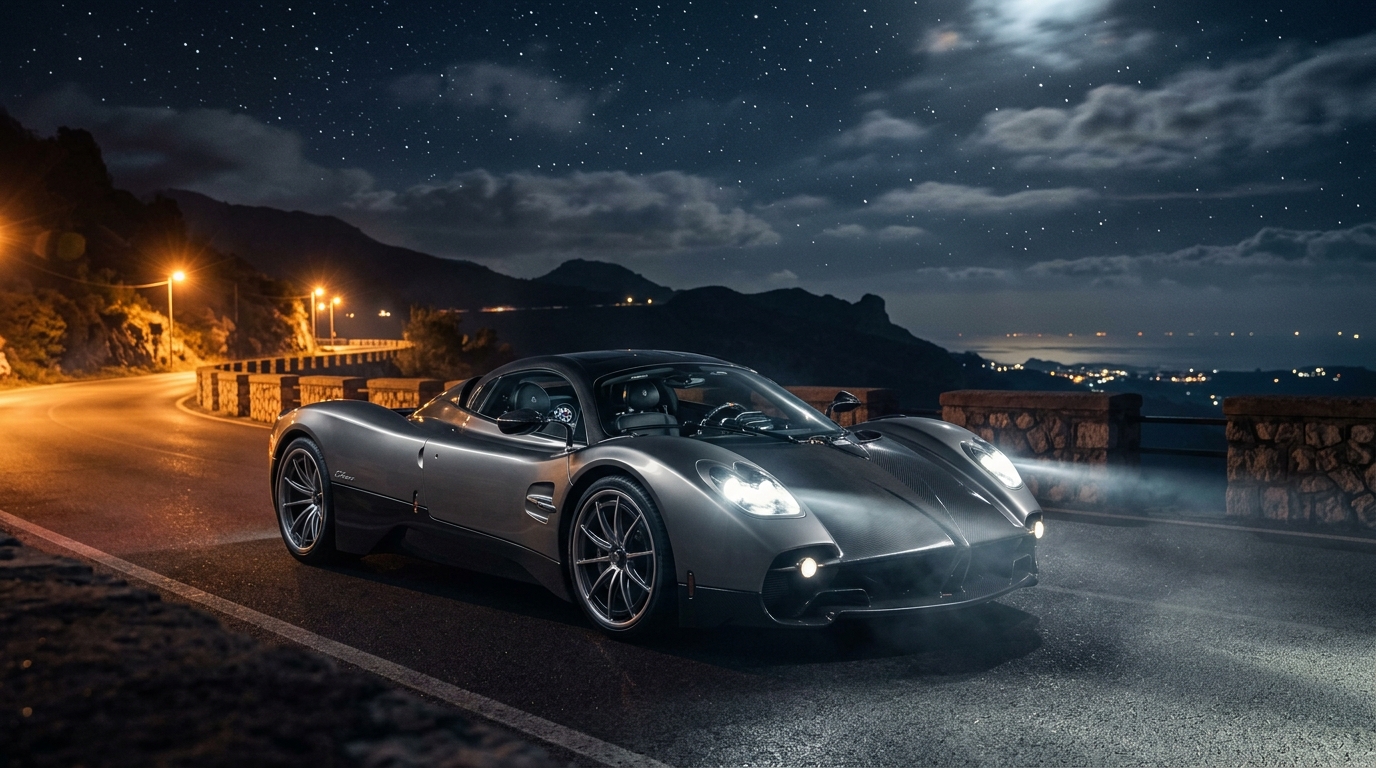
It is well past midnight and the road above Lake Como has gone quiet. The Pagani Utopia sits at the trailhead of a switchback climb, its engine ticking as it cools, the cabin lit like the inside of a jewelry box. Horacio Pagani has said he wanted this car to feel like a piece of art you can drive, and under a sky full of stars, it is easy to believe him.
A Hypercar Built for Drivers Who Still Want a Third Pedal
The Utopia is the successor to the Huayra, revealed in 2022 and delivered from 2023. Pagani built just 99 examples, and the whole production run was spoken for before the car had been shown publicly. Its mission was refreshingly old-fashioned. After years of hypercars chasing lap times with dual-clutch gearboxes and hybrid systems, Pagani went the other way: a naturally simple, deeply mechanical V12 and, crucially, a manual gearbox offered alongside an automated option.
The engine is a 6.0-liter twin-turbocharged V12 supplied by Mercedes-AMG, tuned specifically for Pagani. It produces 852 horsepower and 811 lb-ft of torque, with the torque plateau arriving early and holding on to a redline of 6,700 rpm. That is a lower peak than the Huayra R or some rivals, but this car is not about numbers on a spec sheet. It is about the way the power arrives.
Night Driving Impressions
Night is when the Utopia makes the most sense. The interior is a riot of machined aluminum, leather, and exposed mechanical linkage, and after dark the instrument cluster and switchgear glow with a warm, deliberate intensity. The gear lever moves through a polished aluminum gated shifter, and the clack of each gate is audible over the engine note. At 2 a.m. on an empty road, with nothing else to compete for your attention, that mechanical conversation between hand and gearbox is the entire point.
The headlights use a slim, jewel-like design and throw a wide, even beam, which matters on unlit mountain roads where the Utopia’s long hood and low seating position can make it hard to judge corner entry. Visibility out of the cabin is better than you might expect for a mid-engine exotic, thanks to the thin pillars and a generous glass area, though the rear three-quarter view remains the usual hypercar compromise.
The sound is the real nighttime star. The V12 has a deep, bassy bellow at low revs that builds into a hard-edged howl as the turbos spool and the engine climbs toward its limit. Echoing through a tunnel or off a rock wall, it carries an acoustic richness that EVs and downsized turbo engines cannot match. The quad central exhaust, a Pagani signature, fires the sound out directly behind you, and with the windows down at night you hear every crackle on the overrun.
The Mechanical Details That Matter
Power goes to the rear wheels only, through a choice of two gearboxes. The first is a seven-speed manual built by Xtrac, a transverse unit with a conventional clutch. The second is a seven-speed automated manual (AMT) that Pagani describes as a modern take on the traditional single-clutch sequential box. Roughly a third of buyers were expected to choose the manual, a remarkable number at this price. The manual car is also lighter, with Pagani citing a dry weight of around 1,280 kg (2,822 lb), against about 1,280 kg for the AMT car, with the Xtrac unit shaving roughly 40 kg versus a dual-clutch alternative.
The chassis is a carbon-titanium monocoque, a Pagani specialty, wrapped in carbon fiber bodywork. Suspension is an independent double-wishbone setup with pushrod-actuated dampers at each corner. Carbon-ceramic brakes from Brembo handle stopping duties, and the car rides on forged magnesium wheels with Pirelli P Zero Corsa tires.
Aerodynamics are active but restrained, with a small adjustable rear spoiler and flaps that deploy under braking. The styling is unmistakably Pagani, with a flowing, almost organic form, exposed carbon weave, and clever cooling inlets that feed the twin turbos and intercoolers. Look closely at the details: the stitching, the machined screws, the little brass and titanium touches. Each car takes thousands of hours to build in Pagani’s atelier in San Cesario sul Panaro, near Modena.
How It Drives Between Stops
On the road the Utopia is surprisingly approachable. The steering is light and communicative, the ride is firmer than a grand tourer but far from punishing, and the clutch is manageable even in slow traffic. The V12 pulls cleanly from low revs, so you are not forced to chase redline to feel quick. This is a car you could genuinely take on a long late-night run to the coast.
Push harder and it rewards you. Pagani quotes a 0-60 mph time of roughly 2.9 seconds and a top speed of around 220 mph, and the car feels stable and planted well beyond any sensible road speed. But the real story is the connection. The manual gearbox, the hydraulic steering feel, the raw V12 soundtrack, these are the things that make a night drive in the Utopia worth losing sleep over.
Editor’s verdict: The Utopia is the rare hypercar that cares more about how it feels at 2 a.m. than how it looks on a spec sheet. With a thundering AMG V12, a proper manual gearbox, and craftsmanship that borders on sculpture, it is Horacio Pagani’s love letter to driving itself. Sold out, scarce, and spectacular, it is worth every sleepless mile.