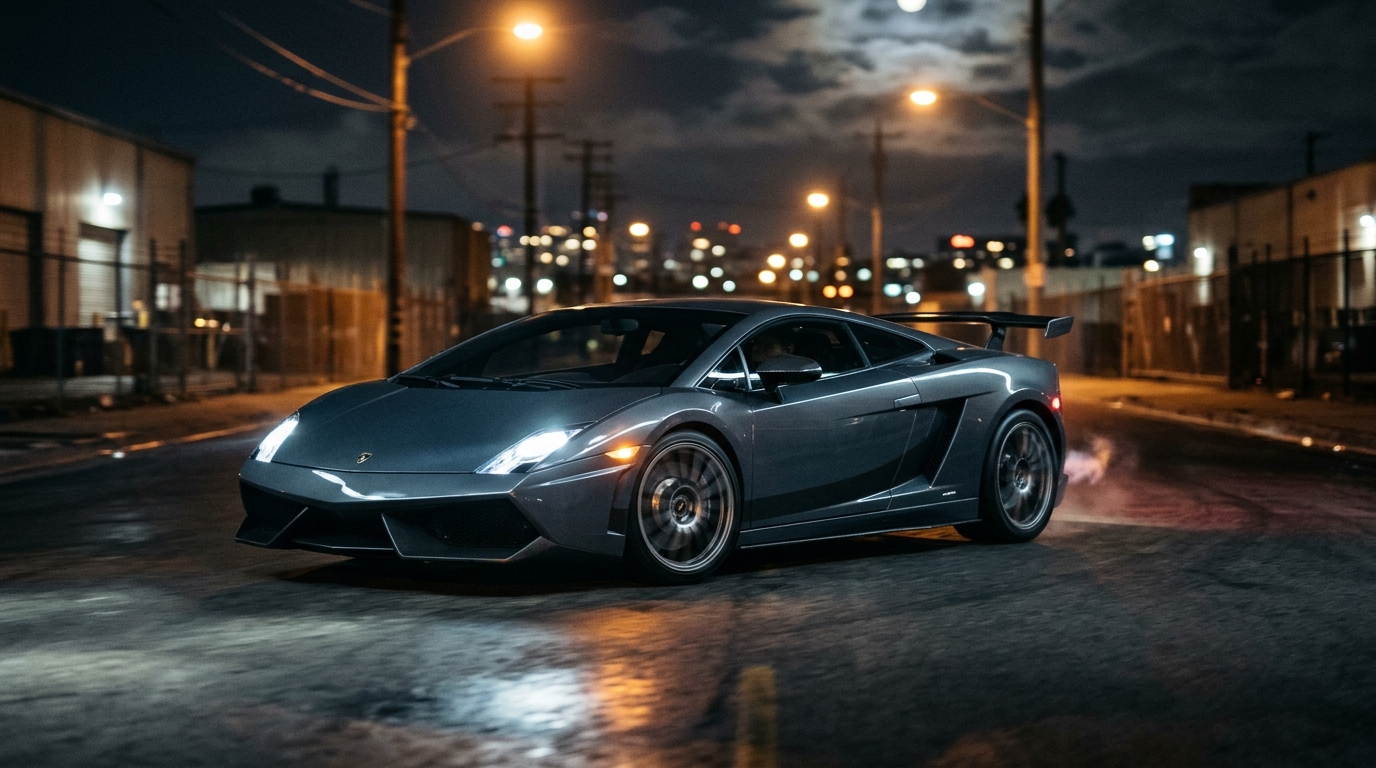
It is a little after midnight, the commuter traffic has evaporated, and the only light on the road is the sodium glow bouncing off wet asphalt. Behind you, a 5.0-liter V10 idles with a hard, metallic bark that echoes off every concrete wall in the underpass. This is the Gallardo Superleggera, the version of Lamborghini’s baby bull that traded creature comforts for carbon fiber and a serious diet.
Why Lighter Matters After Dark
Superleggera means super light in Italian, and Lamborghini did not use the name lightly. Introduced at the 2007 Geneva Motor Show, the Gallardo Superleggera shaved roughly 100 kg from the standard Gallardo’s mass, bringing the claimed dry weight down to about 1,340 kg. That diet came from extensive use of carbon fiber: the rear wing, engine cover, mirror housings, rear diffuser, sill covers and much of the interior trim. Lexan was used for the engine bay cover windows and rear side glass, and the car wore lightweight 19-inch Mimas wheels and a stripped, Alcantara-heavy cabin with carbon-shell bucket seats.
By 2008, the Superleggera was the sharpest tool in the Gallardo range. Under the engine cover sits the familiar 5.0-liter 90-degree V10, tuned to 530 hp at 8,000 rpm and 376 lb-ft of torque at 4,250 rpm, up 20 hp over the regular Gallardo. Power goes through permanent all-wheel drive with a viscous-coupling center differential, and it can be paired with either a six-speed manual gated shifter or the single-clutch e-gear automated manual with paddle shifters.
Driving It at Night
The first thing you notice after dark is how much the cabin ambience changes. The dashboard is a low, faceted wedge of Alcantara and carbon, lit by a small collection of red and white gauge illumination that feels almost like a fighter cockpit. There is no sound deadening to speak of, so the V10 is not a distant soundtrack but a physical presence. Through a tunnel, the exhaust note ricochets off the walls and fills the car, a raw, rising howl that pulls toward its 8,000 rpm limit with a guttural intensity you feel in your sternum.
The stock headlights are a product of their era: bright halogen-style projectors that do a decent job, but they do not match the adaptive LED systems of modern supercars. On a winding back road, you will want to be a touch more deliberate about your pace in the corners, because the beam pattern simply does not reach as far or as wide as current technology. What the car gives back is feedback. The steering is quick and loaded with detail, and the lighter nose responds more eagerly than the standard Gallardo, so you can place the car precisely even when you cannot see the full exit of the corner.
The all-wheel-drive system is the quiet hero on a cold, damp night. Rear-biased in normal conditions, it sends power to the front axle when the rear tires begin to slip, giving you a safety net that rear-drive rivals simply cannot offer. With 530 hp and around 1,400 kg to move, acceleration is ferocious: Lamborghini quoted 0-60 mph in about 3.8 seconds and a top speed of roughly 196 mph. Independent testers regularly confirmed figures right around that mark with the e-gear car.
The e-Gear Question
Transmission choice defines the experience. The e-gear single-clutch automated manual is quicker on paper but delivers jerky, head-nodding shifts in town and a slightly unrefined feel at low speeds. At night on an open road, however, flat out through the gears with the paddles, it delivers a satisfying mechanical punch on each upshift. Purists chase the manual gated shifter, which is a gorgeous piece of theater and far more engaging on a quiet midnight run. Manual Superleggeras are the ones collectors now prize.
A Lightweight in a Heavy Legacy
The Gallardo launched in 2003 as the first Lamborghini developed under Audi ownership, and it became the best-selling model in the company’s history, with more than 14,000 units built over its decade-long life. The Superleggera was a limited-run halo trim within that lineup, and it set the template for later track-focused variants like the Performante. Its Audi-derived V10 architecture, fixed in place with Lamborghini’s own aggression, gave the brand reliability and attitude in equal measure, which is why used examples remain compelling today.
Living with one is another matter. The ride is firm, the visibility out the back is poor, and the nose-lift system was not a standard fixture on early cars, so steep driveways demand care. But after dark, with the city quiet and the road open, none of that matters. The Superleggera feels purposeful and slightly feral, the kind of car you wake up the neighborhood with and do not apologize for.
Editor’s verdict: The 2008 Gallardo Superleggera is a lighter, louder, more focused Lamborghini that rewards the driver who knows the road is empty and the night is long. It is impractical, thirsty and unapologetically dramatic, and that is exactly why it works. Find a manual one if you can, and drive it after midnight.