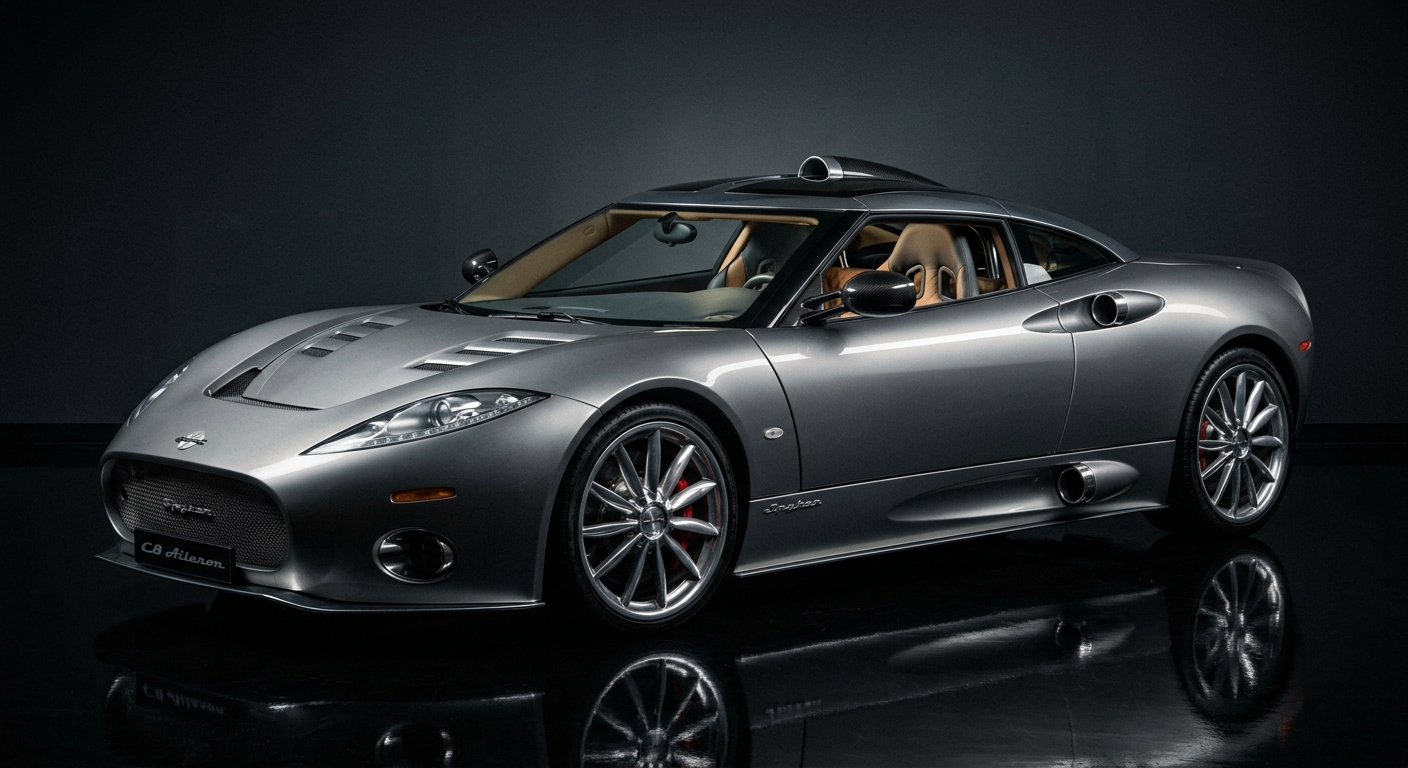
In a world dominated by Italian stallions and German precision, the Netherlands produced something utterly extraordinary: the Spyker C8 Aileron. This wasn’t just another supercar trying to muscle into an overcrowded market, but a handcrafted love letter to aviation history wrapped in carbon fiber and powered by pure passion.
Aviation Heritage Made Manifest
Every Spyker tells a story, and the C8 Aileron’s narrative runs deeper than most exotic cars dare venture. The company’s roots stretch back to 1880s aircraft manufacturing, and that aeronautical DNA courses through every aluminum rivet and leather stitch. The Aileron takes its name from the movable flight control surface, a fitting tribute considering how this car was designed to slice through air with surgical precision.
Step inside, and you’re not entering a cockpit so much as a flying machine’s command center. The exposed gear linkage runs down the center console like aircraft control cables, while the machined aluminum dashboard pieces could have been lifted straight from a vintage fighter plane. Every surface tells the aviation story, from the propeller-blade door handles to the turned aluminum instrument surrounds that gleam like polished aircraft components.
Handcrafted Perfection
In an era of mass production and shared platforms, Spyker remained defiantly artisanal. Each C8 Aileron required approximately 3,500 hours to build by hand in the company’s Zeewolde facility. The attention to detail borders on obsessive: every piece of leather is hand-stitched, every aluminum component is individually machined, and the paint process alone takes several weeks to complete properly.
This meticulous approach extended to the engineering. The space frame chassis was crafted from chrome-molybdenum steel, providing exceptional rigidity while keeping weight to a reasonable 3,200 pounds. The body panels, formed from carbon fiber, wrapped around this skeleton with the precision of a tailored suit.
American Heart, European Soul
Beneath the Aileron’s sleek hood beats a 4.2-liter Audi V8, modified by Spyker to produce 400 horsepower and 354 lb-ft of torque. While some purists might have preferred a more exotic powerplant, this choice proved inspired. The naturally aspirated unit delivered linear power delivery and a soundtrack that complemented rather than overwhelmed the car’s sophisticated character.
Mated to either a six-speed manual or optional automatic transmission, the V8 propelled the Aileron to 60 mph in just 4.5 seconds while maintaining remarkable refinement. The engine’s midrange punch made real-world driving effortless, whether carving through Alpine passes or cruising down Sunset Boulevard.
Driving the Dream
Behind the wheel, the C8 Aileron reveals its true nature not as a track weapon, but as a grand touring machine of the highest order. The steering offers exceptional feedback without beating up your wrists, while the suspension strikes that magical balance between sportiness and comfort that so many exotics fail to achieve.
On winding roads, the Aileron demonstrates the benefits of its aerospace-inspired engineering. The car feels planted and confidence-inspiring, with handling characteristics that encourage spirited driving rather than demanding professional-level skills. It’s exotic enough to turn heads at every stoplight, yet civilized enough for daily use.
The Rarity Factor
With fewer than 50 C8 Ailerons ever produced, encountering one in the wild ranks among automotive’s rarest experiences. This exclusivity wasn’t born from artificial scarcity but from the reality of hand-building each example to order. Every Aileron was essentially a bespoke creation, tailored to its owner’s specific desires.
The limited production run ended when Spyker faced financial difficulties, making the Aileron not just rare but irreplaceable. No other manufacturer approaches exotic car construction with quite the same blend of aviation heritage and artisanal craftsmanship.
The Spyker C8 Aileron represents everything the exotic car world lost to mass production and corporate homogenization. It’s a reminder that true craftsmanship and uncompromising vision can create something genuinely special, even if only for a brief moment in automotive history. In a sea of carbon fiber supercars, the Aileron soars on wings of pure individuality.