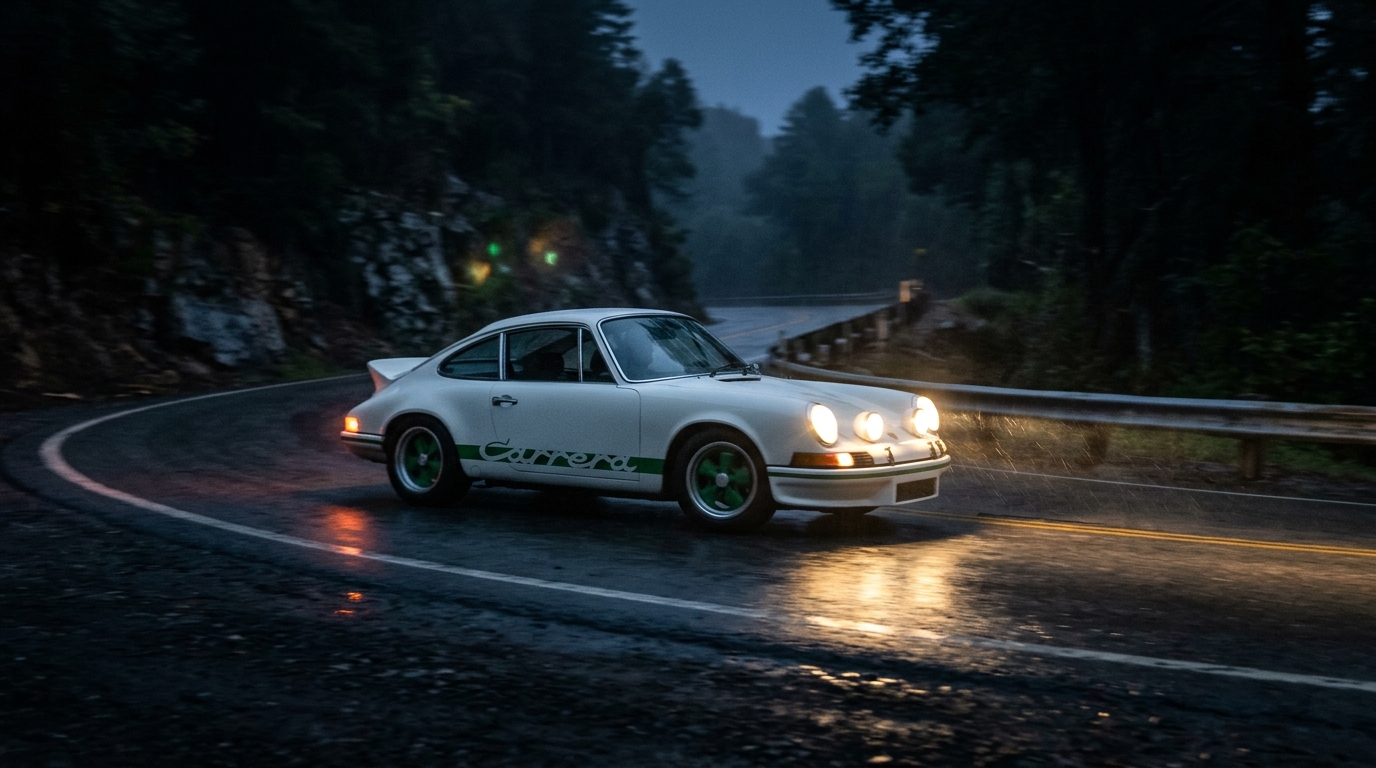
It is 1 a.m. and the only light on the road is the amber wash of sodium streetlamps sliding across a white ducktail. The flat-six behind you is cold-blooded and mechanical, a hard-edged rasp that bounces off the empty buildings and comes right back at you. This is the car that taught the world that less is more, and at night, with nothing else to look at, you understand why.
The Car That Had to Be Built
The Carrera RS 2.7 exists because of a rulebook. Porsche wanted to go racing in the FIA’s Group 4 GT class, and that required homologation: 500 road-going examples had to be built and sold. Porsche’s own sales department doubted it could move 500 of such a stripped, loud, uncompromising 911, so the initial run was planned at a modest 500 units. Demand blew the plan apart. The run was extended again and again, and by the time production ended, roughly 1,580 cars had been built across the different specifications, a number that tells you everything about how badly buyers wanted it.
The recipe was a diet and a displacement bump. The flat-six grew from 2.4 to 2.687 litres (the bore went from 82.5 mm to 90 mm), and the engine used Nikasil-coated aluminum cylinders with forged pistons and Bosch mechanical fuel injection. It made 210 PS (about 207 hp) at 6,300 rpm. That sounds modest today, but this car was never about the figure on the spec sheet.
Weight Is the Whole Story
The Touring specification weighed in around 1,075 kg, while the stripped Lightweight (M471 Sport) could dip near 960 kg thanks to thinner steel and glass, no rear seats, minimal sound deadening, and lightweight bumpers and trim. Much of the body was thinner sheet metal, and the front and rear fenders were flared to cover wider wheels, 6 inches wide up front and 7 inches wide at the rear, a first for a series-production 911 of this type.
Then there is the ducktail. Porsche’s engineers found the small rear spoiler cut rear-axle lift considerably at speed, and it became one of the most recognizable shapes in automotive history. It is hard to believe such a small flip of fiberglass could define a car so completely.
Driving It After Dark
Night is where a car like this earns its reputation. With no traffic and a dry road, the Carrera RS feels alive in a way that modern cars filter out. The steering is unassisted and wonderfully chatty, loading up through your fingertips as you turn into a corner. There is almost no weight over the front axle, so it tells you precisely what the tires are doing. You feel every change in camber, every patch of cold asphalt, every damp spot you cannot see.
The engine is the other half of the conversation. Below 4,000 rpm it is tractable and almost civil, but past that, the mechanical injection hardens and the flat-six begins to howl behind your shoulders. In a quiet night street, with the windows cracked, the induction note rolls off the walls and builds to a metallic scream near the 7,300 rpm redline. Nothing electronic stands between you and the noise.
The 915 five-speed gearbox is the old Porsche argument in a nutshell: a long, deliberate throw that rewards patience and punishes haste, with first gear sitting down on a dogleg pattern to the left. It takes a few miles to learn, and then it feels perfect. Cold, you shift deliberately; warm, you start to flow.
Seeing and Being Seen
The headlights are the honest weak point. The round halogen units of the era give a warm, yellowish pool of light that is perfectly acceptable at moderate speed, but they do not reach far by modern standards. You drive the Carrera RS at night by feel and by anticipation, reading the road a corner ahead rather than relying on a lightbar. It forces you to slow your thinking and sharpen your attention, which is half the pleasure. The big, upright windshield and thin pillars give you superb all-round visibility, so the car feels airy and easy to place even when the world outside is black.
Living With a Legend
This is not a comfortable car by any current definition. Road noise is constant, the ride is firm, there are no frills, and the cabin smells of vinyl, petrol, and warm metal. But it is also astonishingly usable in a way that purer racing specials never are. The Touring version came with decent trim and could serve as a genuine daily driver in its day, which is partly why so many survived to become six- and seven-figure collectibles.
Prices reflect the legend. Strong Touring cars now routinely trade well into the high six figures, and the best Lightweights and low-mileage originals have crossed the million-dollar line at auction. It is the car that set the template for every Porsche since, from the GT3 RS back to the humble Carrera, and it still feels like the purest expression of that idea.
Editor’s verdict: The Carrera RS 2.7 is proof that subtraction can be the highest form of engineering. It is loud, raw, and demanding, and after midnight on an empty road it is one of the great driving experiences ever sold with a license plate. If you can find one, and afford it, nothing else feels quite like it.