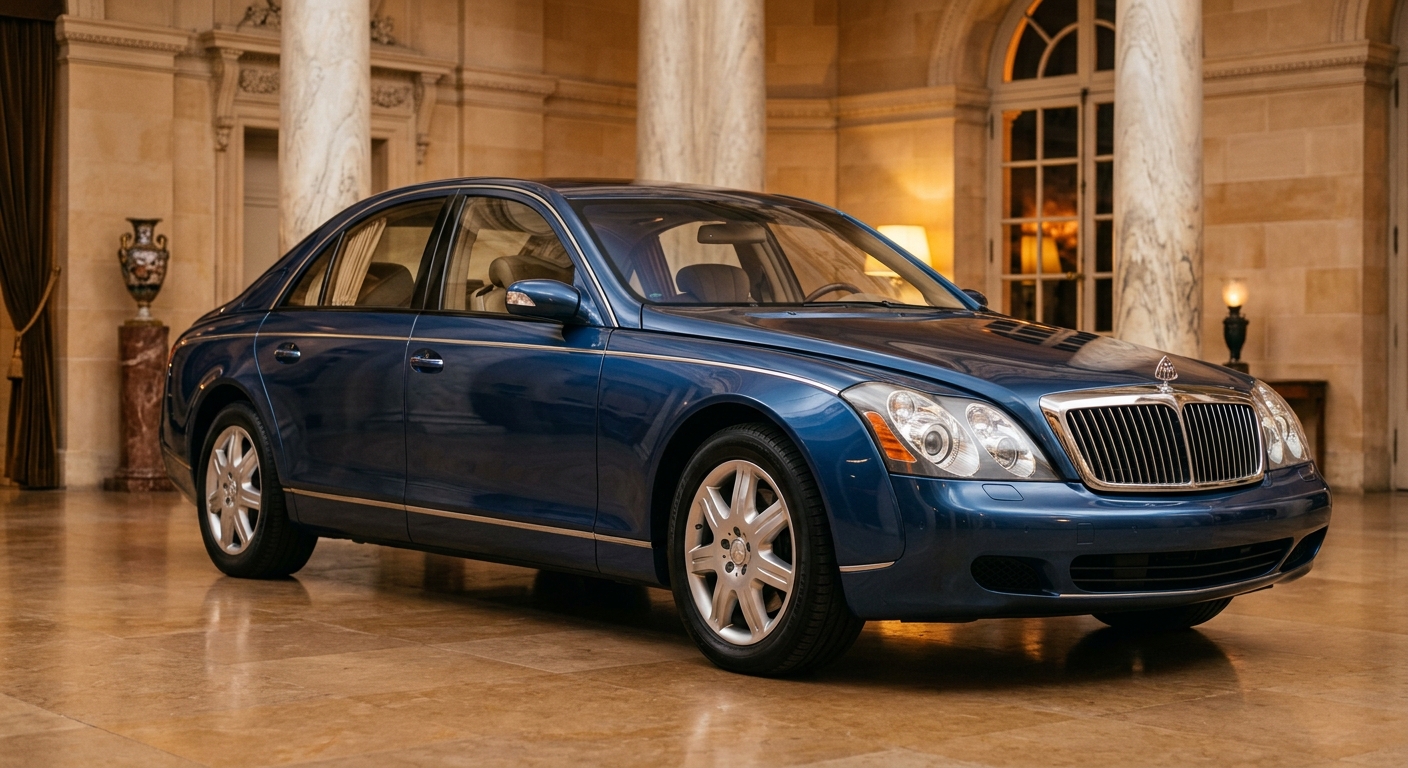
When Mercedes-Benz decided to resurrect the legendary Maybach name in 2002, they weren’t just launching another luxury car, they were making a statement about the very pinnacle of automotive opulence. The Maybach 57, named for its 5.7-meter length, represented Germany’s answer to Rolls-Royce and Bentley, combining cutting-edge technology with old-world craftsmanship in a package that cost more than most people’s houses.
A Name Reborn
The Maybach heritage stretches back to 1909, when Wilhelm Maybach and his son Karl founded their company to build ultra-luxury automobiles for European royalty and industrialists. After World War II, the name disappeared, but Mercedes-Benz saw an opportunity to compete at the very top of the luxury market. The result was the W240 platform that would underpin both the 57 and its longer sibling, the 62.
Built on a stretched and reinforced S-Class platform, the Maybach 57 was engineered to be the ultimate expression of automotive luxury. Every component was scrutinized, upgraded, or completely reimagined to meet the exacting standards expected of a car that would compete with the world’s most prestigious marques.
Engineering Excellence
Under the imposing hood lies a 5.5-liter twin-turbocharged V12 engine producing 543 horsepower and 664 lb-ft of torque. This powerplant, derived from Mercedes’ AMG division, propels the 6,000-pound luxury liner from 0-60 mph in just 5.2 seconds, a remarkable feat considering its substantial mass and focus on refinement over outright performance.
The engine is mated to a five-speed automatic transmission that prioritizes smoothness above all else. Shifts are imperceptible, and the powertrain delivers its considerable torque with the kind of effortless authority that makes highway cruising feel like floating on air. The AIRMATIC air suspension system continuously adjusts to road conditions, maintaining that characteristic Maybach ride quality regardless of surface imperfections.
Interior Sanctuary
Step inside the Maybach 57, and you enter a world where no expense has been spared. The cabin is a masterclass in luxury craftsmanship, featuring hand-selected leather, real wood veneers, and metal accents that are both functional and beautiful. The rear seats are the true throne room, with individual climate controls, massage functions, and enough legroom to host a small meeting.
Every surface that occupies could touch has been considered and refined. The dashboard features analog gauges with that distinctive Maybach font, while the center console houses controls for the advanced infotainment system. Even the smallest details, like the umbrella holders in the rear doors or the champagne flutes in the center console, speak to the car’s ultimate mission: providing an unparalleled luxury experience.
The Driving Experience
Behind the wheel, the Maybach 57 feels more like piloting a luxury yacht than driving a conventional automobile. The steering is light and precise, but not sporty in the traditional sense. This is a car designed for serene progress rather than spirited driving, and it excels in that mission. Road noise is virtually nonexistent, wind noise is minimal, and the V12 engine operates with whisper-quiet refinement.
The real magic happens when you experience the Maybach as a passenger. The rear seats offer a level of comfort and luxury that rivals first-class airline accommodations, with enough technology and amenities to keep occupants comfortable on even the longest journeys.
The Maybach 57 succeeded in its ambitious mission to reestablish German ultra-luxury credibility, even if commercial success proved elusive. This was automotive craftsmanship at its absolute pinnacle, a rolling testament to what happens when engineering excellence meets unlimited budgets. While the brand would eventually fade again, the 57 remains a fascinating glimpse into the rarified world of seven-figure luxury sedans.