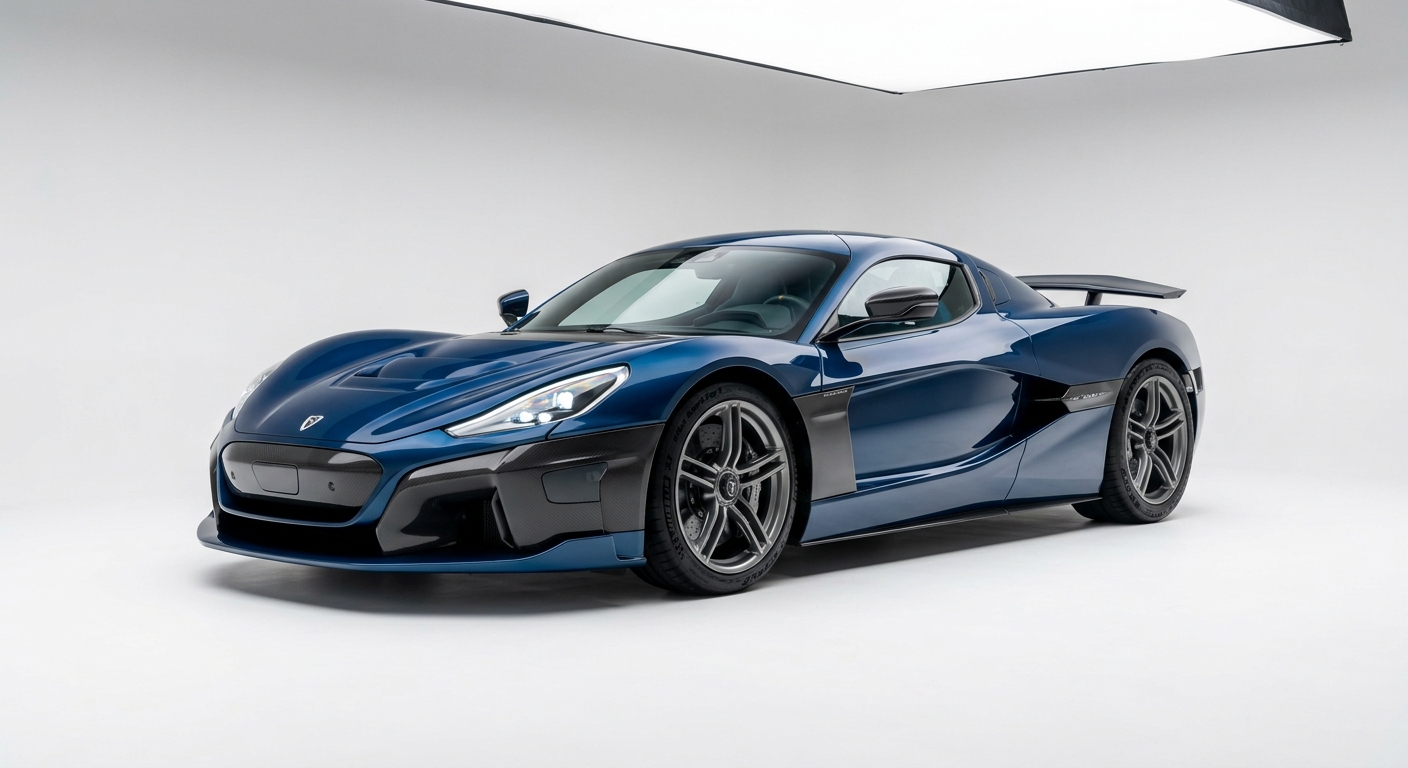
From a small workshop in Croatia comes perhaps the most technologically advanced hypercar ever built. The Rimac Concept Two doesn’t just challenge conventional supercars, it obliterates every assumption about what electric performance can achieve. With nearly 2,000 horsepower and the ability to torque-vector each wheel independently, this machine represents a quantum leap in automotive engineering.
Electric Revolution
Mate Rimac’s vision for the Concept Two was audacious: create an electric hypercar that would make established manufacturers look primitive. The result is a 120kWh battery-powered monster that produces 1,914 horsepower and 1,696 lb-ft of torque from four independent electric motors. But raw power is only part of the story.
The torque vectoring system is the real magic. Each wheel receives its own motor, allowing for precise control that borders on telepathic. The car can brake individual wheels, accelerate others, and manipulate torque delivery with millisecond precision. This creates handling characteristics that simply cannot be replicated by any internal combustion engine.
Carbon Fiber Mastery
The monocoque chassis is a masterpiece of carbon fiber engineering. Rimac developed new manufacturing techniques specifically for the Concept Two, creating a structure that’s both incredibly light and remarkably rigid. The bodywork features active aerodynamics, with elements that adjust automatically based on speed and driving mode.
Inside, the cabin blends luxury with technology in ways that feel genuinely futuristic rather than gimmicky. The dashboard features multiple touchscreen displays, but physical controls remain for critical functions. The seats are carved from carbon fiber and upholstered in premium leather, creating an environment that feels both spacious and purposeful.
Performance Redefined
The acceleration figures read like science fiction: 0-60 mph in 1.85 seconds, 0-100 mph in 4.3 seconds, and a top speed of 258 mph. But numbers alone cannot capture the sensation of instant, linear acceleration that builds relentlessly to the redline. There’s no gear changes, no power curves, just an endless tsunami of torque that pushes you deeper into the seat.
The regenerative braking system works in harmony with carbon-ceramic brakes to provide stopping power that matches the acceleration. More importantly, the system can harvest energy while maintaining perfect balance and control, turning every corner exit into an opportunity to replenish the battery.
Handling Precision
On track, the Concept Two feels like it’s operating by different physical laws. The torque vectoring allows for impossible cornering lines, while the low center of gravity and perfect weight distribution create stability that inspires confidence at any speed. The steering is precise without being nervous, and the chassis communicates beautifully with the driver despite the electronic assistance.
Different driving modes transform the character completely. Comfort mode provides smooth, quiet cruising with impressive range. Sport mode sharpens responses and increases regeneration. Track mode unleashes the full fury while optimizing cooling and aerodynamics for sustained performance.
The Rimac Concept Two doesn’t just represent the future of hypercars, it makes that future tangible today. With technology that reads like a wishlist and performance that defies physics, this Croatian masterpiece proves that electric power isn’t just the future, it’s the present. At $2.4 million, it’s an investment in automotive history.