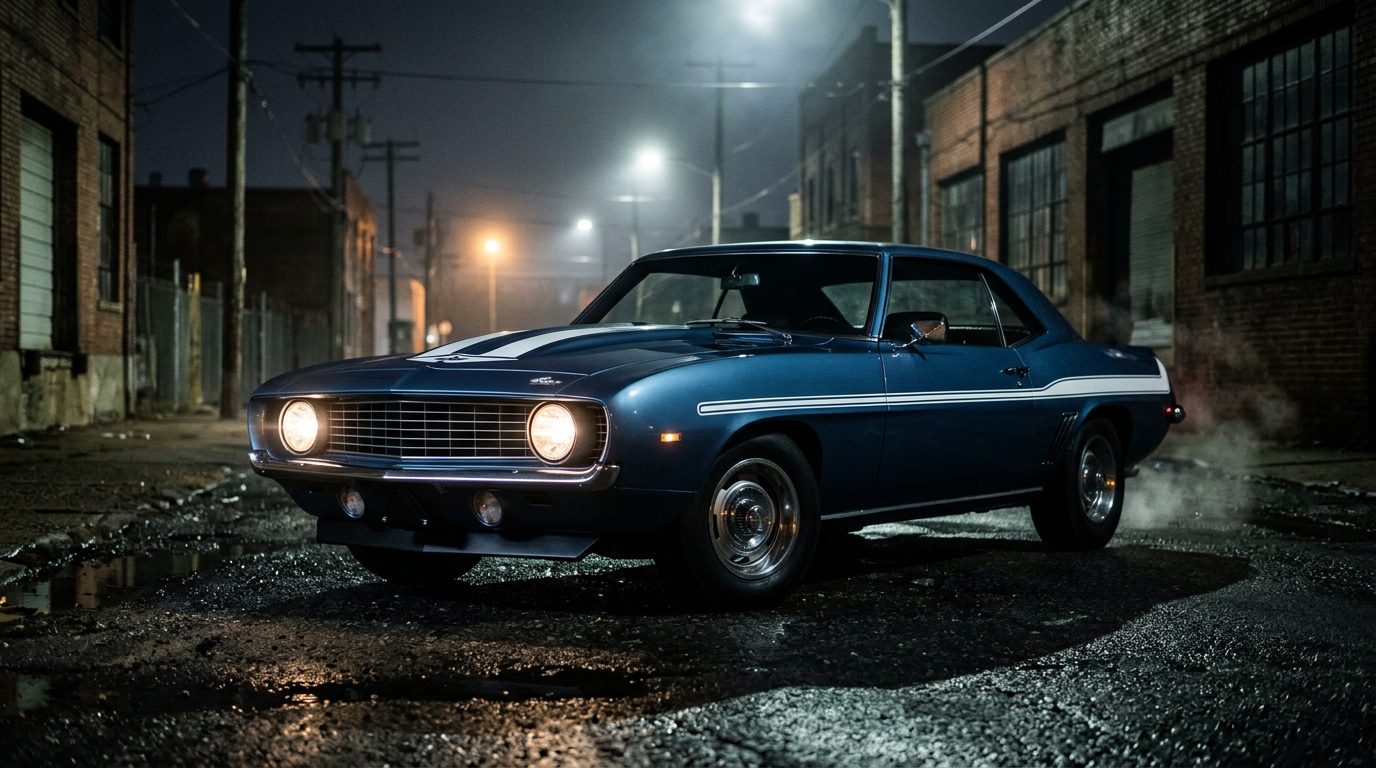
It is a little past midnight in a sleeping Pennsylvania town, and the only light on Main Street is the amber glow of a single sodium lamp. Then you hear it: a lumpy, restless idle rolling out of the dark, the sound of a solid-lifter 427 that has no business being legal. This is the 1969 Yenko Camaro, and it was built for exactly this hour.
The Rebel from Canonsburg
Don Yenko ran a Chevrolet dealership in Canonsburg, Pennsylvania, and he raced the cars he sold. When Chevrolet’s own rules kept the Camaro capped at 396 cubic inches in regular production, Yenko found a loophole: the Central Office Production Order system, better known as COPO. In 1969, ordering COPO 9561 got you a Camaro with the monstrous L72 427 cubic inch V8 installed at the Norwood, Ohio assembly plant. Chevrolet built roughly 1,015 of the COPO 9561 cars. Yenko ordered around 201 of them and then converted them into Yenko Super Camaros, sold as the Yenko/SC.
The dealer touches were what made them a legend. Yenko added his own striping, the SYC badging, a hood tach in some cars, and unique wheels. The paperwork trick was just as important: the cars wore the identity of a street-ready muscle machine while being sold through a hometown dealership, which gave buyers a direct line to factory-adjacent hardware without a trip to a racetrack paddock.
What Is Under the Hood
The L72 is a big-block built to be flogged. It is rated at 425 horsepower at 5,600 rpm and 460 lb-ft of torque at 4,000 rpm, with an 11.0:1 compression ratio, a solid-lifter camshaft, and a Holley 4150 four-barrel carburetor on an aluminum intake. Those figures are the factory number; period testers and racers widely believed the true output ran higher. The engine is a rev-happy, noisy, temperamental thing, and it sounds like a freight train being fed through a cheese grater in the best possible way.
Power went through a heavy-duty Muncie four-speed manual, typically the M21 or M22 depending on the build, with a Positraction rear end and a 4.10 gear set common on these cars. Most of the 1969 COPO Camaros came with the four-speed, and a few were optioned with the Turbo-Hydramatic automatic. Chevrolet also fitted a heavy-duty cooling package, front disc brakes, and stiffened suspension to cope with the weight and torque.
Driving Impressions After Dark
Climb in at night and the cabin is an analog cockpit lit by a handful of soft green-white gauge lights. The seat is basic, the wheel is thin, and the shifter feels like a steel rod bolted to the gearbox. Turn the key and the solid-lifter engine settles into a rough, uneven idle that rattles the mirror and sends vibrations through the floor.
Roll on the throttle and the 427 wakes up. The torque is immense and arrives in a rush, with the rear tires scrabbling for grip long after you expect them to hook. Quarter-mile times in the low-to-mid 13-second range at around 105 mph were reported for these cars in period tests, and that is a respectable number even by modern standards. At night it feels faster still, because the world outside your headlights shrinks to a short tunnel of road, and the engine note bounces off every dark storefront.
The headlights themselves are an honest period product: round sealed beams that are adequate at best by today’s standards. They throw a warm, yellowish pool of light, and the high beams only reach so far. That works in its own way. You drive these cars at night in a more committed, more attentive manner, with your eyes scanning the edges of the beam. Braking is modest, the steering is slow, and body roll is a part of the experience. This is not a precision tool. It is a brute, and it asks you to respect it.
Why It Still Matters
The Yenko Camaro represents the peak of the factory-meets-dealer hot rod era, the moment when a savvy salesman could outflank the corporate rulebook and put a race engine in a street car. Values today are extraordinary. Authentic, documented Yenko Super Camaros regularly sell for several hundred thousand dollars, with the very best examples pushing well beyond that at major auctions. For an original, a Yenko is as blue-chip as American muscle gets.
The Yenko Camaro is raw, loud, and gloriously impractical, a muscle car that feels most alive when the sun is gone and the road is empty. It is the ultimate expression of dealer-built rebellion, and any garage that holds one holds a piece of American performance history.