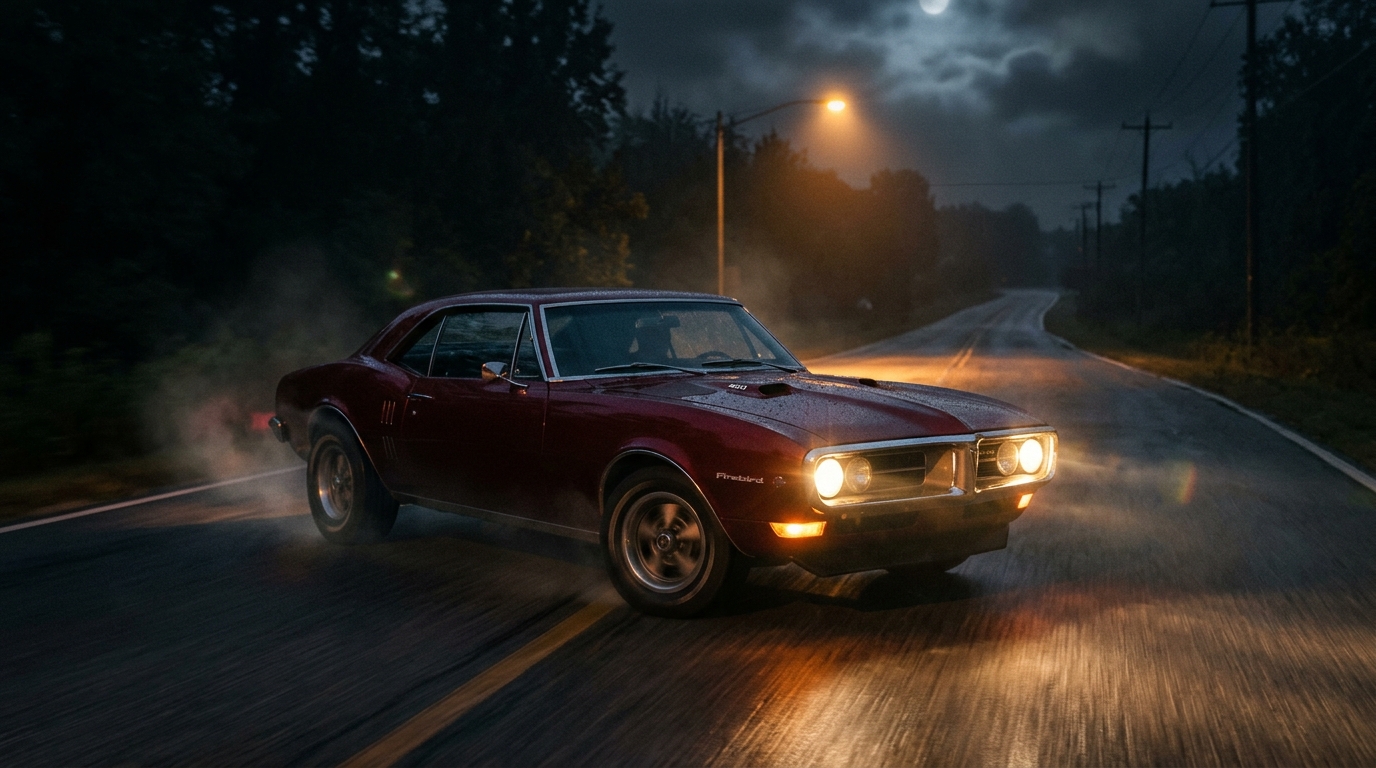
The sodium lights along the old boulevard turn everything the color of weak tea, and the Firebird 400 looks like it was born for exactly this. At idle, the 400 cubic inch V8 burbles with a lazy menace that carries across an empty parking lot, and when the throttle opens, the whole street seems to inhale. This is Pontiac’s first pony car, and after dark, it is easy to see why it earned a following.
A Late Arrival to the Pony Car Party
Ford had been selling Mustangs since April 1964, and Chevrolet unveiled the Camaro in September 1966 for the 1967 model year. Pontiac’s answer, the Firebird, arrived in February 1967, built on the same F-body platform as the Camaro. It was a rushed, clever piece of corporate engineering: shared floorpan, shared unibody structure, shared basic dimensions, but with unmistakable Pontiac identity layered on top.
That identity started up front. The Firebird wore Pontiac’s signature split grille, with a body-colored Endura nose panel flanked by the grille openings, and it carried the brand’s long-standing love of horizontal taillights, in this case wide, slim units tucked into the rear panel. The shape was shared with Chevrolet, but the face and tail were all Pontiac.
The Firebird Lineup, and Where the 400 Fits
Pontiac offered five Firebird variants for 1967, each named for its engine. The Firebird carried an overhead-cam inline-six at 165 hp, the Sprint a 215-hp version with a four-barrel carburetor, the Firebird 326 a 250-hp V8, the Firebird H.O. a 285-hp version of the 326, and the Firebird 400 the full-fat 400 cubic inch V8. Pontiac was the only pony car maker to fit a proper overhead-cam six in this era, a bit of engineering swagger that set the Firebird apart.
The 400 sat at the top of the pile. Its 400 cubic inch V8, rated at 325 horsepower at 4,800 rpm and 410 lb-ft of torque at 3,300 rpm, was a close cousin of the GTO’s mill. The 400 also wore the Firebird’s signature hood treatment: a functional-looking scoop pair that gave the car a muscular stance from every angle, and an available Ram Air package that Pontiac added to the options sheet later in the model year.
Driving Impressions After Dark
Turn the key on a 400 and the first thing that hits you is the bark. Dual exhausts, a four-barrel Rochester carburetor, and a big-bore V8 combine into a sound that is hoarse and low, rising to a hard-edged howl as the revs climb. At night, with the city quiet, it fills the whole street. There is no hiding, and there is no wanting to.
Visibility after dark is a period-correct education. The sealed-beam headlights of the era, typically a pair of 5.75-inch round units tucked behind the grille and hood nose, throw a warm yellowish wash that fades quickly at highway speeds. By modern standards the reach is short, and you learn to drive with your eyes up and your right foot honest. On a winding back road at midnight, the dim glow makes every corner feel like a decision.
Underway, the torque is the star. The 400 pulls hard from low revs, and with the optional three-speed Turbo Hydra-Matic it surges forward with that thick, unhurried shove that defines the muscle car experience. The steering is slow and light by modern standards, and the front end likes to push when you overcook a corner. The drum brakes at the back and optional front discs do the job, but they ask for planning rather than late stabbing. This is a car you drive with anticipation, not aggression.
What the Firebird does beautifully is cruise. Roll along an empty two-lane with the windows cracked, the dash glowing amber, and the V8 ticking over just above idle, and the car settles into a rhythm that feels timeless. The gauges are legible, the bench or bucket seats are comfortable, and the long hood stretches out ahead like a runway.
Why the 1967 Matters
The first-year Firebird is the purest expression of the original design, before emissions rules, safety regulations, and styling updates began altering the formula. Pontiac built roughly 82,000 Firebirds in 1967 across all variants, with the 400 making up a relatively small slice of that, which gives it genuine collector appeal today. Its cleaner lines, simple trim, and lack of the later side marker lamps give it a fresh look that the 1968 refresh traded away.
It also marked the beginning of a legend. The Firebird nameplate would run, in one form or another, until 2002, and the Trans Am that followed in 1969 would eventually achieve pop-culture immortality. But it all started here, with a rush job, a shared platform, and a big V8 that gave Pontiac a seat at the pony car table.
The 1967 Firebird 400 is a rowdy, charismatic, slightly rough-edged slice of American muscle that comes alive after dark. Its handling will not impress a modern driver, but its voice and presence will. If you want the original Pontiac pony car in its purest form, this is the one.