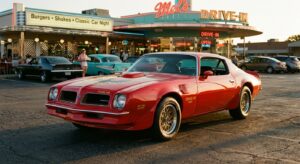
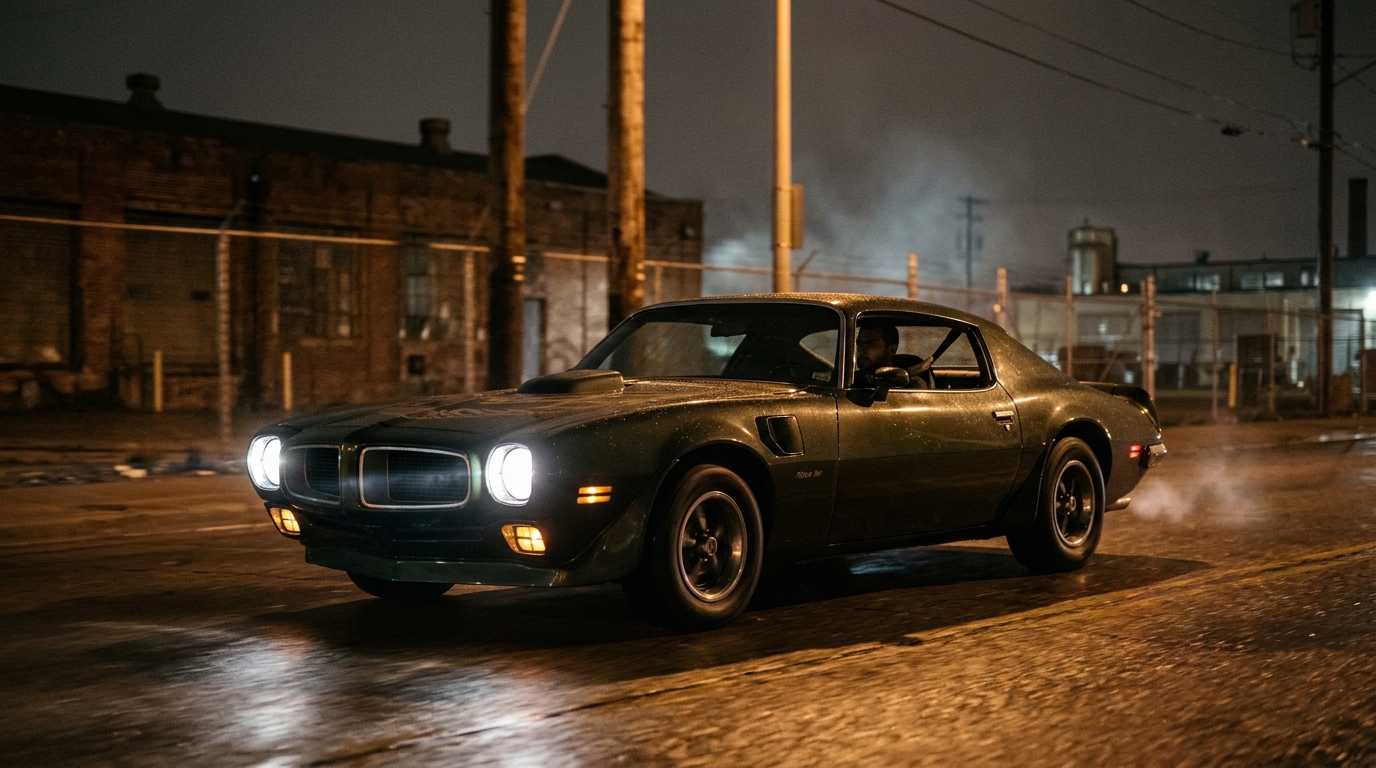
It is well past midnight, the traffic lights are cycling for nobody, and a 455 cubic inch V8 is idling at the curb with that lumpy, impatient shudder that makes the Shaker scoop twitch. The 1973 Trans Am Super Duty is the sound of an era running out of daylight, and the best place to hear it is in the dark.
The Last Great Pontiac Engine
By 1973 the muscle car was being strangled by insurance premiums, new emissions rules and the switch to the SAE net horsepower rating system. Pontiac did something remarkable anyway. The Super Duty 455 was a genuine performance engine, built around a reinforced four-bolt main block, forged steel connecting rods, a forged-aluminum-piston option in the early plan, a high-flow cylinder head, a dual-snorkel Quadrajet carburetor and a unique camshaft. Pontiac rated it at 310 net horsepower and 395 lb-ft of torque, a figure that dwarfed the mainstream 455 and understated what the engine could really do. Pontiac’s own Pure Pontiac engineers, including Herb Adams and Jim Wangers’ circle, wanted a real Trans Am that could win magazine shootouts, and the SD-455 delivered.
Only a tiny fraction of 1973 Trans Ams received it. Production of the SD-455 Trans Am is generally cited at 252 cars, with 180 fitted with the four-speed manual and 72 with the Turbo Hydra-Matic automatic. Many sources note that the SD-455 was dropped from the ordinary option list late, and that only a handful of early cars shipped before the full emissions certification, which is part of why these cars are so coveted today.
Night Driving: What You Actually Feel
Settling into the cabin after dark is half the experience. The dashboard has the engine-turned aluminum fascia, the Rally gauge cluster glowing in soft green and amber, and a thick-rimmed Formula steering wheel. Sealed-beam headlights, round in the Pontiac tradition, throw a warm yellowish pool of light that looks charming and performs modestly by modern standards. Squint at the road and keep your speed honest on unlit back roads; this is a car that rewards looking far ahead, because nobody ever bought one for its low beams.
What the Super Duty does at night is turn sound into scenery. Hitting the throttle on an empty road brings a deep, hard-edged bellow from the dual exhaust, bouncing off sleeping storefronts and returning a half second later. The Shaker hood scoop rocks with the engine’s torque, a little mechanical heartbeat you can see in the reflections of shop windows. Because the 455 SD makes its power with relatively mild gearing and enormous torque, you do not need to chase revs. A squeeze through second gear is enough to pin you into the seat and light the tires.
Pontiac fitted the Trans Am with a firmer suspension, thicker sway bars (a 1.25 inch front bar), variable-ratio power steering and a rear bar, plus power front disc brakes. It handles better than most contemporaries, but this is still a 1970s F-body: there is body roll, the steering is vague by modern measures, and the drum rear brakes ask you to plan your stops. In the quiet of night, with no one to impress, it becomes a relaxed, bellowing grand tourer.
History and Context
The second-generation Firebird arrived in 1970 with Pontiac’s sleek Endura-nose styling and a Trans Am performance package that, in 1973, grew into one of the brand’s halo models. The Shaker hood scoop, the huge shaker-style hood bird decal and the fender air extractors gave the car instant presence. That presence would reach a mass audience later through Smokey and the Bandit, but the 1973 car sits at the quiet, serious beginning of that story. The SD-455 was the last time Pontiac built an engine whose primary goal was outright performance, and it arrived just as the first oil crisis and rising regulation made such an engine impossible to justify.
Period tests were thrilling for the moment. Magazines recorded 0-60 mph in roughly the low six second range and quarter-mile times in the high 13s to low 14s, remarkable for a year in which most Detroit V8s had been neutered. The car’s engineering was so strong that it stood as a benchmark for the next several years, even as horsepower figures sank.
Today the 1973 SD-455 Trans Am is among the most valuable Pontiacs of all time, with documented examples reaching well into six figures at auction. Verification matters: the correct engine codes, VIN, build documentation and original drivetrain components are everything.
Editor’s verdict: The 1973 Trans Am Super Duty is the final, defiant shout of Pontiac performance, and it sounds best when the streets are empty and the streetlights are low. It is rare, loud and imperfect in all the right ways, and an SD-455 on a midnight run is the clearest proof that Detroit knew exactly what it was about to lose.