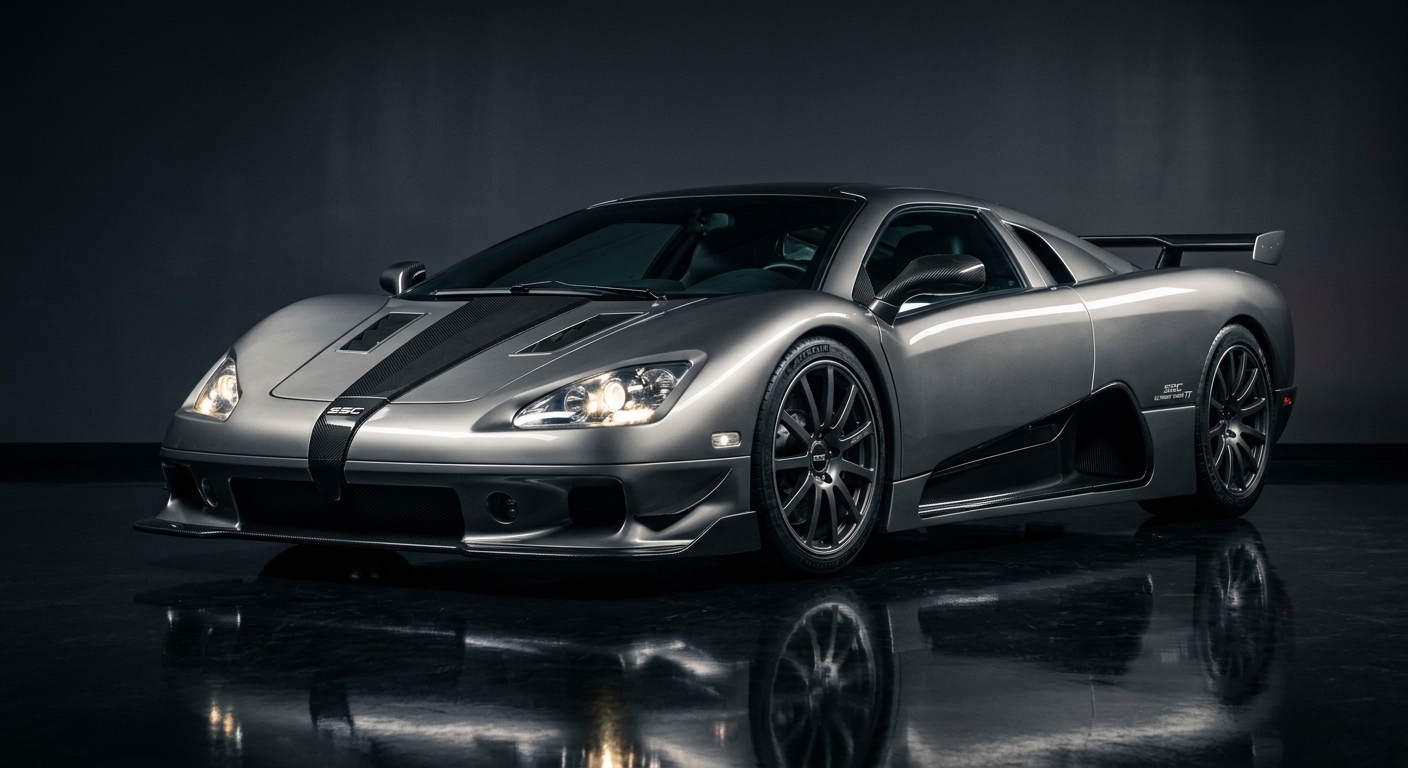
In 2007, while the automotive world fixated on European exotica, a small company in Washington state quietly assembled what would become the world’s fastest production car. SSC’s Ultimate Aero TT represented American ambition distilled into carbon fiber and twin-turbo V8 fury, briefly dethroning the mighty Bugatti Veyron with a verified top speed of 256.18 mph.
The Pursuit of Ultimate Speed
Shelby SuperCars (no relation to Carroll Shelby) approached hypercar development with refreshing directness. Where others obsessed over luxury appointments and electronic aids, SSC focused purely on power-to-weight ratio and aerodynamic efficiency. The Ultimate Aero TT’s carbon fiber monocoque chassis weighed just 2,750 pounds, creating a foundation for the kind of power-to-weight ratios that European manufacturers could only dream about.
The heart of this American monster was a 6.3-liter twin-turbocharged V8 producing an astronomical 1,183 horsepower and 1,094 lb-ft of torque. Built by SSC in-house, this engine represented a fundamentally different philosophy from the complex quad-turbo W16 in the Veyron. Raw, uncomplicated, and devastatingly effective.
Engineering Without Compromise
The Ultimate Aero TT’s bodywork prioritized function over fashion, though the result was undeniably striking. Every curve and crease served aerodynamic purpose, with active rear spoiler deployment and carefully managed airflow creating stability at triple-digit speeds. The interior stripped away unnecessary luxury in favor of weight savings, featuring carbon fiber racing seats and minimal electronic systems.
SSC’s manual transmission choice proved controversial but ultimately brilliant. The six-speed gearbox saved weight and provided direct connection between driver and drivetrain that automated systems couldn’t match. This decision required exceptional skill at high speeds but rewarded committed drivers with unfiltered feedback.
The Record Run
On September 13, 2007, the Ultimate Aero TT achieved automotive immortality on a closed stretch of highway in Washington state. With Guinness World Records officials present, the car averaged 256.18 mph across two runs in opposite directions, officially becoming the world’s fastest production car. This achievement represented vindication for SSC’s uncompromising approach to speed.
The record run revealed the Ultimate Aero TT’s greatest strength: pure, undiluted velocity. Unlike the Veyron’s luxury-focused approach, SSC created a machine designed solely for maximum speed. Every system, every component, every design decision served this singular purpose with laser focus.
Living With Lightning
Daily driving an Ultimate Aero TT required commitment bordering on masochism. The car’s race-bred suspension transmitted every road imperfection directly to the driver, while the massive engine’s heat output could overwhelm air conditioning systems in traffic. Visibility was limited, ingress and egress challenging, and the manual transmission demanded constant attention in stop-and-go conditions.
Yet for those brave enough to explore the upper reaches of the performance envelope, the Ultimate Aero TT delivered transcendent experiences. The engine’s linear power delivery and the chassis’s exceptional high-speed stability created confidence at speeds that would terrify in lesser machines. This was automotive purity distilled to its absolute essence.
The Ultimate Aero TT stands as proof that American ingenuity could challenge European hypercar supremacy through pure engineering excellence rather than heritage or prestige. Its brief reign as the world’s fastest production car cemented SSC’s place in automotive history and demonstrated that speed records could be claimed through focused determination rather than unlimited budgets. For collectors seeking the ultimate expression of early 21st-century American performance, few machines match the Ultimate Aero TT’s combination of raw power and historical significance.