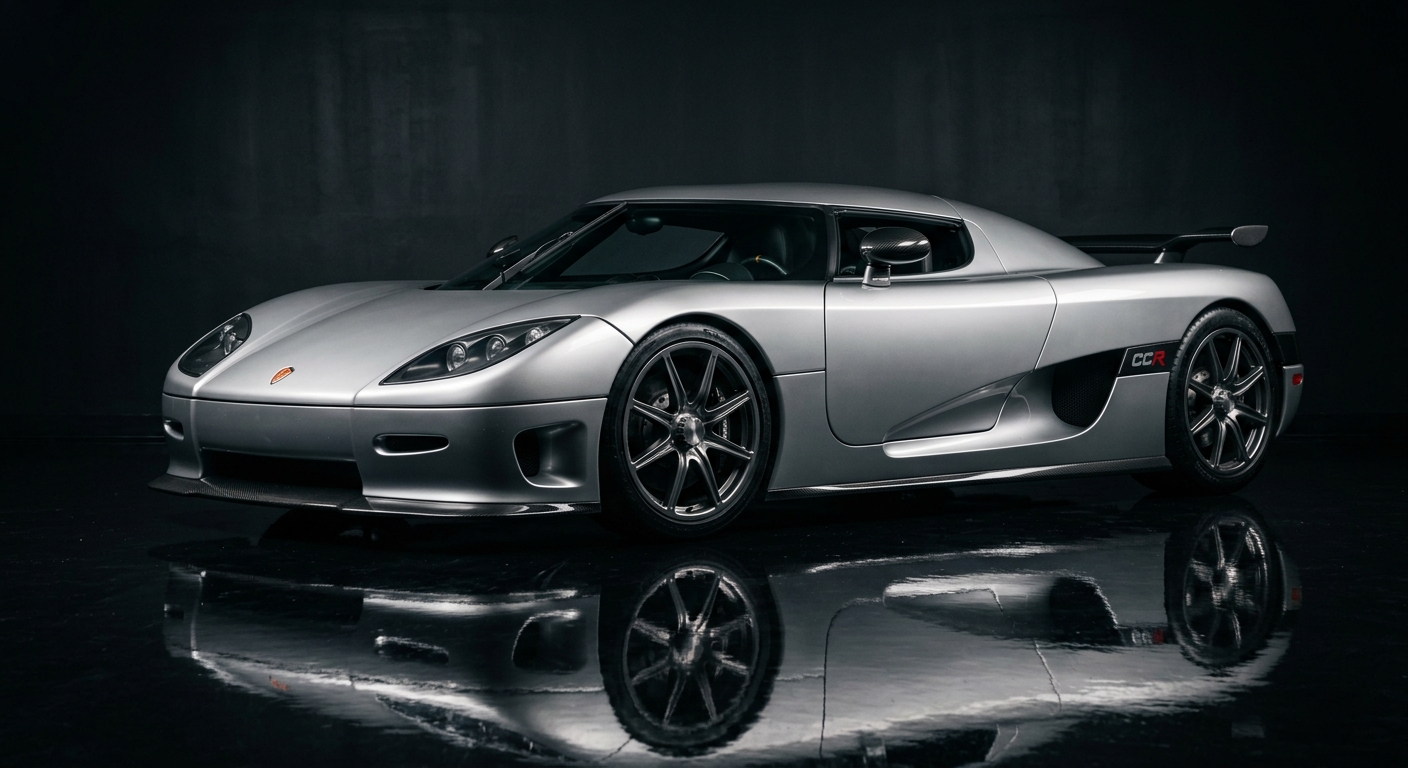
In the early 2000s, while established supercar manufacturers refined their formulas, a small Swedish company called Koenigsegg was quietly rewriting the hypercar rulebook. The CCR represented Christian von Koenigsegg’s vision fully realized: a carbon fiber missile that combined Formula 1 technology with road car usability, all wrapped in distinctively Scandinavian design.
Swedish Engineering Excellence
The CCR’s heart is a supercharged 4.6-liter V8 developing 806 horsepower, making it one of the most powerful production cars of its era. Built entirely in-house at Koenigsegg’s Ängelholm facility, this engine represents a masterclass in forced induction, with the supercharger mounted low in the valley between cylinder banks for optimal weight distribution.
What sets the CCR apart isn’t just raw power, but how that power is delivered. The engine pulls cleanly from 2,000 rpm, building to a crescendo that feels more like a naturally aspirated unit than a blown motor. The sound is intoxicating: a deep, mechanical growl overlaid with supercharger whine that builds to an almost Formula 1-like shriek at the 7,000 rpm redline.
Carbon Fiber Philosophy
Every body panel on the CCR is carbon fiber, not as a performance affectation but as core engineering philosophy. The monocoque weighs just 65 kilograms, contributing to an overall curb weight of only 1,180 kg. This obsessive weight-saving extends to details: the wheels are carbon fiber, the seats are carved from carbon fiber shells, even interior trim pieces shed grams wherever possible.
Behind the wheel, the CCR feels alive in ways that mass-produced supercars cannot match. The steering is unassisted but perfectly weighted, offering direct communication with the front wheels. There’s no electronic nannying here: the CCR predates stability control, traction control, and launch control. It’s pure mechanical connection between driver and machine.
Track-Bred Performance
On track, the CCR reveals its true nature. The suspension, derived from Koenigsegg’s racing programs, offers remarkable body control without sacrificing compliance. The car changes direction with startling precision, the lightweight construction and 50/50 weight distribution creating balance that rivals purpose-built race cars.
Braking performance matches the engine’s output: massive Brembo discs with six-piston calipers provide fade-free stopping power that inspires confidence even during extended track sessions. The carbon fiber bodywork aids aerodynamics while keeping weight over the wheels rather than hung out in overhangs.
Rarity and Exclusivity
With only 14 examples produced, the CCR represents Koenigsegg at its most focused. Each car required months to complete, with extensive hand-finishing throughout. The attention to detail is remarkable: body panels fit with precision that shames mass-production vehicles, while the interior blends carbon fiber minimalism with surprising comfort.
The CCR’s significance extends beyond its performance figures. It established Koenigsegg as a legitimate hypercar manufacturer, proving that innovative engineering and uncompromising design could emerge from unexpected corners of the automotive world.
The CCR stands as Koenigsegg’s breakthrough moment, proving that Swedish engineering could challenge automotive giants with pure innovation and uncompromising vision. Today, these ultra-rare machines represent the very essence of boutique hypercar philosophy. For those seeking the ultimate expression of analog supercar performance, few machines match the CCR’s intoxicating combination of raw power and mechanical purity.