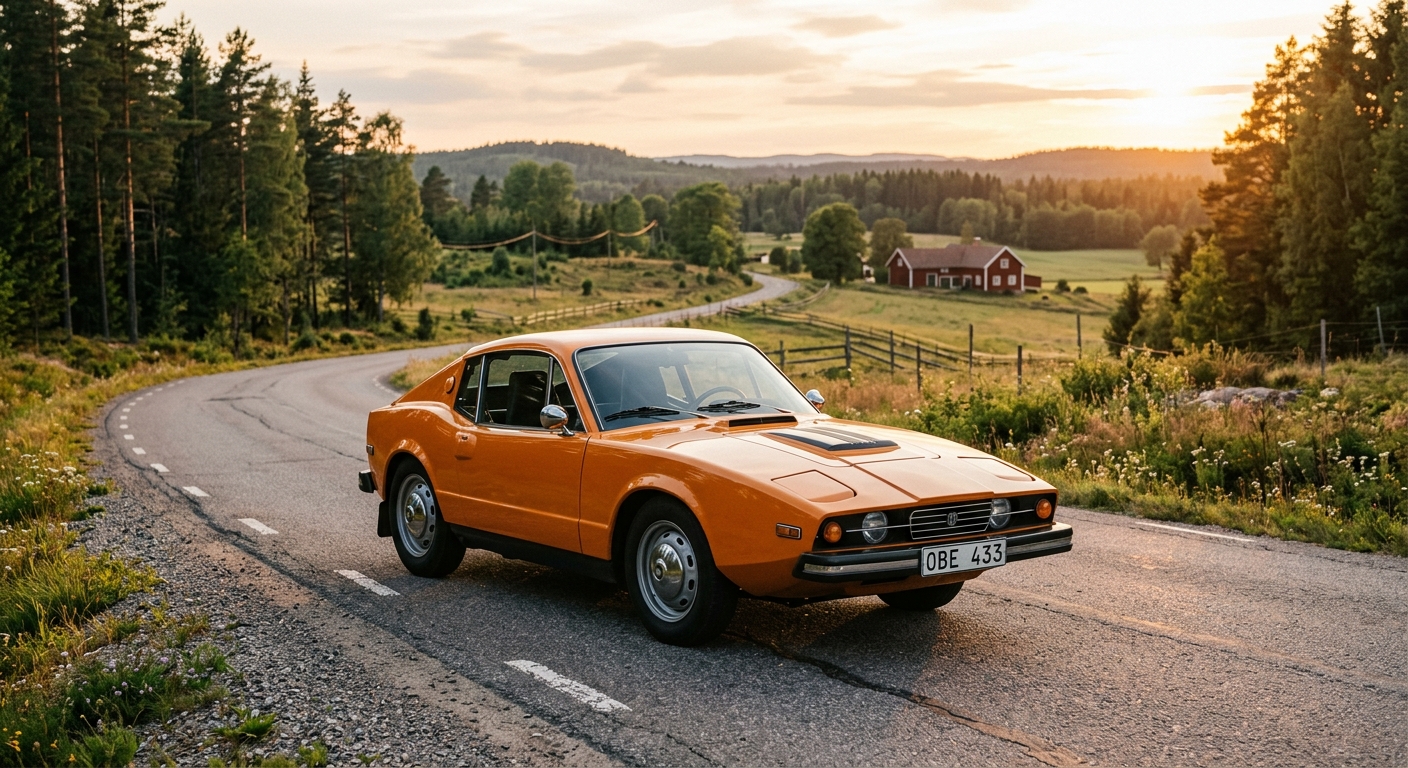
While other nations built their sports cars from steel and aluminum, Sweden took a different approach. The Saab Sonett III represented Scandinavian engineering at its most unconventional: a fiberglass-bodied sports car powered by a Ford V4 engine and engineered with the same methodical precision that made Saab aircraft legendary.
This wasn’t just another European roadster trying to ape British or Italian formulas. The Sonett III was unmistakably Swedish in its approach to the sports car concept, prioritizing safety, durability, and innovative engineering over pure performance numbers.
Engineering Innovation from Trollhättan
The Sonett III’s most distinctive feature was its lightweight fiberglass body, mounted on a reinforced steel chassis. This construction method kept weight down to just 1,800 pounds while providing impressive structural rigidity. The body panels were molded in Saab’s own facilities, allowing for complex shapes that would have been prohibitively expensive to stamp in steel.
Under the long hood sat a 1.7-liter Ford V4 engine producing 65 horsepower. While this might seem modest by modern standards, the engine’s compact dimensions and low center of gravity contributed significantly to the car’s balanced handling characteristics. The V4 was also shared with the Ford Taunus, ensuring parts availability and serviceability.
Distinctive Scandinavian Design
The Sonett III’s wedge-shaped profile was penned by Italian designer Sergio Coggiola, but the final execution was pure Saab. The wraparound rear window, distinctive side air intakes, and prominent front spoiler created a look that was both futuristic and functional. Every design element served a purpose, from aerodynamic efficiency to structural integrity.
Inside, the cabin featured Saab’s characteristic attention to ergonomics and safety. The dashboard was padded and designed to minimize injury in a crash, while the seats provided excellent support during spirited driving. The instrumentation was clear and logically arranged, reflecting Saab’s aircraft heritage.
On the Road
Behind the wheel, the Sonett III revealed its true character. The steering was precise and communicative, providing excellent feedback about road conditions and tire grip. The suspension, featuring independent front suspension and a live rear axle, struck an impressive balance between comfort and control.
Acceleration was steady rather than explosive, with the V4 engine delivering its power in a smooth, linear fashion. The four-speed manual transmission shifted cleanly, though the gear ratios were spaced for efficiency rather than aggressive performance. Top speed was a respectable 100 mph, achieved with typical Saab refinement.
A Different Philosophy
What set the Sonett III apart from its contemporaries was its approach to the sports car formula. Rather than chasing maximum power or razor-sharp handling, Saab created a car that prioritized everyday usability, safety, and long-term durability. The result was a sports car you could drive daily without compromise.
The car’s 30+ mpg fuel economy was remarkable for a sports car of the era, while the fiberglass body eliminated rust concerns that plagued steel-bodied rivals. Build quality was exemplary, with tight panel gaps and meticulous attention to detail throughout.
The Sonett III represents everything that made Saab special: unconventional thinking applied to conventional problems. It may not have been the fastest sports car of its era, but it was arguably the most practical and certainly the most uniquely Swedish. For collectors seeking something truly different from the usual British and Italian suspects, the Sonett III offers character in abundance.