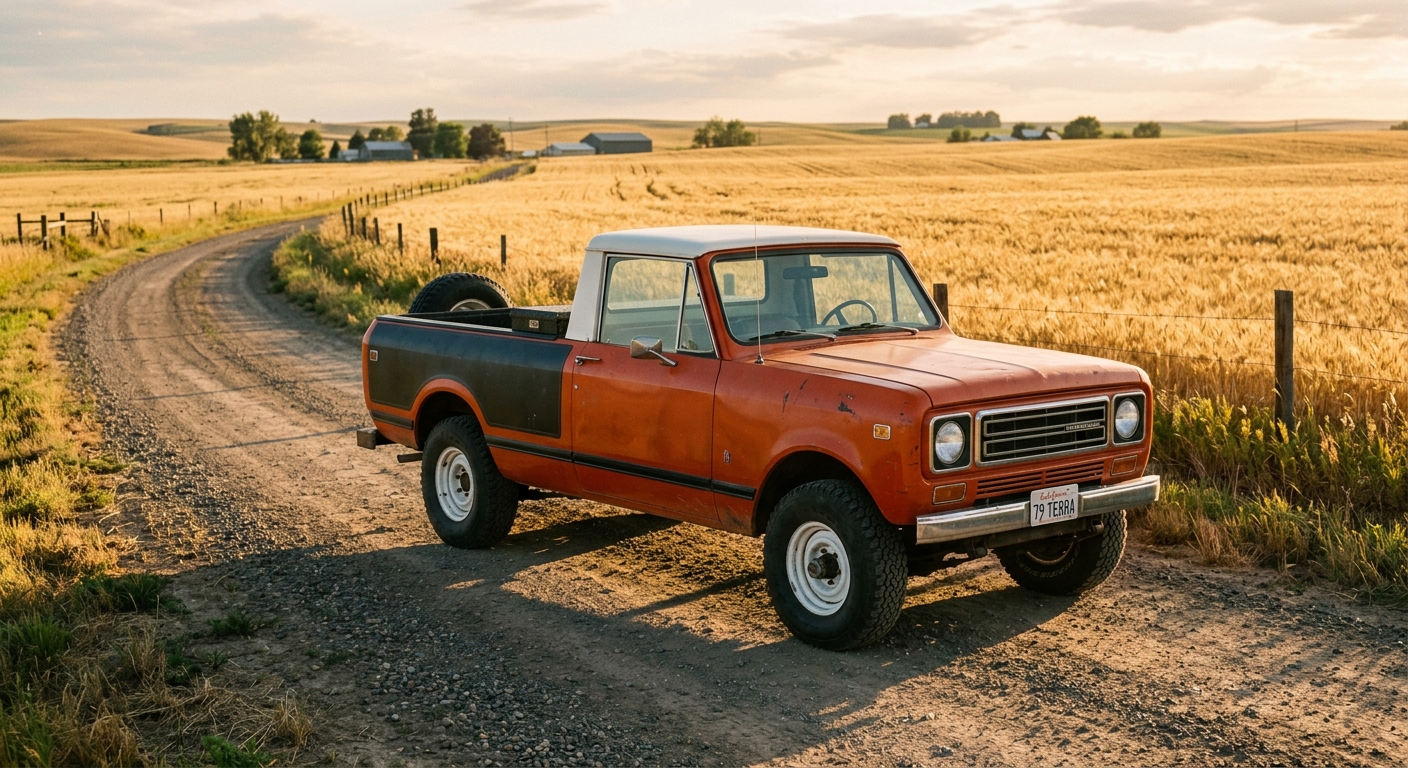
While Ford and Chevrolet battled for pickup truck supremacy in suburban driveways, International Harvester was building something altogether more serious in their Fort Wayne, Indiana plant. The 1979 Scout II Terra wasn’t trying to be pretty or refined: it was engineered for farmers, contractors, and anyone who needed a truck that could haul a ton of gravel through a muddy field and ask for more.
This was the final year for the Terra variant, and International Harvester was already showing signs of the financial troubles that would eventually kill the Scout line. But in 1979, the Terra represented everything the company did well: honest construction, bulletproof mechanicals, and capability that made the competition look soft.
Built for Work, Not Show
The Scout II Terra split the difference between International’s regular Scout SUV and a full-size pickup. With a 6.5-foot bed and seating for three, it offered genuine utility without the bulk of a traditional truck. The high-mounted spare tire and exposed rear-mounted gas tank gave it a purposeful, industrial appearance that screamed function over form.
International offered the Terra with a choice of engines, but the most popular was the 345-cubic-inch V8. This cast-iron workhorse produced 197 horsepower and 290 lb-ft of torque, numbers that looked modest on paper but translated to serious pulling power in the real world. The engine was designed for longevity rather than performance, with a conservative cam profile and robust internals that could handle decades of abuse.
Where Jeeps Fear to Tread
The Terra’s real strength lay in its four-wheel-drive system. International’s Dana 44 front and rear axles were among the strongest in the business, while the dual-range transfer case offered genuine low-range gearing for serious off-road work. Ground clearance was generous, and the short wheelbase made it surprisingly agile on tight trails.
The suspension used simple leaf springs front and rear, a setup that prioritized durability and load-carrying capacity over ride quality. This was a truck designed to haul heavy loads over rough terrain, not cruise smoothly down the interstate. The trade-off was a bone-jarring ride on pavement, but owners didn’t seem to mind.
The Last of Its Kind
By 1979, the writing was on the wall for International Harvester’s consumer vehicle division. The company was hemorrhaging money, and the Terra would be discontinued after 1980 along with the rest of the Scout line. This makes the ’79 Terra something of a historical artifact: the last hurrah for a company that had been building trucks since 1907.
Production numbers were never huge, with International building just over 4,000 Terras in 1979. Most were sold to commercial customers who valued capability over comfort. Today, surviving examples are prized by collectors who appreciate their rarity and uncompromising character.
The 1979 International Scout II Terra wasn’t built to win beauty contests or drag races, but as a honest working truck, it delivered everything its buyers needed and more. Today, it stands as a reminder of when American trucks prioritized capability over comfort, and character over compromise.