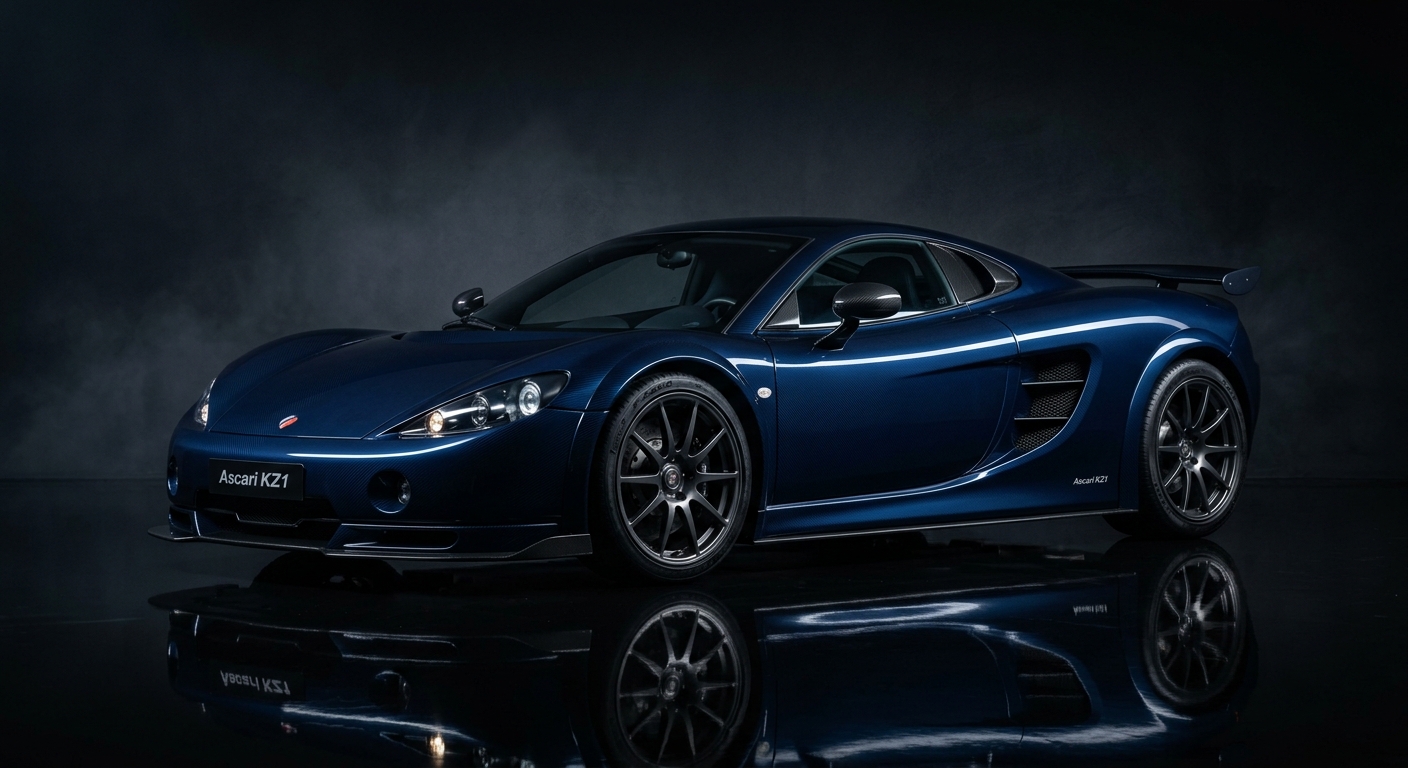
In the rarefied world of British supercars, names like McLaren and Aston Martin dominate the conversation. But tucked away in Banbury, a small company called Ascari was quietly building one of the most uncompromising track machines ever to wear number plates. The KZ1 wasn’t just another pretty face in the supercar crowd: it was a racing car that happened to be street legal.
Founded by Dutch millionaire Klaas Zwart, Ascari Cars emerged from a passion for pure, undiluted performance. The KZ1 represented everything the company stood for, a no-compromise approach to automotive engineering that prioritized lap times over luxury.
Racing DNA in Road Clothes
The KZ1’s origins trace directly back to Ascari’s racing programs. This wasn’t a road car adapted for the track; it was fundamentally a race car that reluctantly accepted the modifications necessary for street use. The carbon fiber monocoque chassis, developed with extensive wind tunnel testing, provided the foundation for what would become one of the most track-focused supercars of the 2000s.
Every surface of the KZ1 served a purpose. The aggressive front splitter, side air intakes, and prominent rear wing weren’t styling exercises but functional aerodynamic elements that generated real downforce. The result was a car that looked like it belonged on a grid at Le Mans rather than cruising through Monaco.
BMW Power, British Engineering
At the heart of the KZ1 sat BMW’s naturally aspirated 5.0-liter V8, extensively modified by Ascari to produce 500 horsepower. While other manufacturers chased higher power figures through forced induction, Ascari chose the purity of natural aspiration for its immediate throttle response and linear power delivery.
The engine’s character perfectly matched the car’s mission. Peak power arrived at 7,000 rpm, encouraging drivers to explore the upper reaches of the rev range where the V8’s note transformed from a cultured growl to an intoxicating wail. This wasn’t an engine for lazy highway cruising; it demanded engagement and rewarded commitment.
Track-Day Perfection
On the road, the KZ1 felt almost apologetic about its street-legal status. The suspension, while sophisticated, prioritized track performance over comfort. The steering required real effort at parking speeds but came alive with precise, unfiltered feedback once the pace increased. This was a car that revealed its true nature only when pushed hard.
But take the KZ1 to a proper circuit, and everything clicked into place. The aerodynamics generated genuine downforce, the suspension perfectly controlled body movements through high-speed corners, and the brakes provided fade-free stopping power lap after lap. It was here that the KZ1 justified its existence, delivering lap times that embarrassed supercars costing twice as much.
Exclusive by Necessity
Ascari built just 50 examples of the KZ1, making it one of the rarest supercars of its generation. This exclusivity wasn’t entirely by design; the car’s extreme focus and hefty price tag limited its appeal to a small group of dedicated enthusiasts who valued track performance above all else.
Each KZ1 was essentially hand-built, with extensive customization options available to buyers. The interior, while stripped down compared to luxury supercars, could be tailored to individual preferences, though most buyers recognized that comfort was never the primary objective.
The Ascari KZ1 stands as a testament to what happens when racing expertise meets road car engineering without compromise. It may not have achieved the commercial success or recognition of its contemporaries, but for those seeking the purest expression of track-focused performance in the 2000s, few cars delivered the experience as authentically. In a world increasingly dominated by electronic aids and comfort concessions, the KZ1 remained gloriously analog and unforgiving.