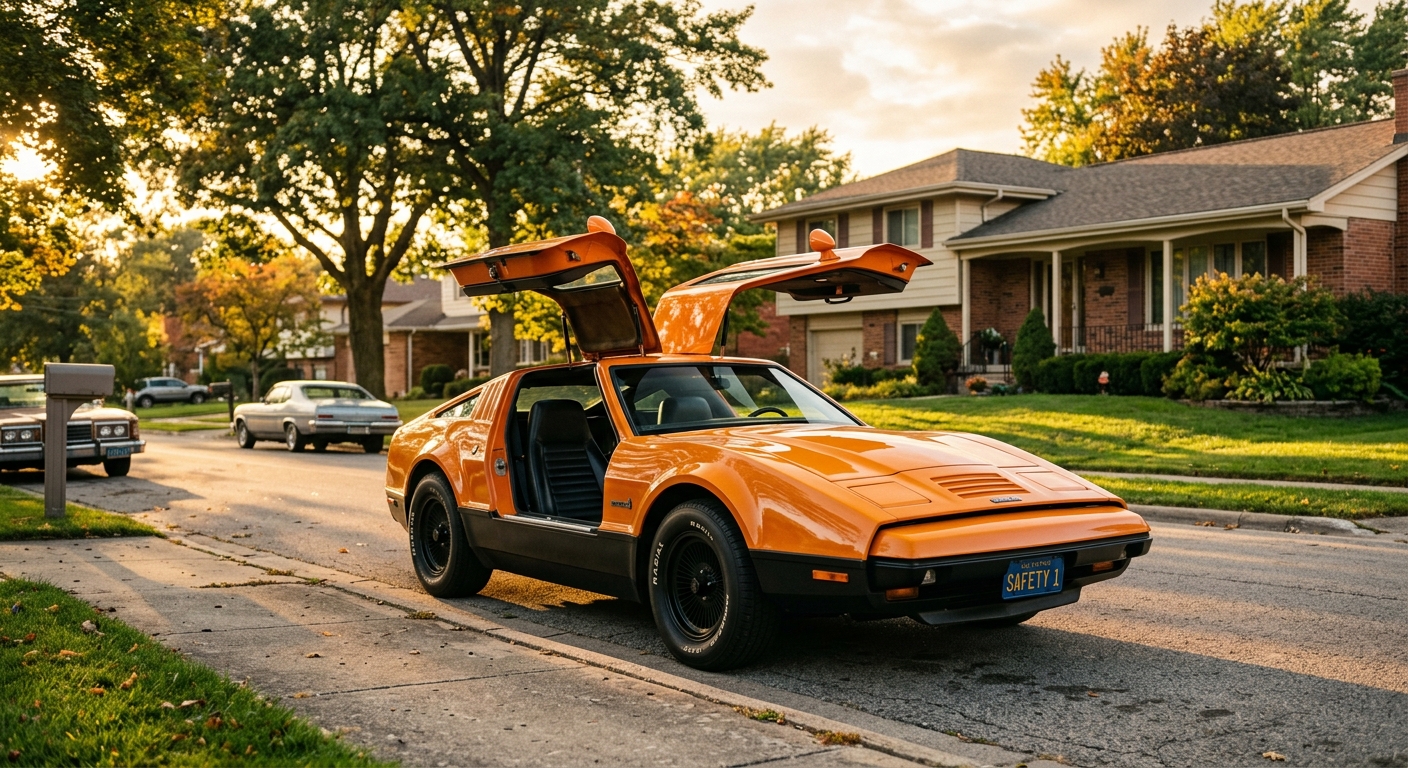
In 1973, Malcolm Bricklin had a vision: create the world’s first truly safe sports car, complete with gull-wing doors, a fiberglass safety cell, and styling that would make European exotics look antiquated. The result was the SV-1, a car so ambitious in its goals and so troubled in its execution that it became one of automotive history’s most fascinating what-ifs.
The Safety Revolution That Wasn’t
The Bricklin SV-1 emerged from Malcolm Bricklin’s conviction that sports cars didn’t have to be death traps. After successfully importing Subarus to America, the entrepreneur set his sights on building something unprecedented: a high-performance car designed around safety rather than despite it. The “SV” stood for Safety Vehicle, and every design decision flowed from that core philosophy.
Built in New Brunswick, Canada with significant government backing, the SV-1 featured an integrated roll cage, energy-absorbing bumpers that were actually part of the body structure, and a cockpit designed to protect occupants in a crash. The dramatic gull-wing doors weren’t just for show – they provided structural rigidity and easier entry and exit compared to conventional doors in a low-slung sports car.
Engineering Ambition Meets Reality
Under the distinctive fiberglass body sat proven AMC mechanicals. Early cars used the 360 cubic inch V8, while later models received the more powerful 351 Ford Windsor V8. The suspension was a sophisticated four-wheel independent setup that provided genuine sports car handling, while the interior featured aircraft-inspired toggle switches and a unique instrument layout.
The SV-1’s party piece was undoubtedly those gull-wing doors. Operated by hydraulic rams rather than the complex spring mechanisms Mercedes used, they opened with theatrical flair. However, they also proved problematic – the hydraulic systems were prone to failure, occasionally trapping occupants inside or refusing to close properly.
A Bold Design Statement
Penned by Herb Grasse, the SV-1’s styling was polarizing but undeniably dramatic. The wedge-shaped profile, aggressive front air dam, and distinctive side vents gave it presence that rivaled contemporary Ferraris and Lamborghinis. Available in Safety Orange, Safety Red, Safety Green, Safety White, and later Safety Suntan, the cars were impossible to ignore.
The build quality, however, never matched the ambition. Panel gaps varied wildly, paint finish was inconsistent, and mechanical reliability was questionable. These were hand-built cars constructed by workers learning on the job, and it showed in every aspect of the finished product.
The Dream Ends
Despite initial enthusiasm and celebrity endorsements, the SV-1 struggled in the marketplace. Priced at $9,980 in 1974 (about $56,000 today), it competed directly with established sports cars that offered better performance, reliability, and dealer networks. Production quality issues and Malcolm Bricklin’s increasingly erratic behavior damaged the brand’s credibility.
By 1975, with government funding withdrawn and creditors circling, Bricklin Vehicle Corporation collapsed. Only 2,854 SV-1s were built, making them instantly collectible but also orphaning existing owners without parts or service support.
The Bricklin SV-1 remains one of automotive history’s most fascinating failures, a car whose ambitions far exceeded its execution. Today, these Safety Orange survivors command respect for their audacity and rarity, representing a uniquely North American attempt to challenge European sports car orthodoxy. Malcolm Bricklin’s dream may have lasted only two years, but the cars he created continue to turn heads and spark conversations nearly five decades later.