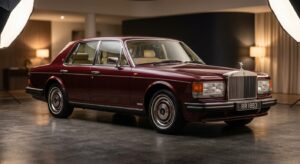
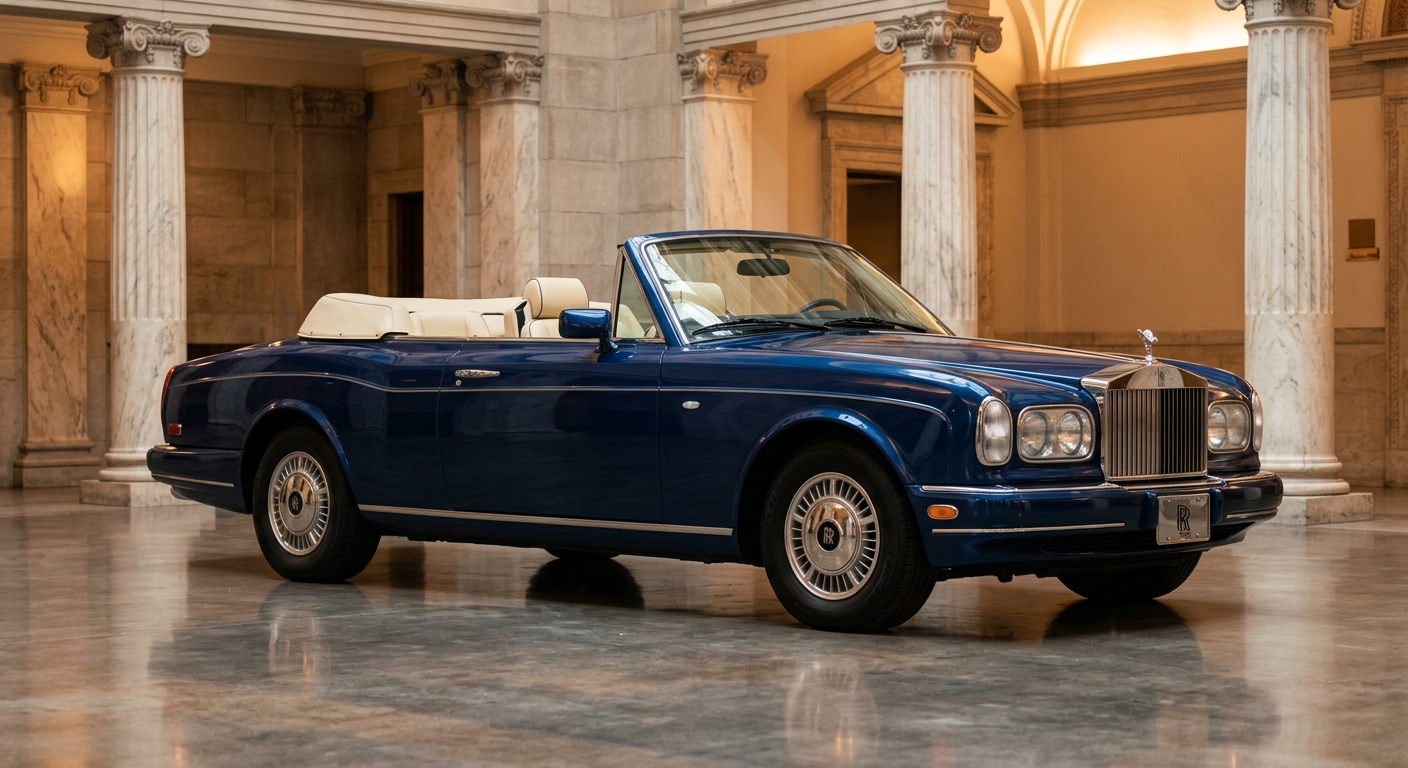
The year 2000 marked the end of an extraordinary journey that began in 1971. The Rolls-Royce Corniche, in its final form, represented the last gasp of traditional British coachbuilding artistry before the marque entered the modern era. This wasn’t just another luxury convertible; it was the culmination of nearly three decades of refinement, hand-crafted perfection, and uncompromising attention to detail that defined Rolls-Royce during its most iconic period.
The Art of Hand-Built Perfection
Climbing behind the wheel of a final-year Corniche is like stepping into a private gentleman’s club that happens to move. The cabin envelops you in acres of Connolly hide, with wood veneers selected and matched by craftsmen who understood that luxury wasn’t about gadgets or technology, but about materials, fit, and finish that bordered on the obsessive.
The famous 6.75-liter V8 engine, turbocharged and fuel-injected by 2000, delivers its 325 horsepower with the kind of effortless authority that made Rolls-Royce legendary. This isn’t about acceleration figures or lap times. It’s about the way the Corniche gathers speed with the inevitability of a tide, accompanied by nothing more than the whisper of wind and the gentle hum of one of the world’s most refined powertrains.
Engineering Heritage
The Corniche’s platform traced its roots back to the Silver Shadow of the 1960s, but by 2000, decades of evolution had created something uniquely compelling. The sophisticated independent rear suspension, self-leveling hydraulic systems, and four-wheel disc brakes represented cutting-edge technology when first introduced, and their refinement over the years created a driving experience that remained unmatched for smoothness and composure.
What strikes you most about the final Corniche is how completely it fulfills its mission. This was never meant to be a sports car or even a performance luxury car in the modern sense. It was designed to transport its occupants in maximum comfort and style, to make every journey feel like an occasion, and to do so with mechanical refinement that bordered on the supernatural.
The End of an Era
By 2000, the automotive world was rapidly changing. Electronic systems were becoming dominant, manufacturing was becoming increasingly automated, and even luxury cars were being designed more for efficiency and performance than for pure elegance. The Corniche represented the last stand of the old guard, a car that took 500 hours to build by hand and cost accordingly.
Only 374 Corniche models were built in the final production year, each one a testament to craftsmanship that was already becoming extinct elsewhere in the industry. The waiting list for a new Corniche stretched over two years, not because of overwhelming demand, but because each car required so much individual attention from Crewe’s master craftsmen.
Driving the Dream
On the road, the 2000 Corniche delivers exactly what it promises: effortless progress wrapped in unparalleled luxury. The steering is light but precise, the ride quality is sublime, and the sense of occasion is overwhelming. With the convertible top lowered, you’re not just driving a car, you’re participating in a rolling celebration of British automotive artistry.
The Corniche’s character reveals itself in the details: the way the doors close with a bank-vault thud, how the controls operate with precision that speaks to their hand-assembled nature, and the satisfaction of owning something that represents the pinnacle of a particular approach to luxury that would never be seen again.
The 2000 Corniche represents the absolute pinnacle of traditional British luxury car manufacturing, a swan song that celebrated everything that made Rolls-Royce special before the modern era began. While you can buy faster, more efficient, or more technologically advanced convertibles today, nothing will ever match the Corniche’s combination of hand-built craftsmanship, effortless elegance, and pure automotive theater. This is rolling sculpture that happens to transport you in unmatched style and comfort.