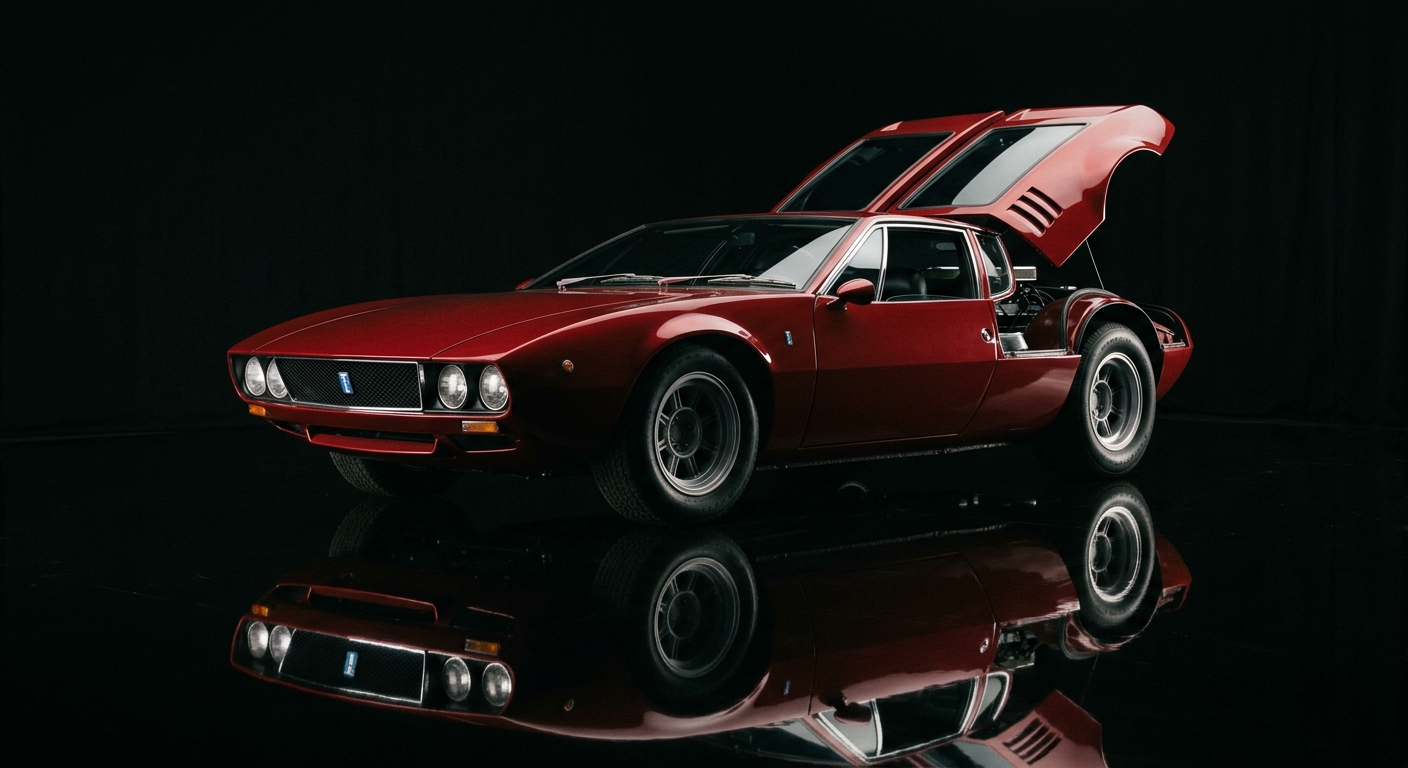
Few cars embody the raw, uncompromising spirit of early supercars quite like the De Tomaso Mangusta. Named after the mongoose, this Italian-American hybrid was designed to be fast, beautiful, and more than a little dangerous. With its dramatic wedge profile hiding a thunderous Ford V8, the Mangusta represented everything exciting and terrifying about 1970s exotic car ownership.
The Mangusta emerged from the ambitious mind of Alejandro de Tomaso, an Argentine racing driver turned manufacturer who had grand plans to challenge Ferrari and Lamborghini. What he created was arguably more dramatic than either, a mid-engine masterpiece that looked like it could slice through air at standstill.
Design Philosophy
Penned by Giorgetto Giugiaro during his tenure at Ghia, the Mangusta’s design was revolutionary for its time. The ultra-low nose barely reached most people’s waists, while the distinctive gull-wing engine covers could be opened independently to reveal the rumbling American V8 nestled behind the cockpit. Every line served a purpose, from the aggressive front air dam to the subtle rear spoiler integration.
The proportions were pure supercar: impossibly wide rear haunches, a greenhouse that seemed to float above the body, and wheels pushed to the absolute corners. Unlike the more rounded curves of contemporary Ferraris, the Mangusta embraced sharp angles and dramatic surfaces that would influence supercar design for decades.
The American Heart
Where Italian exotics traditionally relied on complex, high-revving engines, De Tomaso took a different approach. The Mangusta packed a 302-cubic-inch Ford V8, the same basic engine found in Mustangs but tuned for exotic car duty. This marriage of Italian styling with American mechanical simplicity created a unique character unlike any other supercar.
The Ford powerplant delivered genuine supercar performance with remarkable reliability. While Ferrari owners dealt with temperamental V12s requiring frequent maintenance, Mangusta drivers could service their cars at virtually any Ford dealer. The irony wasn’t lost on enthusiasts: the most reliable supercar of its era came from a tiny Italian manufacturer using Detroit iron.
Driving Experience
Behind the wheel, the Mangusta revealed its true nature as an uncompromising performance machine. The driving position was pure race car: low, cramped, with perfect sight lines down that impossibly long hood. Visibility to the rear was virtually nonexistent, typical of mid-engine designs of the era.
The Ford V8 delivered its power in a distinctly American way, with abundant low-end torque that could overwhelm the rear tires at will. Unlike the high-strung nature of Italian engines, the Ford unit pulled strongly from idle, making the Mangusta surprisingly tractable in city driving despite its exotic appearance.
However, the Mangusta’s handling characteristics separated the brave from the foolhardy. The extreme rear weight bias, caused by the heavy V8 sitting behind the driver, created handling that demanded absolute respect. Push too hard and the Mangusta would bite back with sudden, dramatic oversteer that could catch even experienced drivers off guard.
Production and Rarity
De Tomaso produced just 401 Mangustas between 1967 and 1971, making it one of the rarest supercars of its generation. Each car was essentially hand-built, with subtle variations between examples that reflected the artisanal nature of Italian coachbuilding.
The low production numbers weren’t entirely by choice. De Tomaso struggled with quality control and financial constraints throughout the Mangusta’s production run. Many cars required significant sorting by dealers before delivery, and some examples suffered from poor assembly quality that wouldn’t be acceptable from established manufacturers.
The Mangusta remains one of the most compelling supercars of its era, a machine that prioritized drama and excitement over refinement and safety. For those brave enough to master its challenging nature, it offered an intoxicating blend of Italian style and American muscle that has never been quite replicated. Today, surviving examples are highly coveted by collectors who appreciate automotive art that demands respect.