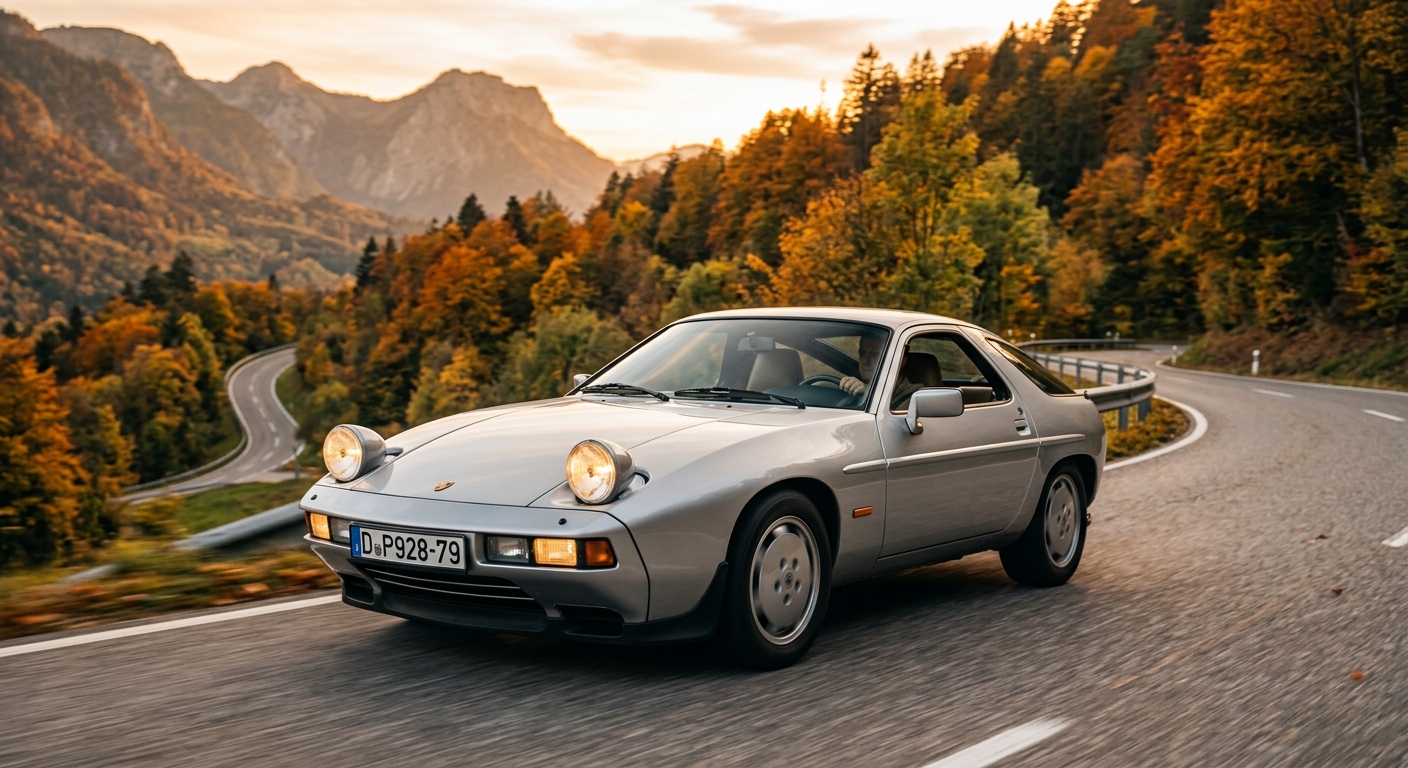
In 1979, Porsche unleashed what many considered automotive heresy: a front-engined, water-cooled V8 grand tourer that was supposed to make the 911 obsolete. The 928 represented everything the traditional 911 was not, yet it possessed a charisma and capability that made it one of the most compelling sports cars of its era.
While purists gasped at the departure from rear-engine tradition, the 928 established itself as a sophisticated alternative that blended American muscle with German precision in ways that few cars have managed before or since.
Engineering Revolution
The 928’s 4.5-liter V8 was Porsche’s first entirely new engine design in decades, delivering 219 horsepower through a smooth, linear power curve that felt nothing like the peaky nature of the 911’s flat-six. Mounted ahead of the front axle and mated to a rear-mounted transaxle, the 928 achieved near-perfect weight distribution while providing the kind of effortless torque that made highway cruising a revelation.
The sophisticated suspension system, featuring independent MacPherson struts all around with the innovative Weissach rear axle, provided handling that was both predictable and engaging. Unlike the 911’s tail-happy dynamics, the 928 telegraphed its limits clearly and forgave driver mistakes with grace.
Design Language
Penned by Wolfgang Möbius under the direction of Anatole Lapine, the 928’s wedge-shaped profile was pure 1970s futurism made manifest. The pop-up headlights, integrated bumpers, and flowing roofline created a cohesive design that looked equally at home parked outside a Monte Carlo casino or carving through the Alps.
Inside, the 928 pioneered the driver-focused cockpit that would influence Porsche interiors for decades. The instrument cluster moved with the steering wheel, ensuring optimal ergonomics regardless of driver position, while the build quality showcased German craftsmanship at its finest.
Driving Experience
Behind the wheel, the 928 reveals its true character as a continental grand tourer rather than a track weapon. The V8’s soundtrack is cultured and muscular, building to a crescendo that’s more symphony than scream. The steering is precise without being overly quick, and the ride quality strikes an impressive balance between comfort and control.
Acceleration feels effortless rather than explosive, with the 928 gathering speed in a refined rush that suits its grand touring mission perfectly. The transmission, whether the standard five-speed manual or optional three-speed automatic, complements the engine’s character beautifully.
Market Impact and Legacy
Despite critical acclaim and impressive performance, the 928 never achieved the commercial success Porsche hoped for. American buyers, the primary target market, were entering a period of economic uncertainty, while European customers remained loyal to the 911. The 928’s complexity also meant higher maintenance costs compared to its rear-engined sibling.
Today, the 928 is experiencing a renaissance among collectors who appreciate its unique position in Porsche’s history. Early cars like this 1979 model represent the purest expression of the original vision, before later updates added power but also weight and complexity.
The 928 stands as proof that Porsche’s genius extends far beyond the 911 formula. It may not have replaced the rear-engined icon as intended, but it created something arguably more special: a sophisticated grand tourer that perfectly captures the optimism and ambition of late-1970s automotive engineering. For enthusiasts seeking a classic Porsche with a different flavor, few cars offer this combination of performance, comfort, and distinctive character.