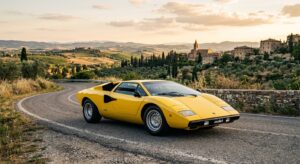
When Lancia decided to build a car specifically for rallying in the early 1970s, they didn’t just modify an existing model or adapt a road car for competition. Instead, they created something entirely new: a purpose-built rally weapon that would redefine what was possible in motorsport. The Stratos HF wasn’t just a car, it was a statement of intent that would dominate the World Rally Championship for years to come.
Born to Win
The Stratos project began in 1970 when Lancia’s competition director Cesare Fiorio realized that traditional rally cars, based on production sedans, had reached their limits. Working with designer Marcello Gandini at Bertone, the team created something revolutionary: a mid-engined, rear-wheel-drive coupe built around Ferrari’s Dino V6 engine. The result was a car so radical that it looked more like a concept than a production vehicle.
The homologation process required 500 road cars to be built, but the street version was barely civilized. The driving position was compromised by the need to package the engine behind the seats, visibility was limited by the dramatic wedge shape, and the interior was spartan at best. None of this mattered because the Stratos was never meant to be a comfortable grand tourer.
Engineering Excellence
At the heart of the Stratos was Ferrari’s 2.4-liter Dino V6, producing around 190 horsepower in road trim but capable of much more in competition specification. The engine was mounted transversely behind the two-seat cabin, creating a short wheelbase that made the car incredibly agile on tight rally stages. The tubular steel spaceframe chassis was both lightweight and rigid, while the fiberglass body panels kept weight to a minimum.
The suspension was pure racing technology: independent all around with coil springs and wishbones, designed to handle the extreme demands of rally competition. The steering was direct and unassisted, requiring significant strength but providing incredible feedback. Every component was chosen for its contribution to performance rather than comfort or convenience.
Rally Domination
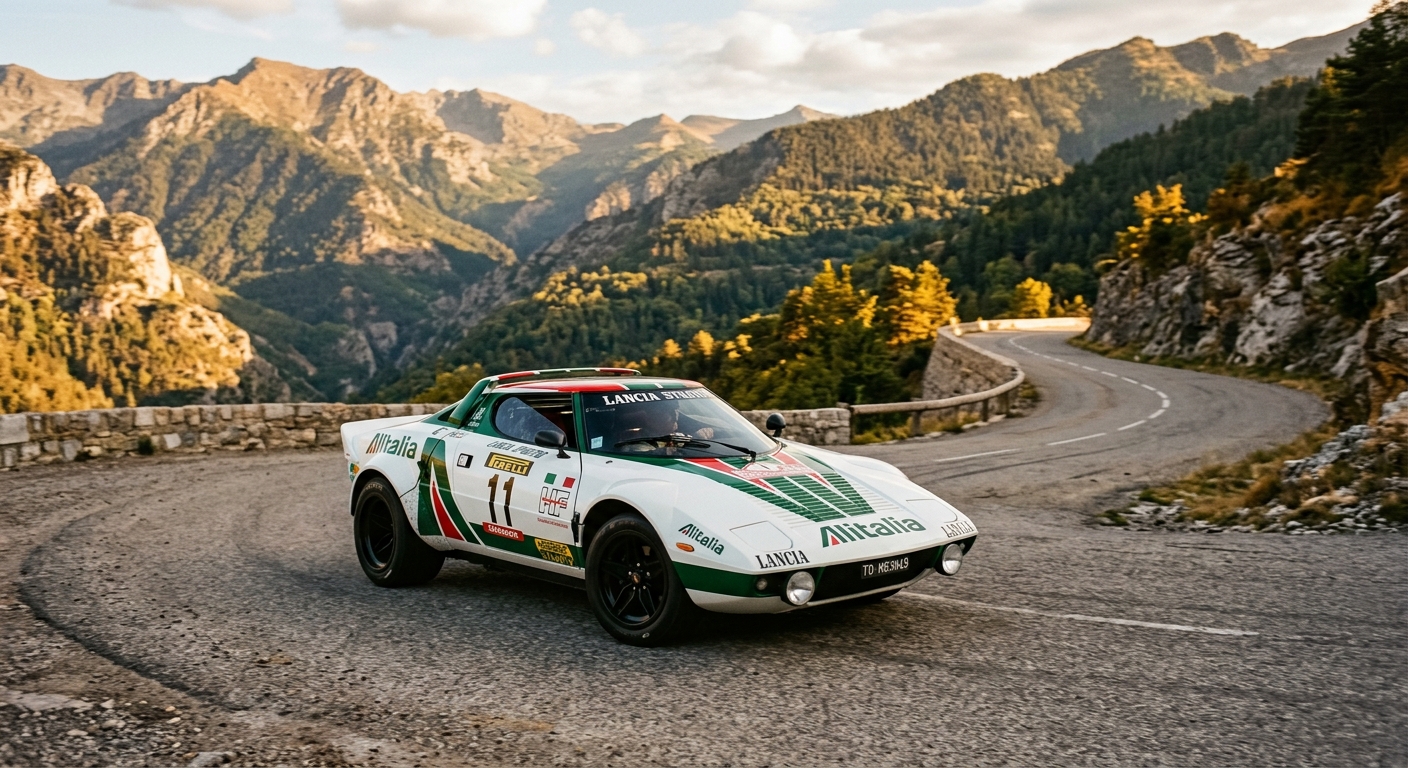
On the competition stage, the Stratos was virtually unstoppable. Between 1974 and 1976, it won the World Rally Championship manufacturers’ title three consecutive times. Drivers like Sandro Munari and Bjorn Waldegard became legends behind the wheel of the Stratos, mastering its challenging handling characteristics to achieve remarkable results on surfaces ranging from snow and ice to gravel and tarmac.
The car’s success wasn’t just about raw performance, it was about adaptability. The Stratos could be set up for any type of rally stage, and its mid-mounted engine provided excellent traction and balance. The short wheelbase that made it difficult to drive on the road became an asset on tight, twisty rally stages where agility mattered more than stability.
The Driving Experience
Driving a Stratos on the road is an exercise in compromise and commitment. The seating position is awkward, with the pedals offset to clear the front wheel arch. Visibility is severely limited by the deep dashboard and narrow side windows. The engine note from the Dino V6 is intoxicating, but the heat and noise levels inside the cabin are intense.
Yet when the road turns challenging, the Stratos reveals its genius. The steering is incredibly precise, the chassis balance is perfect, and the engine’s power delivery is smooth and progressive. On a twisty mountain road, few cars can match its combination of agility and performance. It’s not comfortable, but it’s absolutely thrilling in a way that modern cars simply cannot replicate.
The Lancia Stratos HF represents the pinnacle of purpose-built competition cars, a machine so focused on its mission that comfort and practicality became irrelevant. It’s a reminder of an era when manufacturers built cars to win races first and sell to customers second. Few classics offer such an uncompromising blend of racing heritage and driving intensity.