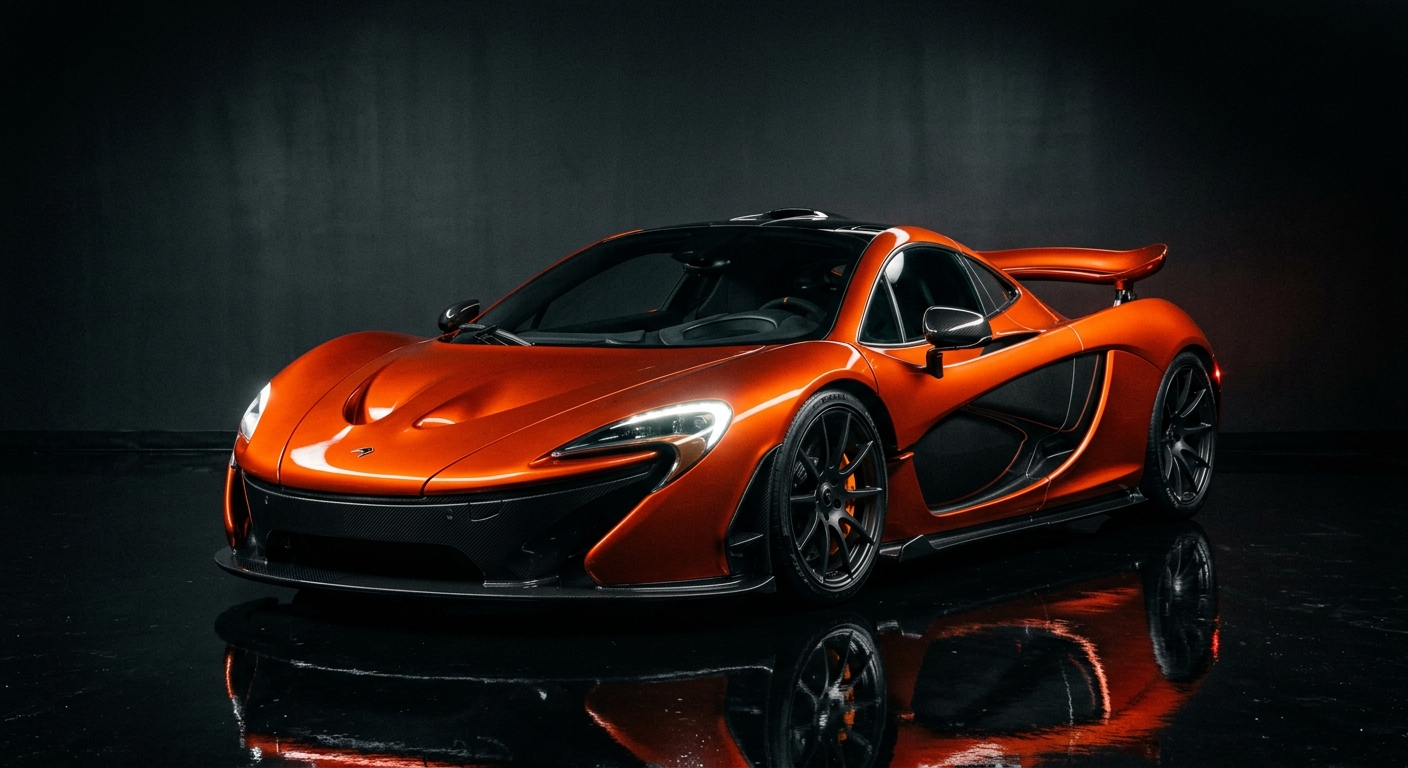
In the pantheon of automotive greatness, few cars arrive with the burden of expectation that greeted the McLaren P1. As McLaren’s spiritual successor to the legendary F1, the P1 didn’t just need to be fast: it needed to redefine what a hypercar could be. The answer came in the form of hybrid assistance, active aerodynamics, and a philosophy that prioritized lap times over straight-line bragging rights.
The Hybrid Revolution Begins
When McLaren unveiled the P1 in 2013, the automotive world was skeptical. A hybrid hypercar? The very concept seemed like an oxymoron. But McLaren’s approach was brilliant in its simplicity: use electric power not for efficiency, but for performance. The P1’s electric motor doesn’t save fuel; it fills in the gaps where the twin-turbo V8 falls short, eliminating turbo lag and providing instant torque delivery that makes the car feel supernaturally responsive.
The numbers tell only part of the story. The 3.8-liter twin-turbo V8 produces 727 horsepower on its own, while the electric motor adds another 176 horsepower for a combined output of 903 horsepower and 664 lb-ft of torque. But it’s the integration that impresses most. Switch the P1 into Race mode, and the car transforms from aggressive road car into track weapon, with the suspension lowering 50mm, the rear wing extending to its full attack angle, and every system calibrated for maximum attack.
Active Everything
The P1’s party trick isn’t just its hybrid powertrain; it’s the car’s ability to transform itself depending on the situation. The active aerodynamics system constantly adjusts the rear wing and front splitter to balance downforce and drag. At low speeds, the wing retracts for minimal drag. Under hard braking, it tilts to 45 degrees to act as an air brake. On track, it provides up to 1,322 pounds of downforce at 160 mph.
The suspension system is equally sophisticated. McLaren’s adaptive dampers work in conjunction with the anti-roll bars to provide both compliance on the road and razor-sharp precision on track. The carbon fiber monocoque, developed from McLaren’s Formula 1 expertise, weighs just 198 pounds while providing incredible rigidity. Every component serves the singular goal of making the P1 devastatingly quick around a circuit.
The Ultimate Track Experience
Behind the wheel, the P1 feels like a Formula 1 car that happens to be road legal. The driving position is perfect, with the steering wheel exactly where you want it and the pedals positioned for heel-and-toe downshifts. The seven-speed dual-clutch transmission shifts with violent precision, each gear change accompanied by a satisfying mechanical clunk that reminds you this is serious machinery.
On track, the P1 is transcendent. The hybrid system’s instant torque delivery makes corner exit acceleration feel like being fired from a cannon. The active aerodynamics provide confidence-inspiring downforce at high speeds, while the carbon ceramic brakes haul the car down from triple-digit speeds with fade-free consistency. This isn’t a car you simply drive fast; it’s a car that makes you faster as a driver.
Road Manners and Daily Reality
Despite its track focus, the P1 manages to be surprisingly civilized on public roads. The suspension, while firm, doesn’t punish you over broken pavement. The hybrid system allows for eerily quiet electric-only driving at low speeds, making the car almost ghostlike in urban environments. Climate control works, the seats are comfortable for shorter journeys, and there’s even a small luggage compartment behind the seats.
But make no mistake: this is not a grand tourer. The P1 demands attention and respect. Visibility is limited, the ride is firm even in its most compliant setting, and the performance potential always lurks just beneath your right foot. It’s a car that rewards commitment and punishes hesitation.
The McLaren P1 stands as one of the most significant supercars ever built, successfully bridging the gap between the analog heroes of the past and the electrified future. Its hybrid system wasn’t a gimmick but a genuine performance enhancement that pointed the way forward for the entire industry. Ten years later, the P1 remains the gold standard for how to integrate electric assistance into a hypercar, proving that innovation and emotion can coexist beautifully.