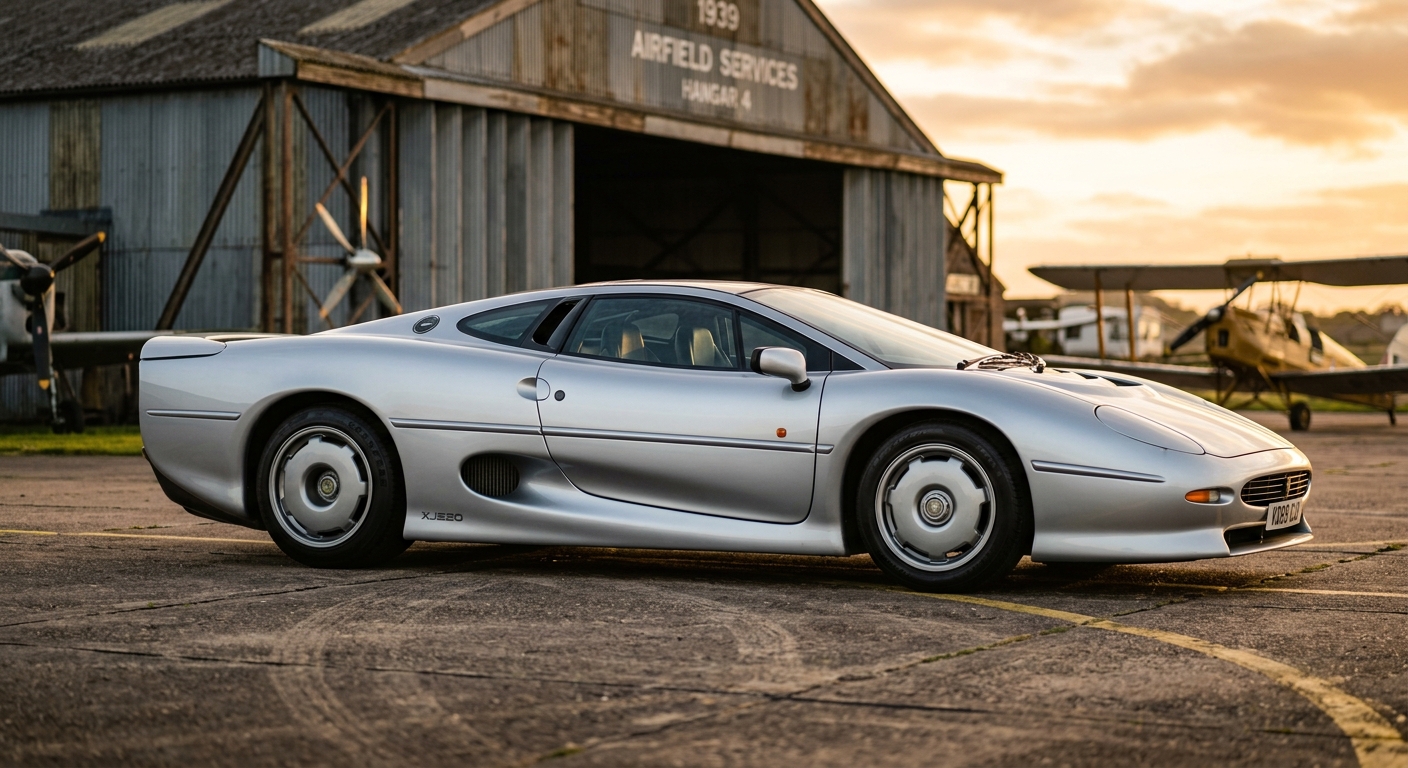
In 1989, when the Berlin Wall fell and the world changed forever, Jaguar unveiled something equally revolutionary: the XJ220. This wasn’t just another pretty face from Coventry, but Britain’s bold declaration that it could build the world’s fastest production car. With a claimed top speed of 220mph and looks that could stop traffic from several time zones away, the XJ220 represented everything ambitious about late-1980s automotive engineering.
The Fastest Cat on Earth
Behind the wheel of an XJ220, you’re not just driving a car but piloting a piece of British automotive history. The twin-turbocharged V6 engine, borrowed from Jaguar’s racing program, delivers power with the subtlety of a freight train and twice the drama. Unlike the naturally-aspirated V12 originally promised, this Metro 6R4-derived powerplant produces 542 horsepower and 475 lb-ft of torque, catapulting the XJ220 from standstill to 60mph in just 3.6 seconds.
The driving experience is rawer than any modern supercar dare attempt. There’s no power steering, no ABS, and certainly no electronic nannies to save you from your own ambitions. The steering wheel kicks and fights in your hands as the turbos spool up, delivering their boost in a rush that feels like being shot from a cannon. This is analog supercar driving at its most pure and terrifying.
Tom Walkinshaw’s Masterpiece
The XJ220’s genesis lies not in Jaguar’s traditional design studios but in the racing workshops of Tom Walkinshaw Racing (TWR). What started as a weekend skunkworks project by a group of Jaguar engineers became the company’s flagship supercar, though not without considerable controversy. The switch from the promised V12 to the racing-derived V6 turbo angered some customers, but those who experienced the final product understood the engineering brilliance behind the decision.
The aluminum honeycomb chassis, clothed in hand-beaten aluminum bodywork, creates a structure that’s both incredibly stiff and surprisingly light. At 3,241 pounds, the XJ220 weighs less than many modern hot hatches, contributing to its explosive performance and razor-sharp handling characteristics.
A Design Icon
Malcolm Sayer’s influence looms large over the XJ220’s design, even though Keith Helfet penned the actual lines. The car’s flowing, organic shape speaks the same visual language as the legendary E-Type and D-Type, but stretched to supercar proportions. Those massive side air intakes aren’t just for show, they’re functional necessities for feeding air to the hungry intercoolers and keeping the twin turbos happy.
The interior reflects the car’s race-bred nature with supportive bucket seats, a no-nonsense dashboard layout, and controls positioned for serious driving rather than luxury cruising. This isn’t a car built for comfort, but for the singular purpose of going faster than anything else on four wheels.
Market Reality and Legacy
When deliveries began in 1992, the global economy had soured, and many customers attempted to cancel their orders. Legal battles ensued, and Jaguar’s supercar dreams turned into a public relations nightmare. Of the planned 1,500 units, only 281 were ultimately built, making the XJ220 one of the rarest supercars ever produced.
Today, that rarity works in the XJ220’s favor. Values have climbed steadily as collectors recognize the car’s significance as both the fastest car of its era and the last truly analog supercar from a major manufacturer. It represents a time when engineering ambition trumped focus groups and safety regulations.
The XJ220 remains the definitive statement about what happens when brilliant engineers are given unlimited ambition and just enough rope to hang themselves. It’s terrifying, beautiful, and utterly uncompromising in ways that modern supercars simply cannot match. For those lucky enough to experience one, it represents the absolute pinnacle of analog supercar engineering.